What very few of them know is that Libya's Mediterranean coast contains Roman ruins that rival all of those, in scale, in preservation, and in atmosphere. The difference is that you'll have them almost entirely to yourself.
Most people who care about the Roman or ancient world have a fairly similar shortlist.
Pompeii. Ephesus. Jerash. Petra.
People plan trips around them. Read books about them. And come home with thousands of photographs.
All whilst battling the crowds.
What almost none of them know is that Libya contains Roman ruins that rival every single one of those sites. In scale. In preservation. And in sheer dramatic power.
Plus, it has one aspect that none of them can beat.
Unlike every other destination on that list, Libya has almost no tourists.
This is the story of two cities: Leptis Magna and Sabratha.
Both sit on the Mediterranean coast of what is now northwest Libya.
Both were among the most important urban centres of the Roman world.
Both are UNESCO World Heritage Sites. And both will, in all likelihood, be entirely yours when you visit.
(Think of the photos!)
These two sites are, in their own right, among the most important and atmospheric ancient sites anywhere on earth.
Sabratha's theatre is one of the great monuments of Roman Africa. Leptis Magna is simply one of the greatest Roman sites in the world, full stop.
The fact that you can visit them today and walk through them in near-total solitude, is one of the most remarkable opportunities available to anyone interested in the ancient world.
It will not last forever.
As Libya continues to open, the crowds will eventually follow.
The window to visit Sabratha and Leptis Magna as they currently exist - silent and extraordinary - is open now.
Let’s take a look.
Sabratha, Libya
Leptis Magna, Libya
Travelling to Sabratha & Leptis Magna
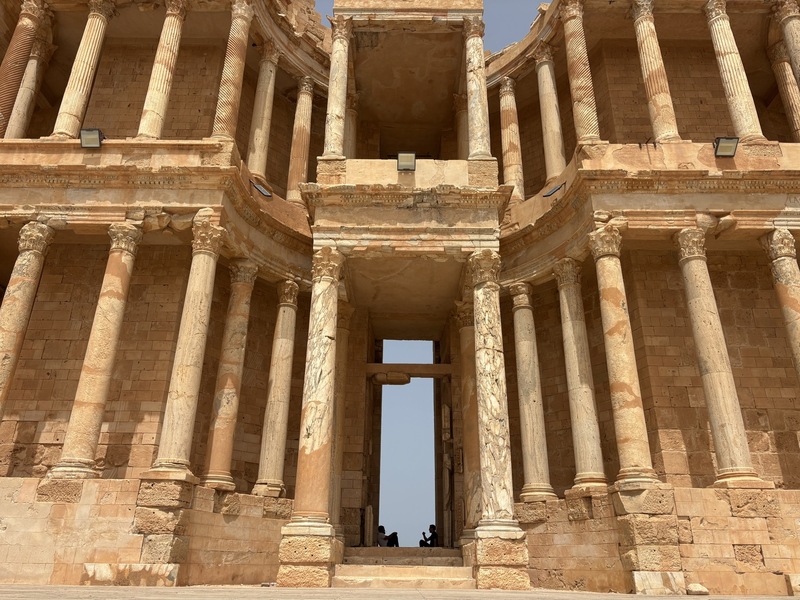
Sabratha: Where Rome Met Africa
Getting to Sabratha
You drive on the road west from Tripoli runing along the Mediterranean for about two hours before you reach Sabratha.
The drive itself is pretty epic and not too long. The sea stays in view for much of the journey, and you arrive at a site where the ancient world meets the shoreline in a way you were probably not expecting. But we’ll get to that.
Sabratha Introduction
Sabratha began as a Phoenician trading post around 500 BC.
Its location was strategic. A coastal outlet for goods flowing north from the African interior. Ivory. Gold. Exotic animals destined for arenas across the Roman Empire...
The city passed through Numidian and then Roman hands, flourishing most spectacularly in the 2nd and 3rd centuries AD during the reign of the Severan dynasty.
Unfortunately, earthquakes in the late 4th century began its eventual decline.
The entire archaeological complex was designated a UNESCO World Heritage Site in 1982.
The Roman Theatre
The centrepiece of Sabratha, and the reason most people who do manage to find this place make the journey.
The Sabratha Roman Theatre
Built between approximately 175 and 200 AD, its three-storey stage wall was largely reconstructed by Italian archaeologists in the 1930s and now soars almost intact against the blue Mediterranean sky behind it.
The numbers alone are impressive.
The theatre could seat between 5,200 and 6,450 spectators, entering through 25 separate entrances.
It remains the largest theatre in Roman Africa.
But that alone doesn’t capture how incredible this place is.
The stage wall rises in three tiers of columns and carved panels. You can sit inside these and look out to the sea. Rest inside them in the shade. Or walk up the steps on the other side for a panoramic view. The honey-coloured stone against a backdrop clashes against the beautiful shade of blue of the sky.
There is no fence between you and it. No crowd. No queue. You simply walk up and stand there, and enjoy the theatre to yourself.
Exploring Sabratha
Sabratha is certainly not just its theatre and indeed warrants an entire half a day or at least a couple of hours.
There are temples dedicated to Liber Pater, Serapis, and Isis. The Byzantine-era Basilica of Justinian, showing how the city continued to function centuries after Rome's fall. Well-preserved mosaic floors in the Forum Baths. And an on-site museum.
Leptis Magna: The Emperor's City
Sorry to have started very strong with how incredible Sabratha is but we have to go into hyperbolies again… If Sabratha is extraordinary, Leptis Magna is in a category of its own.
Leptis Magna is truly one of the greatest Roman sites anywhere in the world.
Getting to Leptis Magna
The site sits about 130 kilometres east of Tripoli along the coast.
Leptis Magna History
Leptis Magna was founded by Phoenician colonists from Tyre in the 7th century BC, at the mouth of the Wadi Lebda river, where a natural harbour made it a perfect trading post.
Under Roman rule it prospered steadily.
But its golden age arrived when a local boy became one of the most powerful men in the ancient world.
Septimius Severus was born at Leptis. He became Roman Emperor in 193 AD and proceeded to transform his hometown into one of the most magnificent cities in the Roman Empire, second only to Carthage in Roman North Africa.
He granted Leptis exemption from property and land taxes and initiated a building programme of extraordinary ambition.
A new harbour, forum, basilica, and colonnaded street - all constructed with marble shipped from across the Mediterranean world.
After Leptis was eventually abandoned, the desert did something remarkable.
It buried the city.
Sand drifted over the streets and forums and bathhouses and preserved them in a state that Italian archaeologists, beginning excavation in the 20th century, found astonishing.
What they uncovered, and what you walk through today, is a Roman city that time essentially froze.
Exploring Leptis Magna
The Triumphal Arch of Septimius Severus stands at the intersection of the city's two main roads, a four-sided ‘tetrapylon’ richly decorated with carved reliefs celebrating the emperor's victories.
It is intact enough that you can read the inscription carved into it.
The Hadrianic Baths are among the largest and best-preserved bath complexes in the Roman world, covering an area comparable to the Baths of Caracalla in Rome.
The Amphitheatre was partially cut into the hillside overlooking the sea and once hosted gladiatorial contests for Leptis's substantial population.
The Severan Basilica is a vast colonnaded hall with pilasters carved with scenes from the Twelve Labours of Hercules and the Life of Dionysus.
The Severan Forum is a marble-clad statement of imperial power, while the older forum at the heart of the original city contains temples and the original market buildings.
The scale of it, across a site you will almost certainly have largely to yourself, makes Leptis unlike almost any other ancient site in the world.
At Pompeii, you shuffle through streets with thousands of other visitors. At Leptis, you walk alone through a city that was once home to tens of thousands of people, and the silence is part of the experience.
Travelling to Sabratha & Leptis Magna
As with all travel to Libya, if you want to visit Leptis Magna and Sabratha you must do so as part of an organised tour.
Libya has a whole lot more on offer than just these two Roman sites. Heading East, we turn to Ancient Greece. Its cities such as Tripoli offer an interesting crossection between italian and Arab culture. And the vast Saharan desert and Berber culture is another completely different region.
If you’re planning a trip to Libya, make sure it includes Sabratha and Leptis Magna.
But make sure it doesn’t just include these places!
Libya has a whole lot on offer. Waiting to be explored!
Koryo Tours
Libya Travel Guide
Share
Zoe Stephens
Zoe is the marketing manager and a tour leader at Koryo Tours.
Her love of meeting new people and exploring new cultures has led her to study several languages including German, Japanese, and Chinese. Having lived in several different countries across 4 continents, she often writes about languages and culture in her blogs and is very active on social media. During the COVID-19 pandemic, she was 'stuck' in Tonga for 1.5 years after a weekend away. Ask her for some stories!
🎥 Vlogs on North Korea
🎙 Discover North Korea Podcast
➤ Instagram | Facebook | TikTok | Twitter/X