There is a moment on the road from Seiyun when Shibam appears out of the valley floor and everyone in the vehicle reaches for their camera. Five hundred mud-brick towers, up to ten storeys tall, still lived in, still maintained by the same families who built them five centuries ago. Here is what it is actually like to visit.
Your Complete Guide to the Manhattan of the Desert
There's a moment on the road from Seiyun, about twenty minutes in, when the driver says something to the guide, the guide turns around grinning, and everyone in the vehicle starts fumbling for their phones.
Because there it is, rising out of the valley floor like a mirage with planning permission - Shibam.
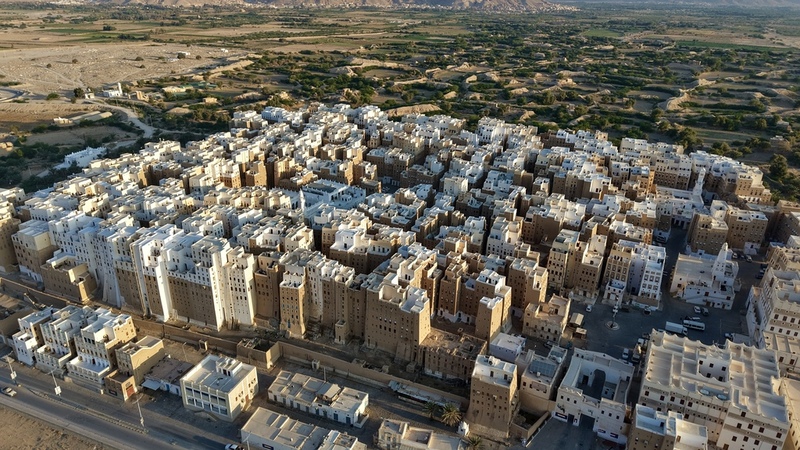
Five hundred towers. Eight to ten storeys each. Up to 40 metres tall.
All of it built from mud.
I've seen a lot of famous skylines. Manhattan, Hong Kong, Dubai from the highway at dusk. None of them made me actually laugh out loud with disbelief. Shibam did.
So, let's talk about the Manhattan of the Desert, why it exists. And - perhaps most importantly - how you, too, can actually stand in its shadow.
What Exactly Is Shibam?
Why Did They Build Skyscrapers Out of Mud?
What It's Like to Visit Shibam
How to Actually Get to Shibam
Tips for Visiting the Manhattan of the Desert
What Else to See Nearby Shibam
Is Shibam Worth the Effort?
What Exactly Is Shibam?
Shibam is a walled city in the Hadhramaut Valley of southern Yemen.
It holds a claim that sounds invented until you're standing in it - it's one of the oldest examples of high-rise urban planning on earth.
While Europe was building outward, the people of Shibam built up, stacking mud-brick tower houses to heights that still seem structurally rude five centuries later.
Hence the name ‘Manhattan of the Desert’.
Whilst sexy and admittedly a bit exaggerated in its title, it’s not just purely for marketing purposes. Of its time, it would really have been akin to something like Manhattan, plonked right in the middle of the desert.
The towers you see today date largely from the 16th century, though the city itself is far older.
But here's the part that gets me - these aren't some ancient ruins.
They aren't a museum with a rope barrier. The towers have been maintained, generation after generation, by the same families who have inhabited them ever since they went up. They’re still inhabited, like before.
You can see laundry fluttering from windows on the seventh floor of a building made of earth.
Kids kicking footballs against walls older than the printing press.
UNESCO inscribed Shibam as a World Heritage Site, and the "Manhattan of the Desert" nickname has stuck for the obvious reason.
From a distance, the silhouette genuinely reads as a miniature city skyline, all verticals and shadows, plopped down in a sea of date palms and sand.
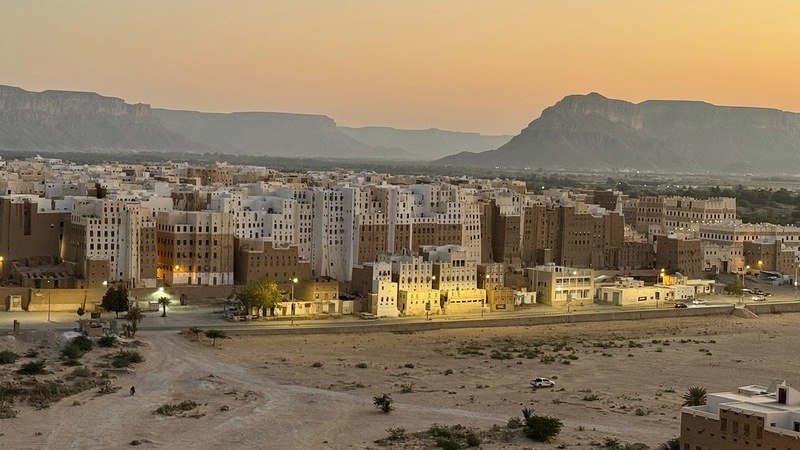
There’s a nearby hill you can visit and watch the sunset and shadows cast along the ‘skyscrapers’ which really puts it into perspective.
Why Did They Build Skyscrapers Out of Mud?
This was my first question, and the answer is wonderfully practical.
Hadhramaut sits on ancient incense trade routes, the same network that once linked the kingdoms of Sheba and Hadramaut to Rome and India. Wealth flowed through this valley, and wealth attracts trouble.
Building vertically inside a defensive wall meant the city could protect itself and its riches while squeezing onto a patch of high ground safe from the wadi's flash floods.
As for the mud, it didn’t seem to be so much as a compromise but an active choice.
Mud-brick is the genius material of this region. It's abundant, it insulates against ferocious desert heat, and when maintained properly with fresh coats of mud render and white lime on the upper floors, it lasts for centuries.
Actually, the whole of Hadhramaut is a masterclass in mud…
Seiyun's enormous Al-Kathiri Palace is one of the largest mud-brick buildings in the world, and nearby Tarim boasts the tallest mud-brick minaret on the planet at 40 metres.
Shibam is the skyline, but it's part of an entire civilisation built from the ground beneath it. Literally.
What It's Like to Visit Shibam
You enter through the city gate and the temperature drops. The alleys between the towers are narrow and shaded, some barely wider than your shoulders, and the buildings lean over you like they're the ones checking you out.
Look up and you'll see the classic Shibam details. Rows of small wooden-shuttered windows, carved doors with chunky wooden locks, and that brilliant white lime wash on the top floors that bounces the sun and protects the mud beneath.
You can wander the alleys for a couple of hours with a guide, who seemed to know roughly every third person we passed.
You can easily get lost in this maze of alleyways so it’s a good idea to stick with someone you know…
We poked around the small museum inside the city. There are a few shops selling antiques, including the beautiful wooden frames used for windowx for privacy, as well as the famous Yemeni daggers and beautiful headdresses for women.
Having a guide bargain for you here is an absolute must.
You’ll come acorss lots of local children wandering the streets, playing football, some following you as you walk. Others you can see hiding away in the windows - looking out curiously before you get too close then quickly ducking behind the shutters.
And then comes arguably the main event.
The sunset at Shibam.
Just outside the city, you climb a viewpoint on the opposite side of the wadi as the light goes soft and amber. The towers turn from brown to honey to gold to rose, the shadows stretch across the valley floor, and the call to prayer drifts up from the minarets.
Just remember - bring your cameras!
How to Actually Get to Shibam
Shibam isn't a destination you tack onto a weekend.
Shibam sits in the Wadi Hadhramaut, a short drive from Seiyun, the regional capital.
You'll fly into Seiyun International Airport (GXF), and most tour itineraries are designed around return flights from Cairo.
Independent travel isn't how Yemen works right now - visits run as organised tours with a local partner, a police escort during all ground transport, and visas and security clearance arranged on your behalf before arrival.
One of the best and most popular ways to visit Shibam is by starting in Tarim, and that pairing is perfect.
In the morning you see the elegant palaces of Tarim, including Qasr Al-Kaf with its Southeast Asian flourishes brought home by the Hadhrami diaspora, plus the Al-Kathiri Palace Museum in Seiyun and the spice-scented chaos of the Al-Handal souk.
Then Shibam closes the show. It's the architectural equivalent of saving the headliner for last.
Not far from Shibam there’s an increbily beautiful hotel you can stay at for the evening - complete with swimming pool!
Tips for Visiting the Manhattan of the Desert
Time it for late afternoon.
The midday light flattens the towers.
The hours before sunset turn the whole city into sculpture, and the viewpoint across the wadi at golden hour - non-negotiable.
Wear the local outfit.
On a Koryo Tour to Yemen, we provide you with a complimentary traditional Yemeni outfit, a thobe for men and an abaya and headscarf for women.
Beyond cultural respect, it's genuinely more comfortable in the heat, and walking the alleys of a 500-year-old city in traditional dress beats doing it in a sweat-soaked tech tee. Plus - think of the photos!
Bring a wide-angle lens, and then ignore it sometimes.
The skyline shot needs the wide angle. But the alleys reward the opposite… details of doors, locks, window shutters, and the texture of mud walls polished by five centuries of hands.
Talk to people, or let them talk to you.
Tourism in Yemen is so rare that you'll be a curiosity. Kids will want photos with you. Elders will want to know where you're from. The guide translates, and these little exchanges end up being half the memory.
For me, this is what travel is all about.
Look after your footing.
The alleys are uneven, the steps are ancient, and your eyes will constantly be pointed upward. This is a recipe. Be smarter than I was outside the museum.
What Else to See Nearby Shibam
Seiyun, the regional capital just down the valley, is known as the City of a Million Palms, and its great white Al-Kathiri Palace, once the sultan's residence and now a museum, makes a perfect warm-up act.
An evening wander through Seiyun's historic women's market and old-city alleyways sets the mud-brick mood before the main event.
And in terms of the rest of your days in Yemen, there’s so much more to see.
Pair Shibam with the desert pilgrimage site of Qabr Hud, a whitewashed ghost town that fills with pilgrims only three days a year, and with two nights in Wadi Doan, the canyon valley where villages perch on cliffs and a resort sits on a boulder 150 metres above the palm groves.
Finish on the Arabian Sea coast at Mukalla, with its white buildings and riotous morning fish market, and you've covered three completely different Yemens in a single week.
Shibam is just one of the several highlights Yemen has to offer.
Is Shibam Worth the Effort?
Let me put it this way. Getting to Shibam requires flying to Cairo, then to a small airport in southern Yemen, joining an organised tour, travelling with a police escort, and accepting an itinerary that's subject to change with conditions on the ground. That's a lot of hoops.
Shibam is truly an incredible site.
Because it isn't just a pretty skyline. It's proof of an idea. That a community can build something audacious out of the humblest material on earth and then keep it alive for five hundred years through nothing but care, repetition and pride. In aworld of glass towers designed to be demolished in fifty years, there's something quietly radical about a mud skyscraper maintained by the great-great-grandchildren of its builders.
The Manhattan of the Desert has no Times Square, no rooftop bars, no subway.
It has date palms, goats, golden light and the most improbable skyline you'll ever see. Go before the rest of the world figures that out.
But whether you would do all that just to see it? Well, that’s up to you to know.
In reality, Yemen has so much more to offer than just Shibam and this truly does make the trip worthwhile.
Koryo Tours
Group Tours to Yemen
Share
Zoe Stephens
Zoe is the marketing manager and a tour leader at Koryo Tours.
Her love of meeting new people and exploring new cultures has led her to study several languages including German, Japanese, and Chinese. Having lived in several different countries across 4 continents, she often writes about languages and culture in her blogs and is very active on social media. During the COVID-19 pandemic, she was 'stuck' in Tonga for 1.5 years after a weekend away. Ask her for some stories!
🎥 Vlogs on North Korea
🎙 Discover North Korea Podcast
➤ Instagram | Facebook | TikTok | Twitter/X