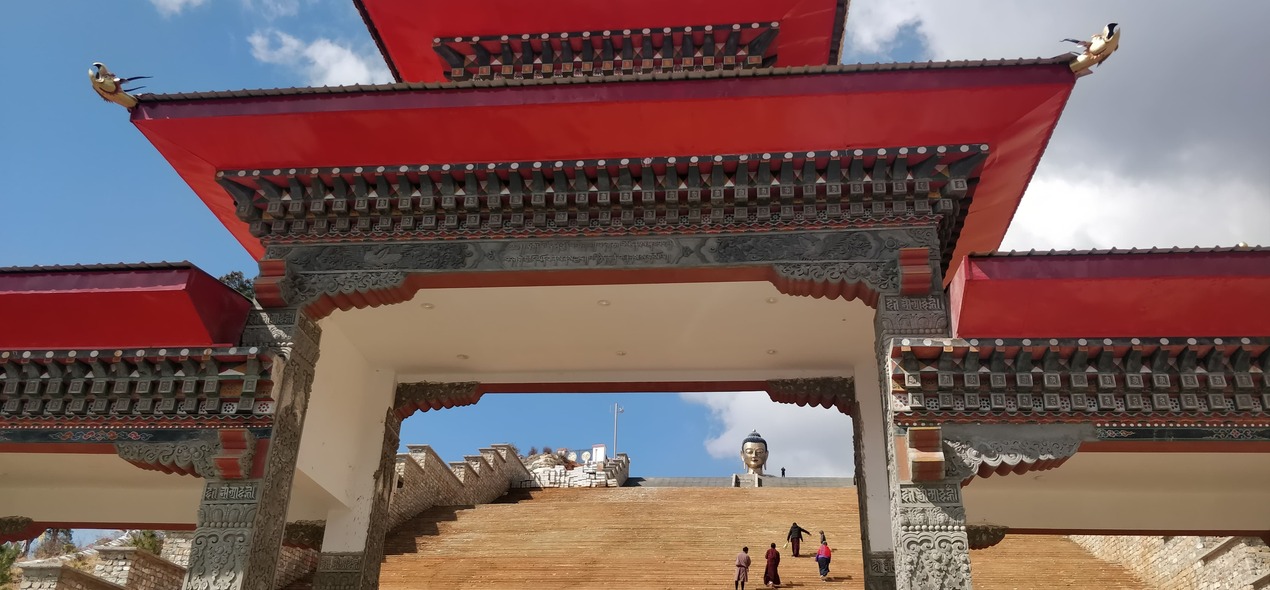
Bhutan Country Introduction
Bhutan, this Himalayan Buddhist kingdom, is one of the most isolated nations on Earth. Not only by geography but also by choice. Also known as the 'Kingdom of the Thunder Dragon', Bhutan chose isolationism to protect its sovereignty, distinct cultural heritage, and unique nature.
Situated between India and China, Bhutan has no diplomatic relations with the five permanent members of the United Nations and maintains formal diplomatic ties with only 60 nations. The country opened for tourism only in 1974 and still maintains a high-value, low-impact tourism model. Television was introduced only in 1999.
This diplomatic and geographic isolation, however, does not mean that the people of Bhutan are ignorant. Quite the contrary. The medium of education is English, and quite a few Bhutanese people are well-travelled and have clear, distinct opinions on world affairs.
Democracy was only introduced in 2008 by the choice of its king, who gave up his absolute power in favour of a constitutional monarchy and parliamentary democracy. As a matter of fact, as per the constitution, the king must abdicate at the age of 65.
The state religion of Bhutan is Vajrayana Buddhism, and Buddhism defines all aspects of daily life in Bhutan. The Chief Abbot has the same power in religious authority as the king has in secular matters, and the administrative centres of the districts, dzongs, share both religious and secular wings.
The landscape of Bhutan is dominated by prayer flags, prayer wheels, and stupas, and all homes have altar rooms. The concept of Gross National Happiness, the idea that happiness is more important than economic development, also originates from Buddhist philosophy - psychological well-being, compassion, and environmental preservation are superior to material gains.
Western Bhutan is the political, economic, and tourism centre of Bhutan. This is where Paro International Airport is situated, where the capital city is, and where important tourist landmarks such as the Tiger’s Nest and Punakha Dzong can be found.
Central Bhutan is the cradle of Bhutanese Buddhism with many sacred, ancient temples, and this is also where the ancestral home of the royal family is. It is home to wide valleys and the black-necked crane sanctuaries.
Eastern Bhutan is the most isolated and economically least developed region of the country, with rugged mountains, steep river gorges, and dense subtropical and alpine forests. It is also home to yak-herding nomadic communities of the Eastern highlands.
Southern Bhutan is characterised by tropical lowlands and jungles and is home to endangered species like the Royal Bengal Tiger and Asian Elephant. This is where most of the Nepali minority live who were the subjects of the Bhutanese refugee crisis in the 1990s after Bhutan introduced the “One Nation, One People” policy. Southern Bhutan is also the centre for trade with India and home to Gelephu Mindfulness City (GMC), an ambitious megaproject that aims for economic diversification and innovation, global connectivity and the prevention of out-migration by the younger generations.
Bhutan History
7th Century
Introduction of Buddhism in Bhutan. The two temples built on the orders of the Tibetan king still stand: Kyichu Lhakhang in Paro Valley and Jambay Lhakhang in Bumthang.
In the following century, Guru Rinpoche (Precious Master) transforms Bhutan into a Buddhist nation. While the 7th introduction of Buddhism was more in the form of building temples, the 8th century meant mass conversions and laid down the spiritual and cultural identity of Bhutan still prevalent today.
1634
Ngawang Namgyal unifies Bhutan after defeating internal rivals (Five Groups of Lamas) and fending off Tibetan invasions. The Bearded Lama, or Unifier, introduced the dual system of secular and spiritual governance and laid down certain elements of Bhutanese identity, like the writing style and the national dress code.
1864-65
Duar War with British India resulting in the loss of a fifth of Bhutanese territory in the south.
1903
Ugyen Wangchuk accompanies the Younghusband Expedition (a subchapter of the great Game) to Tibet as a mediator making his ties with the British even closer. A few years later, Ugyen Wangchuk becomes the first Druk Gyalpo (‘Dragon King’), the first hereditary ruler of Bhutan.
1910
By signing the Treaty of Punakha, British India takes control of Bhutanese foreign relations while guaranteeing sovereignty of internal affairs.
1926
The 1st King of Bhutan dies, and his son Jigme Wangchuk becomes the 2nd King of Bhutan. In 1952, the 2nd King of Bhutan passes away and his son Jigme Dorji Wangchuk becomes the 3rd King of Bhutan.
1949
After India gaining independence from Britan in 1947, Bhutan and India sign the Treaty of Peace and Friendship basically inheriting Britain’s role as an advisor in foreign policy but guaranteeing Bhutan’s independence in internal affairs.
1966
Thimphu becomes the all-year capital of Bhutan. Before, Punakha served as the winter capital. In 1968, certain breaks and balances to the king’s power is introduced. The Council of Ministers, the High Court, and the Bank of Bhutan is established. The king renounces his power of veto, and the High Court has the right to review the king’s decisions. Shortly after in 1971, Bhutan became a member of the UN, a year before the 3rd King of Bhutan passes away. His son Jigme Singye Wangchuk becomes the 4th King of Bhutan.
1974
First foreign tourists allowed to enter Bhutan.
2005
King Jigme Singye Wangchuk announces reforms that will transition Bhutan from an absolute monarchy to a constitutional monarchy and parliamentary democracy. He also announces that he will step down from the throne in favour of his son in 2008 when the proposed transitions are complete. The following year, the 4th King of Bhutan abdicates two years early, making his son, Jigme Khesar Namgyel the 5th King of Bhutan.
2007
The revision of the Indo-Bhutan Friendship Treaty grants Bhutan sovereignty over its foreign relations, ending India’s influence that was inherited from the British.
2008
Bhutan becomes a constitutional monarchy by the enactment of the first-ever Constitution of Bhutan on 18 July. The first parliamentary elections were held earlier this year in March.
Travelling in Bhutan
Most travellers to Bhutan arrive by flight to Paro with a breathtaking approach and landing. It is also possible to enter by land from India via three checkpoints. Koryo Tours’ Offbeat Eastern Bhutan tour uses Samdrump-Jongkhar, which is 3-4 hours from Guwahati.
Tourists in Bhutan must be accompanied by a licensed tour guide. For group tours, transportation is by minibus, while for private tours by Four-wheel drives. To connect between East Bhutan and Central Bhutan, Koryo Tours uses Drukair’s domestic flight.
Road conditions in Western Bhutan (Paro, Thimphu, Punakha) are generally good, while in other regions the mountain roads are less well maintained and one can also encounter gravel roads.
Most people stay in the Western Region, visiting the capital Thimphu, the former capital and winter capital Punakha, and Paro, which is a major tourist hub due to its proximity to the international airport and Tiger’s Nest Monastery.
The other regions of Bhutan all have their distinct characters but are less accessible, and visiting these regions extends the time spent in Bhutan. These offer a more immersive experience with local culture and Bhutanese nature. There are great opportunities for trekking and eco-tourism.
Most of the hotels are 3* establishments and offer WIFI. Rooms are clean and basic. Hotels have restaurants and a bar. It is also possible to spend nights at homestays. The conditions vary, and the more intimate and authentic the experience is, the more basic the facilities are. At most homestays, only shared bathroom facilities are available.
Most of the meals are served in a buffet style, usually consisting of one-two meat and vegetable dishes, rice, noodles, and dhal.
Bhutan is a high-altitude nation with an average elevation of 3,280 meters (10,761 ft). There is a risk of high-altitude sickness. It is strongly recommended that one consult their family doctor before travelling.