Timor-Leste, officially the Democratic Republic of Timor-Leste, occupies the eastern half of the island of Timor along with the small islands of Atauro and Jaco and the exclave of Oecusse, which sits within Indonesian West Timor.
It is one of the youngest nations on Earth, having only regained its independence though a referendum in 2002. The scars and the pride of the struggle for self-determination are visible everywhere, from war memorials in Dili to the resistance museums that document nearly a quarter century of occupation.
Also known as East Timor, the country sits at the meeting point of Southeast Asia and the Pacific, and its culture reflects that position. Four hundred and fifty years of Portuguese colonial presence left behind Catholicism, the Portuguese language, and a taste for coffee, while centuries of trade and migration wove in Melanesian and Austronesian traditions that predate colonization by a wide margin. The result is a place where a Catholic mass and a lulik, or sacred, ceremony honoring ancestral spirits can both take place in the same village within the same week without much tension between the two.
Unlike some of its neighbors, Timor-Leste has not built its identity around tight control of tourism, but rather around the opposite: a country still finding its footing after decades of conflict, working to rebuild infrastructure and diversify an economy currently dependent on oil and gas revenue from the Timor Sea. Tourism is a young industry here, meaning visitors are relatively rare outside a handful of dive and trekking circuits, but it also means the experience can feel wonderfully unpolished and genuine.
Dili, the capital, is the political and economic center of the country and home to the Cristo Rei statue, the Resistance Museum, and the waterfront where much of the country's modern history played out. The central highlands around Aileu, Ainaro, and Ermera are the coffee-growing heart of Timor-Leste and home to Mount Ramelau, the country's highest peak and a site of pilgrimage due to the statue of the Virgin Mary at its summit.
The eastern districts, particularly Baucau and the far tip of the island near Lospalos and Jaco Island, hold some of the best-preserved colonial architecture and coral reefs in the country. Oecusse, cut off from the rest of the nation by Indonesian territory, is now the site of an ambitious special economic zone called Zona Especial de Economia Social de Mercado (ZEESM), intended to attract investment and diversify the economy away from petroleum.
Humans reached Timor by sea around 44,000 years ago, and Austronesian migrants arrived around 3000 BC bringing agriculture and new languages.
Portuguese traders begin regular contact with Timor, drawn by the sandalwood trade, and gradually establish colonial administration over the eastern part of the island.
The Treaty of Lisbon formally divides the island of Timor between Portugal in the east and the Netherlands in the west, a division that would later become the modern border between Timor-Leste and Indonesia.
Imperial Japan occupies Timor during the Second World War despite Portugal's neutrality. Timorese civilians support Australian commandos in a guerrilla campaign against the Japanese, and tens of thousands of Timorese die as a result of the fighting and the reprisals that follow.
The Carnation Revolution in Lisbon topples the Portuguese dictatorship and sets in motion the decolonization of Portugal's overseas territories, including Timor. Local political parties quickly form around competing visions for the territory's future.
Following a brief civil war between Timorese factions, Fretilin unilaterally declares the independence of the Democratic Republic of East Timor.
Nine days later, Indonesia invades, beginning an occupation that will last nearly twenty-four years and claim an estimated 100,000 to 200,000 lives through violence, famine, and disease.
Indonesia formally annexes East Timor as its twenty-seventh province, a move never recognized by the United Nations.
Indonesian forces open fire on mourners at the Santa Cruz cemetery in Dili during a memorial procession, killing well over a hundred people. Footage smuggled out by foreign journalists brings international attention to the occupation for the first time.
Under international pressure, Indonesia agrees to a UN-supervised referendum on autonomy. On 30 August, nearly 80 percent of Timorese vote for full independence. Pro-Indonesia militias respond with a scorched earth campaign that destroys much of the country's infrastructure and displaces hundreds of thousands of people before an international peacekeeping force restores order.
The United Nations Transitional Administration in East Timor (UNTAET) governs the territory and prepares it for statehood, culminating in a new constitution and elections.
Timor-Leste is formally recognized as an independent nation, becoming the first new sovereign state of the twenty-first century. Xanana Gusmão, the former resistance leader, becomes the country's first president.
A crisis within the security forces triggers factional violence and unrest in Dili, forcing over one hundred thousand people to flee their homes and prompting the return of international peacekeepers.
José Ramos-Horta, a longtime diplomat for the independence movement, is elected president, while Xanana Gusmão takes over as prime minister later that year.
Timor-Leste is formally admitted as the eleventh member of ASEAN, a milestone the government had pursued for over a decade as part of its effort to integrate more closely with the region.
Most visitors arrive by air into Presidente Nicolau Lobato International Airport in Dili, with connections typically routed through Bali, Darwin, or Singapore. It is also possible to cross overland from Indonesian West Timor, most commonly at the Mota'ain-Batugade border crossing on the north coast road between Kupang and Dili.
Unlike some of its neighbors, Timor-Leste does not require tourists to travel with a licensed guide, and independent travel is entirely possible, though guides are strongly recommended for trekking in the highlands or diving off Atauro Island, both because the infrastructure for independent travelers is thin and because local guides open doors to villages and traditions that would otherwise stay closed to outsiders.
Roads in and around Dili are reasonably good, but conditions deteriorate quickly once you head into the mountains, where switchbacks, landslides, and unpaved stretches are common, particularly during the wet season. Four-wheel drives are the standard way to get around outside the capital, and travel times can be deceptively long given the terrain even when distances look short on a map.
Accommodation options are still developing. Dili has a growing number of comfortable hotels and guesthouses, while smaller towns like Baucau, Maubisse, and Same tend to offer more modest guesthouses or homestays. Diving lodges on Atauro Island range from simple to fairly upscale given the island's reputation as one of the best and least crowded dive destinations in Southeast Asia. Meals typically center on rice or corn, grilled fish or meat, and vegetables, with strong Portuguese and Indonesian influences showing up in dishes involving coconut, chili, and tamarind.
The country's dive sites, particularly around Atauro Island and the coast near Dili, are considered among its biggest draws, with some of the highest reef biodiversity counts recorded anywhere in the world. On land, trekking to the summit of Mount Ramelau, exploring the colonial old town of Baucau, and visiting the white sand beaches of Jaco Island near the eastern tip of the country are among the most popular activities. Between roughly September and December, the waters off the north coast become a migratory corridor for blue whales, sperm whales, and other cetaceans, drawing a small but growing number of visitors specifically for whale watching.
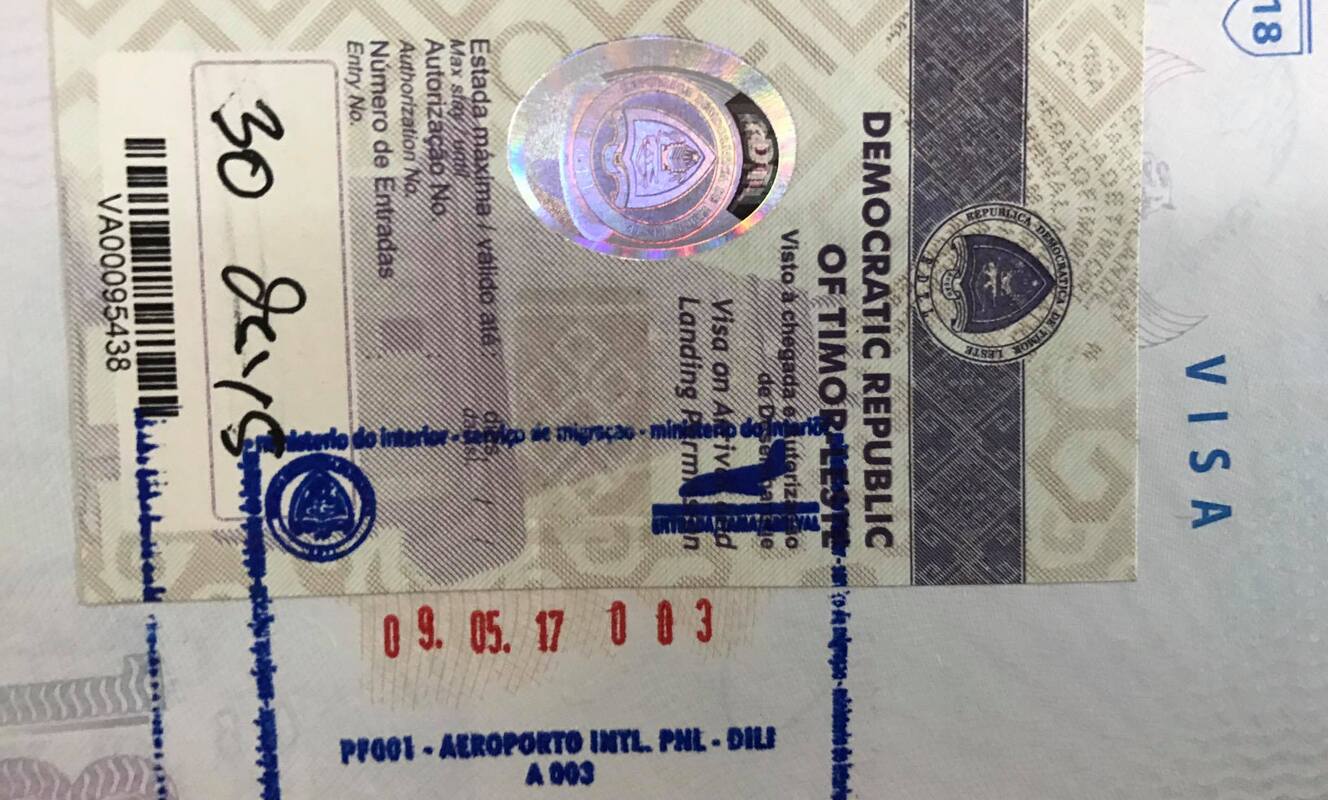
Do I need a visa to visit Timor-Leste?
When is the best time to visit Timor-Leste?
What language is spoken in Timor-Leste?
What currency is used and how do I access money?
Do I need a guide to visit Timor-Leste?
Timorese food maybe unknown to many, but with deep history of Portuguese rule, Indonesian influence, Goan spices, it maybe one of the most unique cuisine that you can't find anywhere else on earth. Here is what to order.
Read full storyThe country's name translates to East East. Its only mall is a point of genuine local pride. And packages addressed to Dili still occasionally arrive in Delhi. Here are the facts about Timor-Leste that will make you the most interesting person at your next trivia night.
Read full storyChoosing when to visit Timor-Leste comes down to two things: rain and festivals. May to November is the dry season and the Timor-Leste Independence Day. September to November adds one of the best whale watching windows on the planet. Here is how to decide.
Read full story
[email protected] | + 86 10 6416 7544
WhatsApp (message only): +44 7822 014058