Libya is one of our newest destinations at Koryo Tours, and one we're most excited about. From the Roman coast of the northwest to the newly opened Greek ruins of the east, a tour to Libya covers more ground, more history, and more genuine adventure than almost anywhere else we operate. Here's what to expect before you go.
Koryo Tours is travelling to Libya!
And we have lots of things to see.
Touring Libya is a unique, once-in-a-lifetime opportunity, and we want to make sure that doesn’t pass you by. Come with us to see Libya’s Mediterranean coast, ancient Greek and Roman ruins and take in the sights of the Sahara Desert at sunset.
You might be wondering - what exactly can I expect when joining Koryo Tours in Libya?
Whether you’re considering a tour to Libya, just wondering how to prepare, or still need convincing for your Libya tour, we take you through all you need to know before you go.
Overview of A Tour to Libya
Libya with Koryo Tours
A Group Tour to Libya (Limitations)
Tour to Western Libya
Tour to Eastern Libya
Libyan Visa
Libyan Food
Libyan People
Best Time of Year to Visit Libya
Internet in Libya
What Currency is Used in Libya?
Should I visit Libya?
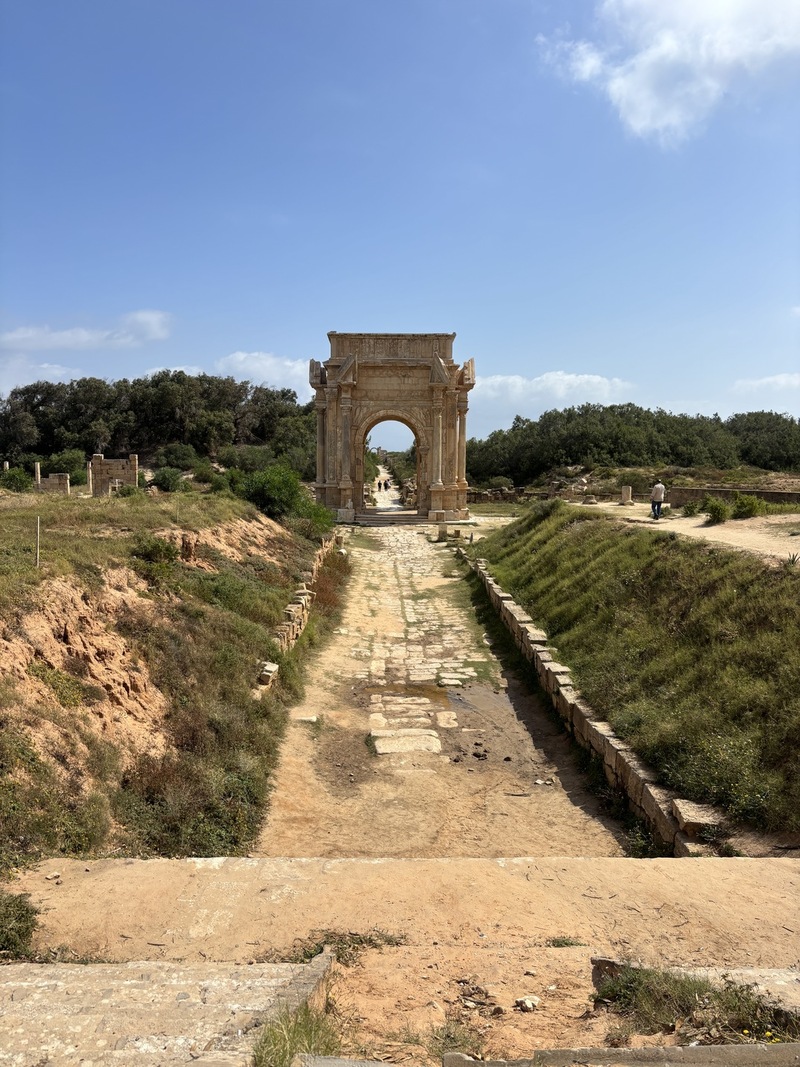
Overview of A Tour to Libya
Tourism in Libya Today
Tourism in Libya has been transformed as a result of the Libyan Civil War, but that doesn’t mean you still cannot travel safely.
Upon Libya’s ceasefire agreement to end the civil war in 2020, it has opened up many new opportunities for tourism in the country.
Some clashes between rivalling groups is always a possibility but, as with any country, staying informed and taking the correct precautions is essential to safe travelling.
If you do decide to travel to Libya, always make sure to travel with experienced guides and tour leaders who know the region.
These are the people who can navigate the local security updates and help you enjoy Libya while also keeping you in a safe environment. And, of course, making sure you enjoy and see the highlights along the way.
Libya with Koryo Tours
Libya is one of our newest destinations here at Koryo Tours. And one we’re most excited about.
With almost 35 years’ experience in the adventure travel industry, we’re here to offer our expert opinion, facts, and advice based on extensive research and on-the-ground information.
Firstly, we offer two safe and secure group tours to Libya. Secondly, we go on group tours either to Western Libya only, or both Western and Eastern Libya. Finally, we prioritise both your safety and your enjoyment when travelling in Libya.
We can certainly guarantee that it will be unforgettable.
As with all of our tours, we work with local partners to specially curate itineraries including places or activities no one else is visiting. This is no different with our Libya tour as we take part in cultural activities such as traditional women-only cultural experiences, a cooking class, and enjoying a live music performance at the incredible Roman site of Leptis Magna.
A Group Tour to Libya (Limitations)
Another important thing to know is that travelling to Libya as a tourist is only possible through an organised tour. Either a private tour or a group tour.
You must travel with a local registered tour company, and you will be accompanied by local police escort.
You can’t walk around by yourself in Libya, and most destinations or activities have to be pre-arranged/authorised in advance.
So, where can you expect to visit on a Koryo Tours tour to Libya?
Libya is a country where Arab, African and European influences all join together, and one with an incredibly interesting but complex both recent and ancient history.
With its troubled recent history it has seen a massive reduction in tourism over the past few decades. But the incredible sites, amazing food, and welcoming people remain.
You just get that all to yourself…!
There is so much to discover in Libya, and we want to take you with us - and we want to do so as safely as possible.
Whilst visiting the many sites along the way - both east and west.
Let’s take a look at where you can visit in Libya today.
Tour to Western Libya
Tripoli
Tripoli is our first stop on both of our Libya tours, and where you’ll be met at the airport by your Koryo Tours tour leader and local partners.
Tripoli is Libya’s capital city and is also the most populous city in Libya. Located on the breezy Mediterranean coast, Tripoli also serves as a port city in Libya and is the country’s largest commercial and manufacturing centre.
Tripoli serves as the epicentre of our Libya tours, and here you can see -
- Old Medina Walk
- Arch of Marcus Aurelius
- Leptis Magna
- Old British Consulate
- Red Castle
- Libya National Museum (subject to reopening)
Sabratha
Sabratha is around a two-hour drive west of Tripoli. Driving along the Mediterranean coast, the views are simply breathtaking.
Sabratha holds such heavy Roman influence, and has been a UNESCO World Heritage Site since 1982.
From here, you can see:
- Roman Theatre of Sabratha
- Temples of Liber Peter, Serapis and Isis
- Byzantine Basilica of Justinian
- Forum Baths mosaics
Jebel Nafusa Mountains
The Jebel Nafusa mountains are a mountain range in the western Tripolitania region of Northwest Libya. These mountains supported significant developments in pre-Roman and Roman agriculture.
The population that settled here originally was almost entirely Berber, and served as a pocket of Berber language speakers in Libya. The mountain villages here tend to raise goats and grow olives, figs and apricots.
Ghadames
Ghadames is known as “The Pearl of The Desert”, and is an oasis town in Northwestern Libya. It is one of the oldest pre-Saharan cities and a very good example of traditional settlement in Libya.
Here, you’ll leave city life and Roman Architecture for a taste of traditional culture in Libya and desert life. Life is slow here.
The Old Town of Ghadames has been a UNESCO World Heritage Site since 1986, and has been left depopulated and therefore the old buildings have been lacking maintenance.
However, you can still see the traditional covered alleys and interconnected rooftop networks and be guided around this historic city. We’ll also enjoy lunch here in one of the traditional, colourful buildings.
Nalut
Nalut is halfway between Tripoli and Ghadames and is at the western end of the Jebel Nafusa Mountains. It is approximately 60km from the Tunisian border and lies very close to some oases, making it an important part in the caravan trade.
Nalut gets its name from the pagan Berber goddess of springs, Tala. Here also lies Ǫasr Nalut, which is a fortified granary with over 400 storage cells. How they used to store food and keep it fresh!
Gharyan
Gharyan is around 80km south of Tripoli, and was on the trade routes south to Fezzan and over the Jebel Nafusa Mountains.
Gharyan is well known for its ceramics industry, and fig and olive production.
Olive oil companies here have won silver and bronze prizes in the 2020 and 2021 olive oil competitions which were held in Greece and Italy.
Yafren
Yafren lies west of the Jebel Nafusa Mountains, and is an ancient Berber city.
It also has a very deep connection to Jewish history, and it is said that the Jewish community in Yafren really flourished during the Ottoman rule in Libya.
During Italy’s colonial period in Libya, they suffered heavy persecution and some fled to Tripoli as a result.
In 2011, Yafren was the site of large demonstrations against Mummar Gaddafi’s rule, despite falling to Gaddafi’s forces later on.
Multiple areas of history have converged here, and each one has left their mark on Yafren.
Tour to Eastern Libya
From ancient Rome to ancient Greece. On this Libya tour, we travel to the newly opened eastern part of Libya.
If Libya is a largely untravelled place - the eastern part of Libya is on a whole new level of adventure.
Benghazi
Benghazi is the second most populated city in Libya after Tripoli, and is located on the Gulf of Sidra.
Similar to Tripoli, Benghazi is also a very important port city in Libya.
The Greek colony of Eusperides was located here from approximately 525BC, before being handed to the Ptolemaic Empire and then to the Roman Empire.
During the Byzantine era however, Benghazi had been reduced to just a small town. It was during the Italian colonial period that Benghazi grew again.
Benghazi was formerly the co-capital city of Libya alongside Tripoli, but later lost that status during the 1969 military coup led by Mummar Gaddafi. Here it is possible to see:
- Benghazi Lighthouse
- Tocra
- Tolmeita
- Ǫasr Libya Museum
Cyrene
Cyrene, similar to Sabratha, is another day trip on our eastern Libya tours section. Cyrene was an ancient Greek colony as well as a Roman city in northeastern Libya. It lies on the edge of the Jebel Akhdar Mountains and is actually surrounded by a necropolis. It has been a UNESCO World Heritage Site since 1982.
The foundation of Cyrene is said to come from a Greek myth, which reports that the god Apollo fell in love with the huntress Cyrene and brought her to Libya, where she gave birth to a son Aristaeus.
Greek historical traditions say that a group of Cretan Greeks, who had been expelled from Sparta and settled on the island of Thera, founded Cyrene in 631 BC.
Apollonia
Apollonia was also founded by Greek colonists in Libya, and ended up becoming a huge commercial centre in the southern Mediterranean.
It became autonomous from Cyrene during the Roman era, also serving as the capital of the Roman province of Libya Superior (which included almost all of Eastern Libya).
Apollonia also served as Cyrene’s harbour, and the ancient port is still very well preserved due to it being underwater. Alongside that, a very well preserved Greek theatre from the 3rd century BC can still be seen here - one of the oldest sites in Apollonia.
Lathrun
Lathrun is a small coastal town in Libya which houses a recently excavated Byzantine church decorated with marble from Proconnesus - a Turkish island in the Sea of Marmara.
Ruins of the church sit on top of the cliffs of Lathrun, providing a beautiful view of the Mediterranean coast.
Ras al-Helal
Ras al-Helal, also known as “Crescent Cape”, is a village on the coast of the Mediterranean Sea.
The nickname "Crescent Cape” comes from the shape of the cape when viewed from the surrounding Jebel Akhdar Mountains.
Ras al-Helal is mainly known for its forestry beach, waterfalls and sea caves.
Libyan Visa
Do I need a visa to visit Libya?
Most likely, yes.
All tourists to Libya require a visa from one of the Libyan diplomatic missions or an online e-visa unless you are a passport holder from one of Libya's visa exempt countries, which are:
- Algeria
- Tunisia
- Egypt, and
- Turkey
Libya provides visa on arrival for 23 countries, which means passport holders do not need to apply for any visa beforehand and just need to pay a visa fee at airport immigration and fill out some paperwork.
These countries are:
Burundi, Cambodia, Cape Verde, Comoros, Djibouti, Ghana, Guinea-Bissau, Madagascar, Maldives, Mozambique, Senegal, Seychelles, Tanzania, Jordan, Lebanon, Macao, Nepal, Sri Lanka, Timor-Leste, Niue, Palau, Samoa, and Tuvalu
You should also note that that passport holders from Israel, or tourists who have had a history of travelling to Israel, will not be permitted to enter Libya at the time of writing.
Passport holders from Bangladesh, Iran, Pakistan, Syria and Yemen must also take extra precautions when applying for a Libyan visa.
For the remaining countries, you have to get a visa to travel to Libya.
Libya has introduced an e-visa process to make tourism more accessible. Koryo Tours provide all documentation needed for your visa application.
For travelling to Libya, you need the following documents to apply to the e-visa -
- A valid passport with at least six months of validity remaining
- A recent passport sized photograph
- A clear copy of your passport photo page
- Proof of itinerary and accommodation
- Letter of Invitation (LOI) issued by a trusted travel agency (like us!)
- Completed application form
Libyan Food
Libyan food is an increadible mix of middle eastern and meditteranean, with some French influence too, and lots of Turkish food around.
You will find a great amount of choice in Tripoli, and on a Koryo Tours tour to Libya we only visit the best restaurants. (Plus, all your food is included!)
Dietary requirements can be catered for, especially in big cities. However, outside the cities the choice is a little limited, and you may have to eat more local-style food.
Libyan People
Libyan people are very welcoming and happy to have foreigners returning to their country.
Everyone is very kind and you don’t have to worry about petty crime in general.
It is very safe.
However, you should note that on a tour to Libya ad-hoc interacts with locals are few and far-between.
Best Time of Year to Visit Libya
Libya’s climate can vary a fair amount from the coast to inland regions. But generally speaking, summers are hot, winters much cooler.
The temperatures fluctuate from Mediterranean breezy conditions to intense Saharan heat. In Tripoli and other towns on the Mediterranean coast, the sea usually allows for a cooler climate, and the further inland you go in Libya, the hotter it gets.
So as a general rule, avoid summer in Libya. Instead, try to visit in winter or autumn/spring months. November - February are the best months to visit!
If you don’t mind the heat or need some sunshine, visiting Libya in summer is never impossible, though!
Internet in Libya
Wifi is widely available in urban areas of Libya, such as in Tripoli and Benghazi. Public wifi is available in the airport, cafes and other busy establishments but is usually slow.
E-sims and local SIM cards are also widely available in Libya. The main Libyan service providers are Libyana, Almadar Aljadid and LTT, and data packages are reasonably priced. SIM kiosks also exist at airports.
What Currency is Used in Libya?
The currency in Libya is the Libyan Dinar (LYD). In Libya, cash is king and is usually required for all transactions. More and more ATMs are popping up around Tripoli, so withdraw cash when you can here before travelling further. It is better to be safe and always have cash on you when travelling Libya.
Exchanging money is also possible in Libya and can be done when you arrive at the airport in Tripoli. Use trusted money changers!
Should I visit Libya?
Libya is a diverse landscape. A country with an interesting recent hisorical and political history but an ancient one so much more deep and unique.
From the Roman town of Sabratha to the “Pearl of the Desert” oasis town of Ghadames in the West, and from the ancient Greek site of Apollonia to the green beaches in Ras al-Helal.
There really is no country like it.
Koryo Tours have organised our tour to Libya to try to foster meaningful interaction with local Libyans as much as possible in this limited setting, by providing space for interaction during cultural programmes and in the areas we visit.
If this overview has convinced you - check out our Libya tours and see these sites for yourself!
Koryo Tours
Group Tours to Libya
Share
Zoe Stephens
Zoe is the marketing manager and a tour leader at Koryo Tours.
Her love of meeting new people and exploring new cultures has led her to study several languages including German, Japanese, and Chinese. Having lived in several different countries across 4 continents, she often writes about languages and culture in her blogs and is very active on social media. During the COVID-19 pandemic, she was 'stuck' in Tonga for 1.5 years after a weekend away. Ask her for some stories!
🎥 Vlogs on North Korea
🎙 Discover North Korea Podcast
➤ Instagram | Facebook | TikTok | Twitter/X