Where to see Socotra's famous Dragon Blood Trees
Everyone says a trip to Socotra to see the Dragon Blood Trees is a real once-in-a-lifetime experience. A quick Google will also show you that it’s ‘one of the most alien places on the planet’.
It’s certainly not my first time hearing these adjectives. After over 100 countries and 2 decades of travel, it’s getting harder and harder to find the unique places. The real once-in-a-lifetime, unforgettable places.
Well, I’m pleased to announce that Socotra is all of the above.
It’s not some marketing tactic. It’s not some hyperbole.
Socotra is the real deal. One of the most incredible places you’ll ever visit. 100% worth it.
And one of the few places in the world I’d still be excited to go back to - after over 5 visits already.
What’s one of the things that makes Socotra so special?
It’s the Dragon Blood Trees. And camping underneath them at Dixam Plateau.
Writing this, I still remember clearly the first time I saw one.
The dragon blood tree is the reason most people first hear about Socotra, and unlike many famous sights, it overdelivers in person.
Here's everything you need to know about the world's strangest forest - what these trees are, why they bleed, and exactly where to find them.
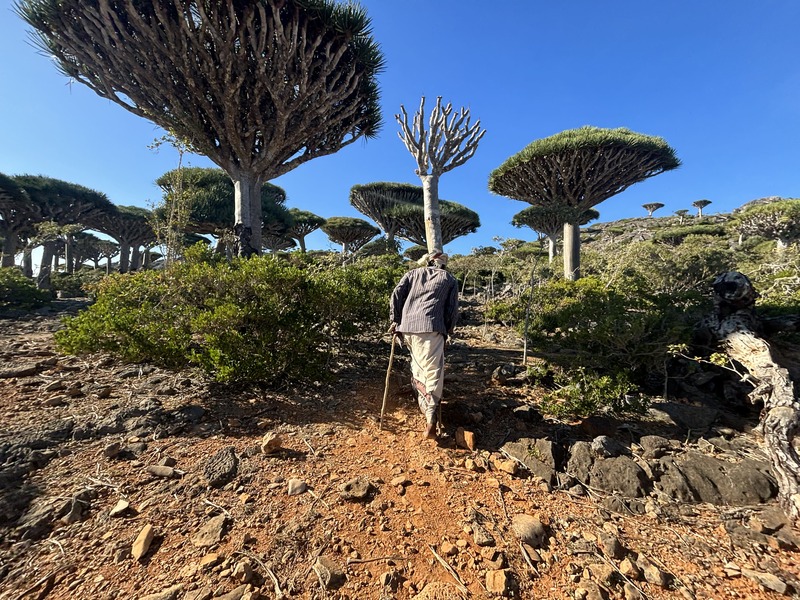
What Is a Dragon Blood Tree?
The dragon blood tree, Dracaena cinnabari, is the botanical superstar of Socotra and one of the most recognisable plants on earth.
Its silhouette is the giveaway - a dense, flat-topped canopy shaped like an umbrella blown inside out, sitting on a thick bare trunk. From a distance, a hillside of them looks like a fleet of green flying saucers coming in to land.
That bizarre shape is pure function. The tightly packed canopy, formed by a repeated branching pattern where each branch splits again and again, shades the tree's own root zone and captures moisture from the fogs and mists that roll over Socotra's highlands. In a dry land, the tree is its own umbrella, its own water harvester and its own microclimate.
Why ‘Dragon Blood Tree’?
And then there's the name.
Cut the bark and the tree bleeds a deep red resin, the famous dragon's blood, prized for thousands of years as a dye, a medicine and even a varnish.
Traders carried it along the ancient incense routes, and legends about dragons grew up around it the way legends do. Standing next to a tree that bleeds red, you understand why the old stories wrote themselves.
Only in Socotra
Here's the fact that reframes the whole island - this tree, in this form, exists only on Socotra.
It's the flagship of an ecosystem so isolated that over a third of the island's plant species grow nowhere else on the planet, a level of endemism comparable only to the Galapagos.
UNESCO recognised Socotra as a World Natural Heritage Site in 2008, and the dragon blood tree is on the cover of that story.
Where to See Dragon Blood Trees on Socotra
A proper circuit of Socotra serves up dragon blood trees in at least four distinct settings, each better than the last. These are the highlights to see the Dragon Blood Trees in Socotra.
Homhil Protected Area
If you want to get personal with the trees, Homhil is the place.
This is the finest location on the island for you to walk up close, complete with demonstrations of traditional resin harvesting, where you watch the famous red sap collected the way Socotris have done it for generations.
The plateau also throws in panoramic views toward the coast, because Socotra refuses to do anything halfway.
Kalisan Canyon and Wadi Dirhur
The trees also moonlight as canyon decoration.
At Kalisan, hidden freshwater pools sit at the base of towering limestone cliffs colonised by dragon blood trees and Socotri figs, and you can swim beneath them. Wadi Dirhur, slicing past the Dixam Plateau, repeats the trick at even grander scale.
The Dixam Plateau and Fermahin Forest
The main event.
Dixam is the high plateau of central Socotra where the dragon blood trees grow most densely and most dramatically, with views of the forest stretching away toward mountains and sea.
Nearby Fermahin Forest is one of the densest stands on the island, and in the late afternoon light, when every canopy glows and the shadows go long, it is flatly one of the most extraordinary places I have ever stood.
You can camp here at Dixam Plateau underneath the Dragon Trees. One of the single most memorable camping spots you’ll ever have.
Walking in the Dragon Trees
Photographs prepare you for the shape. They do not prepare you for the presence.
Dragon blood trees grow slowly and live for centuries, and the big ones radiate the same patient authority as old-growth giants anywhere.
Up close, the canopy is a dense lattice you can stand beneath like a roof, the bark is smooth and elephant-grey, and on a windy plateau the whole forest creaks and whispers.
At golden hour on Dixam, with hundreds of those silhouettes ranged across the ridgelines, the landscape stops looking like Earth having a normal day and starts looking like the concept art for a planet the studio rejected as too imaginative.
And the night shift might be better.
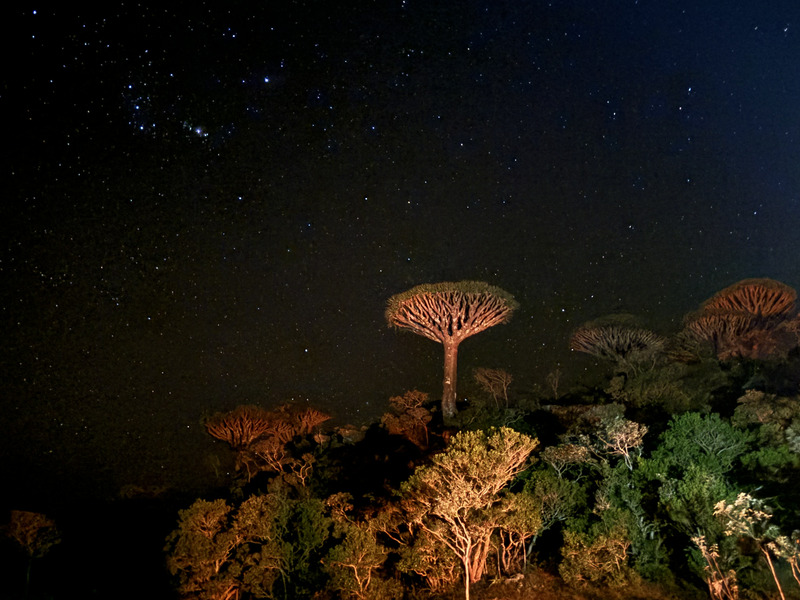
Camping among the trees under Socotra's outrageously clear skies, you get dragon blood silhouettes against the Milky Way.
Top tip: for the best photos under a dark night sky, hold a light or torch onto the tree and use your camera’s night mode or long exposure. And thank me later.
Socotra's Other Famous Trees
The dragon blood tree headlines, but it tours with a remarkable band.
Socotra Bottle Tree
Keep an eye out for the desert rose, also called the bottle tree, a swollen-trunked sculpture that erupts in pink blossoms straight from bare rock, looking like something a cartoonist drew on a dare.
The plant blossoms closer to spring and summer, so time your trip for around this time if you want to see the pink landscape.
Socotri Fig
The Socotri fig appears alongside the dragon bloods in Kalisan Canyon, gripping the limestone with muscular roots.
Frankincense Trees
Frankincense trees, nine species of them on the island, connect the landscape to the ancient incense trade that once made this region rich. And everywhere, smaller endemics fill the wadis: aloes, cucumber trees, succulents with no common names because so few outsiders have ever needed to discuss them.
This is the real magic of walking Socotra's highlands. The dragon blood tree is the celebrity, but you're moving through an entire ecosystem that evolved in isolation, where every second plant is a species the rest of the planet never got.
The Endangered Socotri Dragon Blood Tree
The Dragon Blood Trees in Socotra are endangered. They regenerate slowly. The big ones you’ll see are hundreds of years old.
Young saplings face grazing pressure and a drying climate, and the great forests of Dixam and Fermahin are precious precisely because dense stands have become rare.
That's part of why visits run through protected areas with local guides, why permits fund conservation oversight, and why responsible tourism here matters. Travellers who come for the trees give the island a living reason to keep them thriving.
Dragon Blood Tree Nursery
On a tour to Socotra, you can visit the Dragon Blood tree nursery. This is a protected area originally set up in cooperation with a Czech woman aimed at protecting the trees from their biggest enemies in their youngest years: goats.
Goats are not endemic to Socotra and they’re the biggest threat to Dragon Blood Trees. The saplings take several years to grow strong, and even more years to grow to a height that leaves them less vulnerable to hungry goat mouths.
Walking through the Dragon Blood Tree nursery, enclosed by rock walls to keep our the goats, shows a great example of conservation efforts being made to protect the species. As well as giving you a close up glimpse of what these trees look like in their younger years.
(Spoiler - they look kind of like… pineapples?)
When to See the Dragon Blood Trees
The forests are evergreen and spectacular year-round within Socotra's October to April travel season, but timing tweaks the experience.
Early in the season, after any autumn rains, the plateaus carry a flush of green that sets the canopies off beautifully.
Midwinter brings the coolest, clearest hiking weather, ideal for long days at Homhil and Dixam, with crisp nights that sharpen the stars for forest camping.
Late season warms up and hazes slightly, but rewards with the most settled conditions.
Within any given day, the rule is absolute - dawn and dusk are everything. The trees photograph as flat green discs at noon and as burning gold sculptures at golden hour.
Practical Tips for Visiting the Dragon Blood Trees
Time your forest visits for early morning or late afternoon; midday light flattens the canopies, while golden hour sets them on fire.
Wear proper shoes, since plateau trails are rocky and wadi scrambles are part of the fun.
Bring a wide lens for the forest panoramas and a long one for isolating single trees against the sky.
Ask your guide for the resin demonstration at Homhil. Dragon's blood is for dyes and lore. You can even try to purchase a small amount of this locally.
Some famous sights shrink when you finally meet them.
The dragon blood trees of Socotra do the opposite. They are stranger, older and more beautiful in person than any photo suggests, and they anchor an island that has more botanical originality per square mile than almost anywhere on earth.
Koryo Tours
Experts in Travel to Socotra
Share
Zoe Stephens
Zoe is the marketing manager and a tour leader at Koryo Tours.
Her love of meeting new people and exploring new cultures has led her to study several languages including German, Japanese, and Chinese. Having lived in several different countries across 4 continents, she often writes about languages and culture in her blogs and is very active on social media. During the COVID-19 pandemic, she was 'stuck' in Tonga for 1.5 years after a weekend away. Ask her for some stories!
🎥 Vlogs on North Korea
🎙 Discover North Korea Podcast
➤ Instagram | Facebook | TikTok | Twitter/X