The suspect, as it turned out, was hiding in plain sight. Agatha Christie, the woman the world assumed never left her English drawing room, had spent thirty years adventuring the Middle East.
I don't know about you, but I grew up reading Agatha Christie novels under the covers long after bedtime (sorry, Mom!).
In fact, I named our childhood Rough Collie dog Christie (although it was spelt 'Kristi' for simplicity) after her.
She's one of my all-time favourite authors, and I credit her works, at least in part, for my wanderlust later in life.
It took me years to realise that half of her best work was written in the dust of Iraq and Syria, Egypt and Turkey, and lots of super exciting places throughout the Middle East.
For most of my life, I pictured Agatha Christie exactly how you probably do: a tweedy English lady in a country house, solving murders over tea in a village where a worrying number of vicars keep turning up dead.
Then I started travelling in the Middle East for work with Koryo Tours, and her name kept popping up in the strangest places: A hotel room in Istanbul. A battered old hotel in Aleppo. A dig site in northern Iraq. A paddle steamer on the Nile.
It turns out the Queen of Crime spent around thirty years of her life in this part of the world, and she had a far more adventurous time of it than I ever imagined.
So naturally, I want to dive deeper into her travels, and here's my attempt at following in her footsteps (with fewer bodies, hopefully).
And let's do it in the peculiar Agatha Christie's title style (dun dun duuun ... )
The Curious Case of the Cancelled Ticket (London, 1928)
The Mystery of Room 411 (Istanbul, Türkiye)
A Second Suspect Comes Forward (Aleppo, Syria)
They Came to Baghdad (Damascus to Baghdad)
The Victim Was Based on a Real Person (Ur, Iraq)
The Archaeologist Did It (Iraq, 1930)
A Third Suspect, and a Plague of Fleas (Northeastern Syria, 1934-1938)
The Clue in the Jar of Face Cream (Nimrud, Iraq)
Never Go on Holiday with Hercule Poirot (Egypt)
An Appointment at the Rose-Red City (Petra and Jerusalem)
Revisiting the Scenes of the Crimes
The Final Twist: Gathering Everyone in the Drawing Room
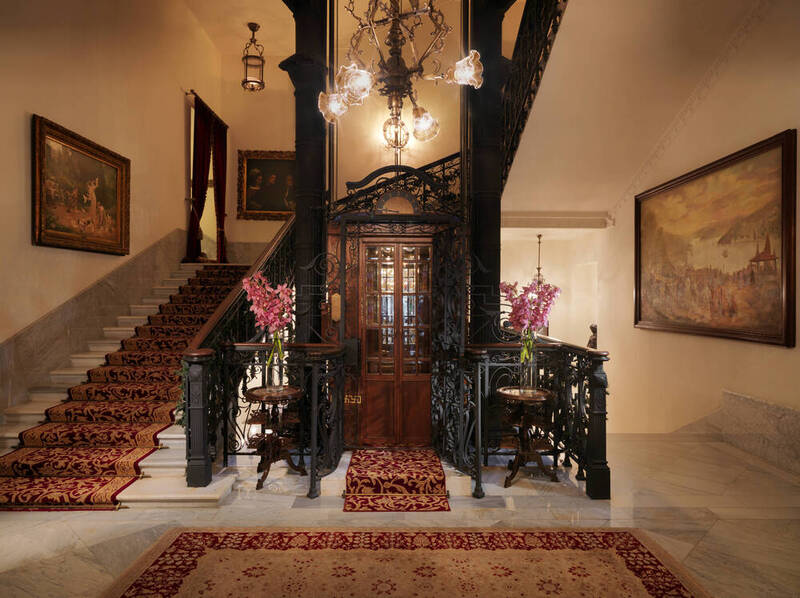
Pera Palace Hotel Elevator, Istanbul
The Curious Case of the Cancelled Ticket (London, 1928)
Christie's Middle East story starts in a way I think a lot of us can relate to.
In 1926, her first husband, Archie, told her he'd fallen for someone else, so understandably, she famously disappeared for eleven days (sparking a nationwide manhunt) before turning up in a hotel in Harrogate.
By 1928, their divorce was finalised. She booked herself a winter holiday in the West Indies in the Caribbean to recover.
Then, a few days before leaving, she went to a dinner party and ended up chatting to someone just back from Baghdad, who told her all about the incredible excavations at the ancient city of Ur.
The next day, she went back to the travel agent and swapped Kingston for Baghdad, travelling alone on the Orient Express at a time when women travelling solo across the Middle East were, well, not exactly common.
And the rest is history.
I like her adventurous soul already.
The Mystery of Room 411 (Istanbul, Türkiye)
Christie travelled east on the Simplon-Orient Express, and she loved it so much she ended up making the journey again and again.
The train, unsurprisingly, gave her a plot or two.
In 1929, an Orient Express got stuck in a snowdrift in Turkey for several days, and on one of her own trips she was held up by floods (and, being a crime writer, took careful notes on her fellow passengers).
Add the shocking 1932 kidnapping of the Lindbergh baby in America, and you've got the ingredients for Murder on the Orient Express (1934).
In Istanbul, she stayed at the grand Pera Palace Hotel, built in 1892 for Orient Express passengers. Legend says she wrote the novel in Room 411, which the hotel has kept as a little memorial room ever since.
There's an even stranger story attached to it.
In 1979, an American medium claimed to have contacted Christie's spirit during a séance and was told a key to her missing diary was hidden under the floorboards.
A rusty old key really was found in Room 411, and to this day nobody knows what it opened.
Dun dun duuun ...
(Honestly, if that isn't a Poirot plot, I don't know what is.)
A Second Suspect Comes Forward from Room 203 (Aleppo, Syria)
Apparently, Istanbul isn't the only place claiming Murder on the Orient Express.
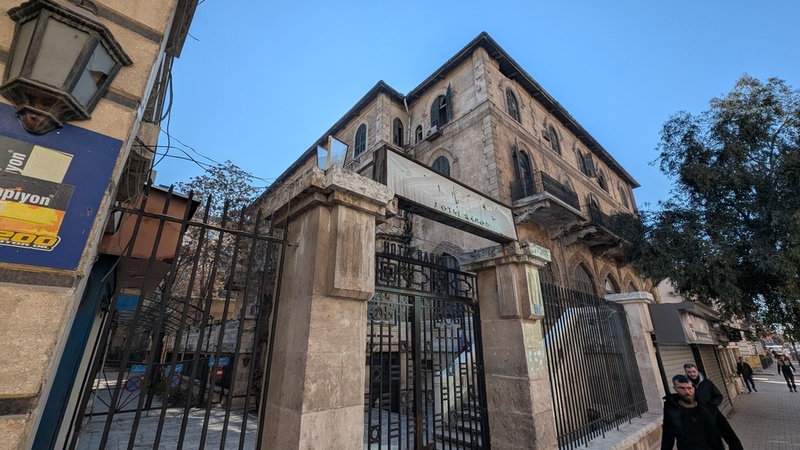
In Aleppo, the legendary Baron Hotel says Christie wrote the first part of the novel in Room 203.
It was the place to stay in northern Syria in the early 20th century, and yeah, gotta say that the guest list is quite impressive: Lawrence of Arabia (whose unpaid bar bill was proudly framed in the hotel), Charles de Gaulle, Atatürk, Yuri Gagarin, and King Faisal, who declared Syria's independence from one of its balconies.
Christie and her husband used it as a base on their way to and from digs in the Syrian desert.
The hotel closed in 2014, when the fighting in Aleppo put the front line just metres away, and it hasn't been open to the public since.
I've been told that Christie's room still has some of the mementoes she left behind.
Boy, do I wish I could have gone in and seen it for myself, but that will have to wait for another day.
Baron Hotel, Aleppo
They Came to Baghdad (Damascus to Baghdad)
Back in the 1920s, you couldn't just hop on a train (or a plane) to Baghdad because the last stretch of the route was by the Nairn Transport Company desert bus (which ran across the open desert from Damascus to Baghdad).
It was long, hot, dusty and bumpy, and Christie absolutely loved it. (I've done a few long overland journeys in this part of the world myself, and "loved" is not always the word I'd use, so hats off to her.)
Baghdad became a sort of second home over the following decades, and it later starred in her spy thriller They Came to Baghdad (1951).
The Victim Was Based on a Real Person (Ur, Iraq)
From Baghdad, Christie headed south to Ur, the ancient Sumerian city where archaeologist Leonard Woolley was digging up the famous Royal Tombs, full of gold and jewellery.
Visitors weren't usually welcome on the dig, but Woolley's wife, Katharine, had just read The Murder of Roger Ackroyd and was a big fan, so Christie got the VIP treatment.
Now, Katharine Woolley was, by all accounts, quite a character. She liked being the centre of attention, and the men on the dig tended to tiptoe around her moods.
A few years later, Christie published Murder in Mesopotamia (1936), set on an archaeological dig in Iraq, in which the glamorous, manipulative wife of the expedition leader is (spoiler alert) murdered.
Christie and Katharine stayed friends, but I would love to know what Katharine thought when she read it.
Ur is still very much there for visitors today, with the giant Ziggurat of Ur towering over the flat desert.
My next trip to Iraq, I'll be taking a copy of Murder in Mesopotamia with me.
The Archaeologist Did It (Iraq, 1930)
When Christie went back to Ur in 1930, she met Woolley's young assistant, Max Mallowan, who was 14 years younger than her.
He was asked to show her around Iraq, and somewhere between the ruins and the desert roads, they fell for each other.
They married in Edinburgh just six months later. (So much for a quiet holiday to get over a breakup.)
Christie is often quoted as saying an archaeologist is the best husband a woman can have, because the older she gets, the more interested he is in her.
She always denied saying it, which is a shame, because it's a brilliant line.
A Third Suspect, and a Plague of Fleas (Northeastern Syria, 1934-1938)
For the next thirty years, Christie spent part of almost every year on digs with Max in Iraq and Syria.
And she wasn't just there to look pretty in a sun hat. She photographed finds, fixed broken pottery, catalogued everything, kept the accounts, and still somehow wrote a couple of bestsellers a year.
(I struggle to write a blog post when the Wi-Fi is slow.)
In 1933 they dug at Arpachiyah, near Mosul, which, according to National Geographic, is where she wrote Murder on the Orient Express.
So that's now three places claiming the same book, and Poirot would have had a field day.
From 1934 to 1938 they worked at Chagar Bazar and Tell Brak in northeastern Syria, and Christie wrote a funny, lovely memoir about it all, Come, Tell Me How You Live (1946).
It's full of mice, fleas, stubborn workmen and collapsing roofs, and if you read one book before travelling in the region, make it this one.
It's honestly the most relatable thing she ever wrote.
The Clue in the Jar of Face Cream (Nimrud, Iraq)
After the Second World War, Max led the excavations at Nimrud, the old Assyrian capital on the Tigris south of Mosul, from 1949 through the 1950s.
The team dug up hundreds of beautiful carved ivories, many caked in ancient mud, and it was Christie who worked out how to clean them.
Her toolkit included an orange stick, a knitting needle and a jar of her own face cream. (I've used a lot of things for a lot of purposes on the road, but never thought to try moisturiser on archaeology.)
The expedition house even had a little mud-brick room just for her, with a sign on the door in cuneiform reading "Beit Agatha", Agatha's House.
It's where she wrote parts of several novels and started her autobiography.
Sadly, the house has long gone, and in 2015 Islamic State militants bulldozed and blew up much of ancient Nimrud.
It's a sad place now, though restoration has begun.
Many of the ivories she helped clean are safe in the Iraq Museum in Baghdad and the British Museum in London, so you can still see her handiwork.
Never Go on Holiday with Hercule Poirot (Egypt)
Egypt was actually Christie's first taste of the region.
In 1910, as a shy 20-year-old, she spent a winter in Cairo with her mother at the Gezirah Palace Hotel, mostly going to dances and polo matches (as you do).
In 1933, she came back with Max for a Nile cruise on the paddle steamer SS Sudan, stopping at the Old Cataract Hotel in Aswan along the way.
Both ended up in Death on the Nile (1937), which proves you should never, ever go on holiday with Hercule Poirot.
The best part is that you can still do it all yourself:
- The Gezirah Palace is now part of the Cairo Marriott in Zamalek.
- The Old Cataract still has an Agatha Christie suite and a terrace made for sunset drinks.
- The SS Sudan is still sailing between Luxor and Aswan, and you can book a cabin.
I'd just keep an eye on your fellow passengers.
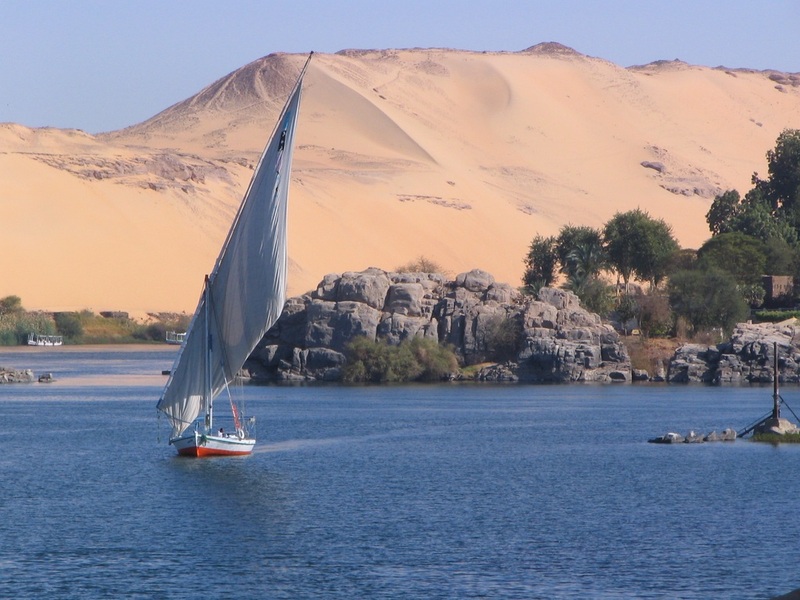
Felucca Boat, the Nile (Aswan)
An Appointment at the Rose-Red City (Petra and Jerusalem)
Christie also took Poirot to Petra in Appointment with Death (1938), where a monstrous American matriarch dies on a family holiday after a first act in Jerusalem.
Having visited both herself, she captures the "rose-red city" beautifully, and anyone who's walked through the Siq will recognise it.
Revisiting the Scenes of the Crimes
For anyone planning their own Christie pilgrimage (I won't judge), here's what's still around:
- Pera Palace Hotel, Istanbul - still open, and Room 411 is bookable.
- Baron Hotel, Aleppo - closed to the public, but you can see it from outside.
- Ur, Iraq - open to visitors, ziggurat and all.
- Nimrud, Iraq - badly damaged, and the dig house is long gone.
- Iraq Museum and British Museum - home to the ivories she cleaned.
- Old Cataract Hotel, Aswan - still open, with an Agatha Christie suite.
- SS Sudan - still cruising between Luxor and Aswan.
- Petra, Jordan - as rose-red as ever.
The Final Twist - Gathering Everyone in the Drawing Room
In every Christie novel, Poirot gathers everyone in the drawing room at the end and reveals the truth, so here's mine.
The woman I'd always pictured as the ultimate homebody turned out to be one of the most adventurous travellers of her time. She crossed deserts on rickety buses, put up with fleas and sandstorms, fell in love on an archaeological dig, and wrote masterpieces in mud-brick huts.
Reading her again now, after travelling in some of the same places, I find myself noticing the little details she got so right, like the heat, the dust, the hotel bars and the mix of strangers you end up stuck with on a long journey. She clearly loved this part of the world, and it shows in everything she wrote here.
If you fancy following in her footsteps, we run tours to Iraq and Syria. I can't promise a murder, but I can promise ziggurats, desert roads, and some very interesting characters at the hotel bar.
(And one day, I'm still hoping to get inside the Baron Hotel and see Room 203 for myself.)
Koryo Tours
Group Tours to the Middle East
Share
Halef Gunawan
Halef is Social Media and Marketing Specialist at Koryo Tours
Born and raised in Indonesia, he moved to the U.S. for college and later pursued full-time travel in 2019. Stranded in Sabah, Malaysia, during COVID, he and his partner, along with their German Shepherd, Kana, embraced van life and have been exploring North America since 2020.
📷 Instagram | 🇮🇩 Instagram (Bahasa Indonesia)
My First Koryo Tours Adventure in Syria During Ramadan (and the Iran War)