Damascus is mentioned in the Bible several times, even before Saul's conversion in the New Testament. Here's what the Bible actually says, and what you can still see in the city today.
Damascus is one of the oldest cities in the world.
The city's history dates back 8,000 to 10,000 years (around 8000–6000 BCE), with its urban centre and city life built by the 3rd to 4th millennium BCE.
Pretty old stuff!
Not surprisingly, that puts it alongside other 'old cities' like Jerusalem, Bethlehem, and Ur, all of which share the honour of being mentioned in the Bible.
I grew up in a devout Catholic family, and I remember many of these biblical stories from our Bible study.
Naturally, once I started working on Koryo Tours' Middle East trips, including a visit to Syria in March 2026, I gravitated toward what I remembered about these biblical places, including Damascus.
The Conversion of Saul (aka Saint Paul) is probably the Damascene story I remembered right away from the bible.
Damascus Was Part of the Biblical Story
Damascus in the Old Testament
Damascus in the New Testamant
What Can You Still See in Damascus From Biblical Times?
An Honourable Mention - The Umayyad Mosque
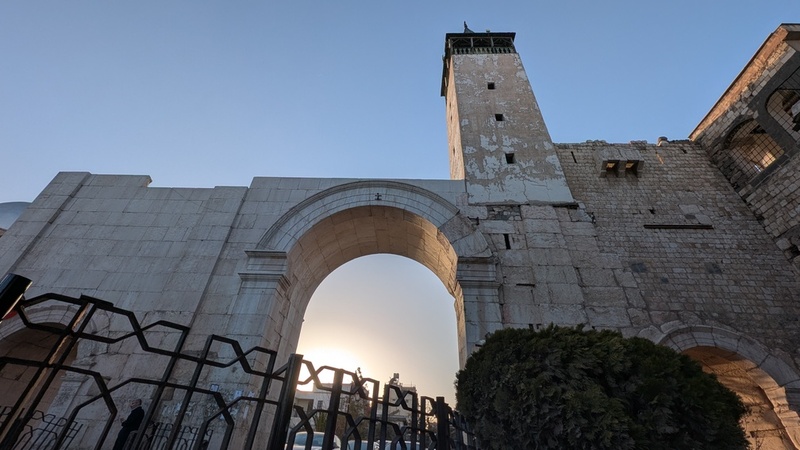
Bab Sharqi, or The Eastern Gate
Damascus Was Part of the Biblical Story
Damascus is older than most of the cities usually associated with the Bible.
It was named in scripture during the time of Abraham (the Old Testament), long before Jerusalem became the city of David, or Bethlehem the birthplace of Jesus Christ.
It's mentioned throughout Genesis, the books of Kings, Isaiah, and a few more, before becoming the famous (or notorious), setting for Saint Paul's conversion.
So, without a doubt, Damascus is an important part of biblical and Christian history, even if it rarely gets grouped alongside the more familiar names.
Damascus in the Bible - Old Testament
Saul's story is the one most associated with Damascus today, but the city is mentioned in the Old Testament many centuries earlier.
Its first appearance comes in The Book of Genesis, during the account of Abram (or, later known as Abraham - the same guy!) rescuing his nephew Lot:
"And he divided himself against them, he and his servants, by night, and smote them, and pursued them unto Hobah, which is on the left hand of Damascus." — Genesis 14:15 (KJV)
Not long after, Damascus is named again by Abram, who laments to God that his household steward from Damascus stands to inherit everything:
"And Abram said, Lord GOD, what wilt thou give me, seeing I go childless, and the steward of my house is this Eliezer of Damascus?" — Genesis 15:2 (KJV)
Centuries later, in the account of the prophet Elisha, a Syrian military commander named Naaman was cured of leprosy after washing in the Jordan and not in the Damascus River:
"Are not Abana and Pharpar, rivers of Damascus, better than all the waters of Israel? May I not wash in them, and be clean? So he turned and went away in a rage." — 2 Kings 5:12 (KJV)
Elisha's story intersects with Damascus once more not long after, when he travels there himself and, weeping, foretells the violence a soon-to-be king named Hazael will inflict on Israel, before Hazael goes on to seize the throne of Damascus.
By the time of the prophet Isaiah, Damascus had become powerful enough, and troublesome enough to the kingdoms of Israel and Judah, to be the subject of a direct prophetic warning, part of a wider oracle addressing Damascus's alliance with the northern kingdom of Israel against Judah:
"The burden of Damascus. Behold, Damascus is taken away from being a city, and it shall be a ruinous heap. The cities of Aroer are forsaken: they shall be for flocks, which shall lie down, and none shall make them afraid. The fortress also shall cease from Ephraim, and the kingdom from Damascus, and the remnant of Syria: they shall be as the glory of the children of Israel, saith the LORD of hosts." — Isaiah 17:1-3 (KJV)
And then the next mention of Damascus in the Bible comes from the New Testament, with the Conversion of Saul.
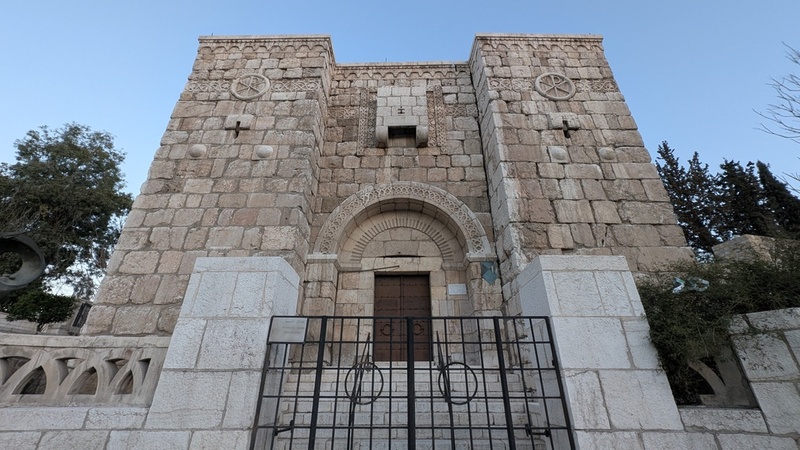
The Church of St. Paul of Bab Kisan
Damascus in the Bible - New Testament
So, what actually happened to Saul in Damascus?
Sometime in the first half of the first century (mid-30s AD), not long after the Crucifixion of Christ, a man named Saul was actively hunting down Christians.
The high priest in Jerusalem had given him authority to go to Damascus, capture those "of the Way," as the early Christians were known, and bring them back in chains.
Then, somewhere on the road into Damascus, a light from heaven appeared, along with a voice asking why he was doing this, and Saul was left blind.
A local Christian man named Ananias was told by God to help the blind Saul at his home in Damascus, and eventually Saul was baptised and joined the very community he had tried to destroy, becoming the Saint Paul known in Christianity today.
Here's the verse from the Bible (Acts chapter 9) that gives the full context:
"And there was a certain disciple at Damascus, named Ananias; and to him said the Lord in a vision, Ananias. And he said, Behold, I am here, Lord. And the Lord said unto him, Arise, and go into the street which is called Straight, and enquire in the house of Judas for one called Saul, of Tarsus: for, behold, he prayeth, and hath seen in a vision a man named Ananias coming in, and putting his hand on him, that he might receive his sight. Then Ananias answered, Lord, I have heard by many of this man, how much evil he hath done to thy saints at Jerusalem: and here he hath authority from the chief priests to bind all that call on thy name. But the Lord said unto him, Go thy way: for he is a chosen vessel unto me, to bear my name before the Gentiles, and kings, and the children of Israel: for I will shew him how great things he must suffer for my name's sake. And Ananias went his way, and entered into the house; and putting his hands on him said, Brother Saul, the Lord, even Jesus, that appeared unto thee in the way as thou camest, hath sent me, that thou mightest receive thy sight, and be filled with the Holy Ghost. And immediately there fell from his eyes as it had been scales: and he received sight forthwith, and arose, and was baptized. And when he had received meat, he was strengthened. Then was Saul certain days with the disciples which were at Damascus." — Acts 9:10-19 (KJV)
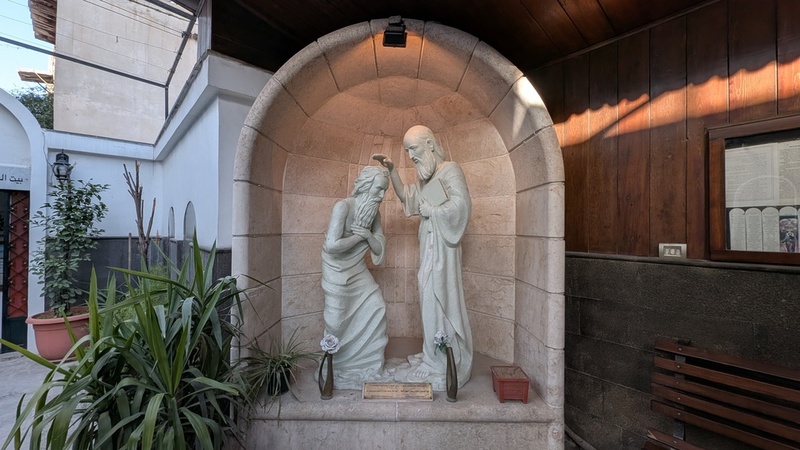
The Church of Saint Ananias
What Can You Still See in Damascus From Biblical Times?
Here are a few places that still exist in Damascus, tied directly to these biblical stories and their significance.
The Straight Street, or the Street Called Straight
In the middle of Old Damascus, the Street Called Straight, known in Latin as the Via Recta, is one of the streets that has been part of the city since the very beginning, some two thousand years ago.
It's one of the earliest streets built during Roman times, and it's mentioned in the Bible in connection with Saul's conversion.
Today it's still, well, straight, running across the length of Old Damascus, lined with shops, restaurants, and markets.
The House of Ananias
Ananias lived in a modest house not far from the Straight Street, and it was here that he brought Saul to be healed and, eventually, baptised.
Today the site is known as the Chapel of Saint Ananias, an active pilgrimage site and church that marks its importance in Christian history.
The Chapel of St. Paul at Bab Kisan
After his conversion, Saul, by this point known as Paul, began preaching in Damascus and made enemies fast.
The Book of Acts records that a plot formed to kill him, with the city gates watched day and night to catch him leaving:
"And after that many days were fulfilled, the Jews took counsel to kill him: but their laying await was known of Saul. And they watched the gates day and night to kill him. Then the disciples took him by night, and let him down by the wall in a basket." — Acts 9:23-25 (KJV)
In his second letter to the Corinthians, Saint Paul recounted his own experience with a few more details of his escape:
"In Damascus the governor under Aretas the king kept the city of the Damascenes with a garrison, desirous to apprehend me: and through a window in a basket was I let down by the wall, and escaped his hands." — 2 Corinthians 11:32-33 (KJV)
Today, a stone chapel stands at Bab Kisan, a gate on the southeastern stretch of the old city wall, marking the very spot where Saint Paul is said to have escaped.
It's been a site of Christian pilgrimage in Damascus for centuries.
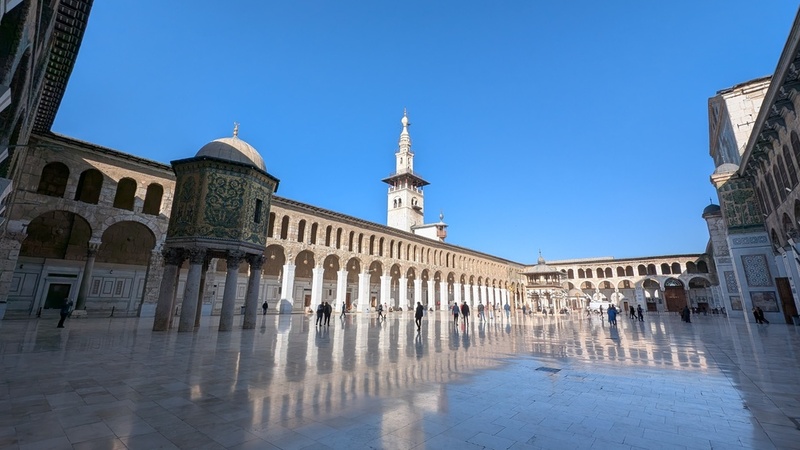
Umayyad Mosque
An Honourable Mention - The Umayyad Mosque
Worth mentioning too is the Umayyad Mosque, which has its own connection to the Bible, in a roundabout way.
At the western end of the Straight Street stands the Umayyad Mosque.
In Saul's time, this was the site of a Roman temple to Jupiter, the outer rectangular walls of which still form part of today's structure.
In the late fourth century, the temple was converted into a Byzantine basilica dedicated to St. John the Baptist. Damascus was conquered by Muslim forces in 636, and for a time, Christians and Muslims are recorded as having shared use of the same site, before the Umayyad Caliph al-Walid I had the church demolished and the present mosque built in its place between 705 and 715 AD.
A shrine within the mosque is believed to hold the head of John the Baptist, a figure revered in both Islam and Christianity.
Interestingly, according to Islamic tradition, the Minaret of Jesus, one of the mosque's minarets, is believed to be where Jesus will descend at the end of days.
To be clear, the Bible itself contains no reference to Damascus in connection with the return of Christ, but regardless, the Umayyad Mosque remains a must-visit site for religious and general tourism purposes alike.
Koryo Tours
Group Tours to Syria
Share
Halef Gunawan
Halef is Social Media and Marketing Specialist at Koryo Tours
Born and raised in Indonesia, he moved to the U.S. for college and later pursued full-time travel in 2019. Stranded in Sabah, Malaysia, during COVID, he and his partner, along with their German Shepherd, Kana, embraced van life and have been exploring North America since 2020.
📷 Instagram | 🇮🇩 Instagram (Bahasa Indonesia)
My First Koryo Tours Adventure in Syria During Ramadan (and the Iran War)