Wherever I seem to travel, there is always a solid Georgian restaurant somewhere nearby. Central Asia, the Caucasus, once even Vietnam. So when you actually visit Georgia, the food should be pretty good. In my opinion, it absolutely is. Here is what to eat, how to eat it, and why the best Georgian meal you will have probably will not be in a restaurant.
One thing I've noticed during all of my years travelling is that wherever I seem to go, there's always a solid Georgian restaurant somewhere.
Whether I'm in Central Asia or elsewhere in the Caucasus, Georgian food travels remarkably well. I even ate at a good Georgian restaurant in Vietnam some moons ago.
So it stands to reason that when you actually visit Georgia, the food should be pretty good.
And in my opinion, it absolutely is.
In fact, the only thing that might be better than Georgian food is Georgian wine. But that's another blog altogether.
Georgian food is hearty, uncomplicated and made for sharing, perfect when travelling as a tour group. More importantly, eating here is a social event. Meals have a habit of lasting longer than expected, plates keep appearing, and there's usually far too much food on the table.
Khachapuri – You’ll Definitely Meet This One (hopefully day one)
Khinkali – There Is a Right Way to Eat Them
Walnuts... Loads of Walnuts
Mtsvadi – Keep It Simple
Lobio
Those Strange Things Hanging in the Markets
And Then There's the Wine...
The Best Georgian Meal?
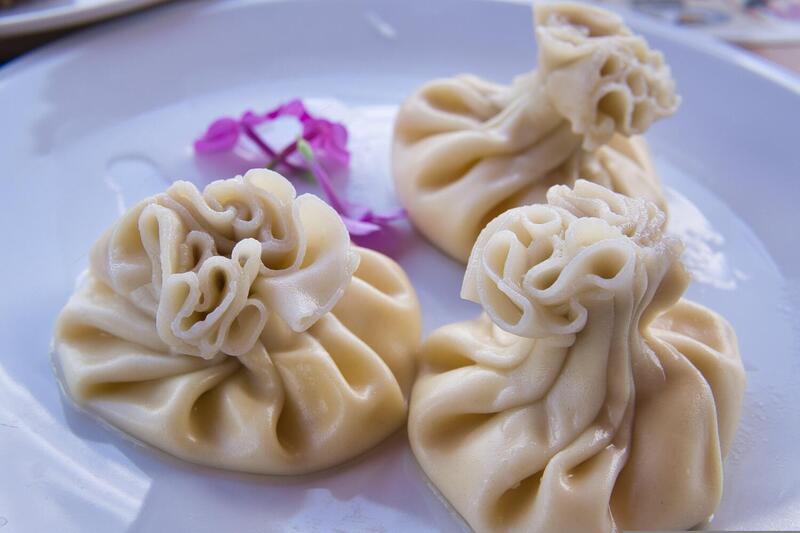
Khinkali Dumplings
Khachapuri, You’ll Definitely Meet This One (hopefully day one)
You won't get very far into Georgia before someone puts a khachapuri in front of you.
Calling it cheese bread is technically correct, but it doesn't really do it justice.
There are different versions all over Georgia. Imeruli is probably the simplest, round bread stuffed with cheese, while Adjaruli khachapuri is the famous boat-shaped version filled with melted cheese, butter and an egg.
When it arrives, you mix the egg and butter into the hot cheese, tear bits of bread from around the edge and dip them into the middle.
It's delicious, but be warned, it's incredibly filling. Finishing a large one by yourself can feel like a personal achievement.
Khinkali, There Is a Right Way to Eat Them
Then we have khinkali, Georgia's wonderful big dumplings.
Well ignore the politics of who invented the dumpling, China, Korea, Mongolia, central Asia etc. lets just say which ever country you’re in when your tasting.
Traditionally, the Georgian form is said to come from the mountain regions; they're usually filled with meat, seasoning, and hot broth, although you'll also find mushroom, potato, and cheese versions.
Eating them requires a little practice.
Grab the dumpling by the thick twisted top, bite a small hole in the side and drink the broth before eating the rest. Attack one with a knife and fork, and there's a reasonable chance the broth will end up all over your plate... or you (definitely not good with white clothing).
After a few, you'll get the hang of it. After ten, you probably won't want to move anywhere for a while.
I shouldn't joke too much about needing a lie down afterwards. Over the years, I've had more than a few people genuinely start dozing off while we've been eating in a local Georgian home.
To be fair, after a table full of khinkali, seemingly endless other dishes and the usual Georgian hospitality, it's quite easily done. Thankfully, our hosts have always seemed more amused than offended!
Walnuts... Loads of Walnuts
One thing you'll quickly notice about Georgian cooking is that walnuts turn up everywhere.
We’ll get to the churchkhela.
Walnuts find their way into plenty of savoury dishes. One of my favourites is badrijani nigvzit. Strips of aubergine wrapped around a walnut, garlic and herb filling, often topped with pomegranate seeds. It sounds simple, and it is, but it's fantastic.
You'll also come across pkhali, usually vegetables such as spinach or beetroot mixed with walnuts, garlic, herbs and spices.
This is one area where Georgian food can surprise people. Everyone talks about the meat, bread and cheese, but there's also an enormous amount of vegetables, salads, herbs and beans on a typical Georgian table.
Mtsvadi, Keep It Simple
Mtsvadi is Georgian barbecue.
Chunks of meat, skewers and hot coals. It really doesn't need to be any more complicated than that.
You'll find it in restaurants, but for me it makes most sense somewhere out in the countryside with bread, onions, tomatoes and inevitably a bottle of Georgian wine nearby.
Lobio
Lobio is essentially a bean dish, often served hot in a clay pot with herbs and spices and accompanied by pickles, bread and sometimes mchadi, a Georgian cornbread.
It's simple, filling food, and particularly good after a day outside in the mountains.
Those Strange Things Hanging in the Markets
Walk around a Georgian market, and you'll probably notice long colorful things hanging everywhere that look a little like badly formed IKEA candles in green and red predominantly.
That's churchkhela.
Walnuts or hazelnuts are threaded onto string, dipped into thickened grape juice and hung up to dry. They're sweet, chewy and surprisingly filling.
They're one of those things that you really should try at least once while you're here.
And Then There's the Wine...
You can't really talk about Georgian food without mentioning the wine.
Georgia has been making wine for thousands of years, and it's not simply something produced for tourists — it's genuinely part of the culture here.
There's the traditional qvevri method, where wine is fermented and stored in huge clay vessels buried underground, the vineyards of Kakheti, small family producers and some very distinctive Georgian wines.
But I think Georgian wine deserves its own blog, so I'll leave that one for another day.
The Best Georgian Meal?
For me, the best food experience in Georgia isn't necessarily found in a restaurant; yes, like anywhere in the world, you can spend hundreds of dollars for fine dining, especially in Tbilisi.
For me, eating in a local home wins.
That's something we try to include when we're travelling here, because sitting down with a Georgian family gives you something a restaurant simply can't reproduce.
The table fills up with home-cooked dishes, everyone sits together, food gets passed around, stories are exchanged and, inevitably, someone produces the wine (and some homes make their own).
You aren't just tasting Georgian food anymore. You're experiencing Georgian hospitality.
And that for me is really what Georgian food is all about. You can eat khinkali and khachapuri in Georgian restaurants all over this part of the world — and I've eaten plenty of both — but sitting around a table in someone's home in Georgia is something completely different.
So if you're heading to Georgia, my advice is very simple.
Come hungry, and don’t plan it as one of those vacations where you'll come to lose weight!
And perhaps leave a little room for the wine.
Koryo Tours
Group Tours to The Caucasus
Share

Rich Beal
Rich Beal is our International Tours Manager.
Rich is one of our most experienced tour leaders. He has led tours worldwide since 2004, specialising in Mongolia, Tajikistan, Turkmenistan, and the surrounding area. Currently living in Mongolia, he leads multiple specialised trips annually and has over 20 years of experience running and designing tours of the region.