More than fifteen years after construction began, and a decade after it was supposed to open, trucks are finally crossing the New Yalu River Bridge between Dandong and Sinuiju. Here is the full story of one of the more patient infrastructure projects in recent memory.
Koryo Tours have been frequent visitors to Dandong, the main Chinese border city with North Korea, since the 1990s.
Since that time the main artery connecting the DPRK with the PRC has been the Sino-Korean Friendship bridge, a Japanese-built (in 1943, originally named simply the Amnok River Bridge) iron structure made up of just a single railway track and a single-lane road, with a low load-bearing limit, making the amount of traffic that could cross the bridge somewhat limited, and with there being a long-running need for something larger and more capacious.
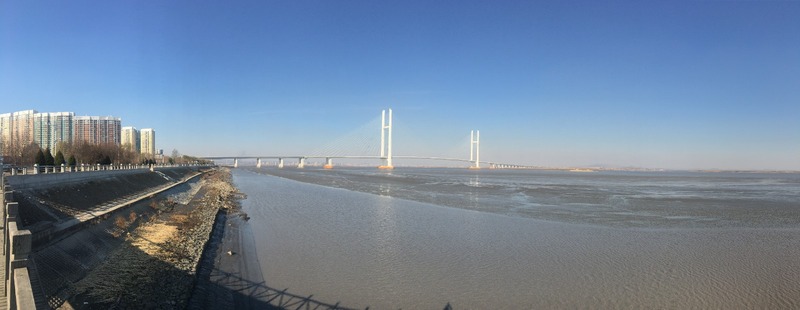
Back in 2009 Wen Jiabao, then-Premier of China, visited North Korea and an agreement was made to increase cross-border capacity with a new bridge, and construction on this 3km long cable-stayed structure began.
Unlike the extant old bridge which is centrally located in both Dandong and the DPRK city of Sinuiju this one reaches from the peripheral new district of Dandong onto somewhat emptier land a few km to the south of the city.
Work began in 2011 and was mostly completed in 2014. However, the actual opening was delayed, and then delayed, and then delayed some more. With no opening date every actually announced.
In 2016 we flew over the bridge on one of the first commercial domestic flights in the DPRK from Uiju Airport (just outside Sinuiju) to Pyongyang, and it was clear that it ended on the DPRK side in what appeared to be a pile of dirt; suggesting that the moniker ‘bridge to nowhere’ which had been attached to this project was more than accurate.
By this stage the bridge was apparently becoming a bit of an embarrassment to China. After sinking hundreds of millions of dollars into the project and having it be highly visible and highly-visibly-unused it was in danger of turning into a laughingstock.
But why?
As with most such things in North Korea there are plenty of rumours but no way to confirm them.
Some say it was approved by the government but then hobbled by the military; with the gap between the desire for more trade and also for border security being one that not even this bridge could get across.
Whatever the reasons it was clearly the North Koreans dragging their feet. China opened a huge customs house on their side, and infrastructure in and around the Dandong New District was upgraded and expanded; but the bridge remained closed.
In 2019 things started moving again, with Xi Jinping himself stating that China would cover the costs for roads and customs points to be built on the DPRK side.
They duly were, but in 2020 the project, and the rest of the world, ground to a halt and the North Korean border became sealed from within for an extended time as the most severe reaction to the threat of the Covid-19 pandemic shut off the DPRK from the outside even more than usual.
At this time, more than six years later, there finally seems to be more happening.
With roads complete, the DPRK border open once more (somewhat anyway, there may be no tourism at the time of writing, but there is trade, and this a need for goods to enter/exit somehow), and finally it was reported in September 2026 that trucks were rolling across the bridge.
More than fifteen years after it was started, and more than a decade after it was supposed to be finished, the New Yalu River Bridge seems finally to be open.
Whether it will ever be a viable crossing for tourists remains to be seen, but for this curious project to finally start to be used in the way it was intended does seem like a step in the right direction and is almost certainly a great relief to those who committed so much money, time, effort, and patience to bridging the Yalu once more.
Koryo Tours
Group Tours to North Korea
Share
Simon Cockerell
Simon has been Koryo’s General Manager since 2002. He has travelled to North Korea more than 175 times and has probably been to the country more than any other Westerner. He is a respected speaker on the country and appears regularly in international media. He is also a tour specialist in Kazakhstan, Turkmenistan, and the Russian Far East where he has personally designed and led multiple tours over the years.