North Korea's capital has been completely destroyed and rebuilt at least once, expanded in waves tied directly to ideology and power, and is currently in the middle of its most ambitious construction period in decades.
Valérie Gelézeau and Manon Prud'homme are researchers at the School for Advanced Studies in the Social Sciences (EHESS) in Paris and two of the foremost academic specialists on North Korean urban development. This is the clearest explanation we've found of what Pyongyang actually is, how it got there, and where it is heading.
By Valérie Gelézeau (EHESS-IFRJ) and Manon Prud’homme (EHESS).
A Look into Pyongyang
The capital of the Democratic People's Republic of Korea (North Korea), Pyongyang, has an estimated population of over three million inhabitants in 2019, covering an administrative area of 1,800 km² and comprising 20 districts, including two rural districts.
Located in a fertile region of the lower Taedong River valley, Pyongyang controls the country's main industrial region and also dominates its urban network: the country's second largest city, Hamhung, has a population of around 800,000.
As the secondary ('Western') capital of the medieval Koryŏ Kingdom (918-1392), Pyongyang has always been considered a strategic location in the region. Developed during Japanese colonisation (industries, railways), the city was completely destroyed by American bombing during the Korean War (1950-1953).
Subsequently, as a showcase for the socialist development model of the Democratic People’s Republic of Korea, Pyongyang underwent several phases of development.
Pyongyang in History
1950
Based on Soviet-style urban models, the 1950s were marked by the reconstruction of the city centre on the site of the old fortified city, around Kim Il Sung Square, following a north-south urban axis towards the railway station.
1960-70s
Urban expansion and infrastructure development (metro) continued in the 1960s and 1970s on the west bank of the Taedong River, with Chollima Street completed in 1970 and the metro built between 1968 and 1987.
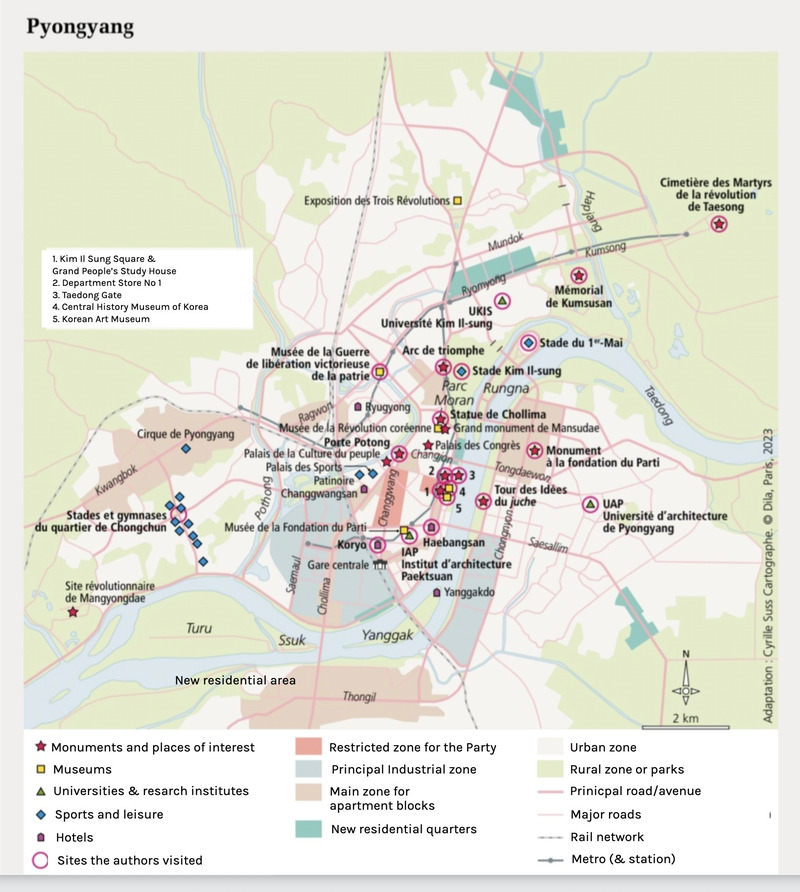
Pyongyang Map
1980s
In the 1980s, new neighbourhoods combining large apartment complexes and major urban facilities appeared on the east bank (around Munsu Street).
For the 13th World Festival of Youth and Students, massive development occurred in the western outskirts, with the construction of the sports village on Chungchon Street, and large-scale apartment complexes of Kwangbok Street.
Following the principle of Juche architecture and Kim Jong Il’s growing implication in urban planning in the 1980s, these phases were marked by monumentalism, to symbolise the progress of the North Korean socialist revolution (Chollima statue erected in 1961, Monument to the Juche Idea in 1982) or the cult of the leader attached to Kim Il Sung (monumental statue of Mansudae built in 1972).
The cityscape and skyline of Pyongyang are heavily influenced by socialist ideology (giant slogans on buildings, propaganda posters lining the wide avenues), which also permeates the lifestyles of a city largely maintained by its citizens, who are involved in community service projects.
1990s
Even in this capital city, home to the country's most privileged, the severe counter-development crisis that has engulfed the country in the mid-1990s can still be detected, in the state of its facilities (malfunctioning public transport, fragile health infrastructure that contributed to a long closure during the health crisis of 2020 to 2023).
The economic vulnerability of the country has also led to the proliferation of black markets across the country, the influx of many goods from abroad (mainly from China) and, more generally, the development of a hybrid, partially monetised system (approximately 30% of goods and services).
2000s
Since the early 2000s, reforms have led to the opening and legalisation of urban markets (Rangrang, Chunggu) and the intensification of trade with China.
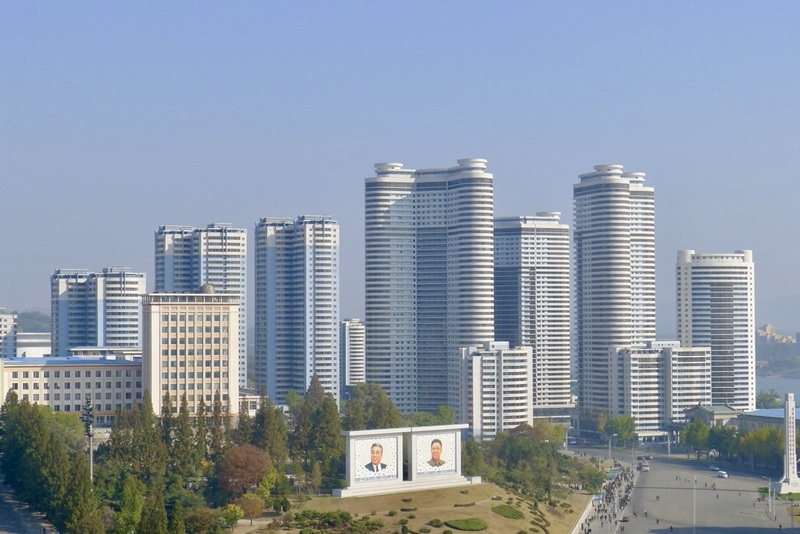
Changjon Avenue
Modern Day Pyongyang
2010s
The early 2010s marked a turning point in Pyongyang's urban history, with the construction of new residential neighbourhoods on Changjon Street (2012), Mirae 'Future Scientists' Street (2016) and Ryomyong Street (2017), and more recently, Songhwa Street (2022) and Hwasong Street (2023).
2020 onwards
These last two projects are part of an urban expansion campaign announced by Kim Jong Un in 2021, which involves the construction of 50,000 new homes in Pyongyang over the next five years. Some of the residential towers in these neighbourhoods are over 80 storeys high and have profoundly transformed the urban landscape.
The new architectural forms are inspired by major projects in Asian and Western cities, and these new homes offer larger living spaces, better water and electricity supplies, and modern amenities.
Recent research has shown the emergence of a housing market, which appeared during the crisis of the 1990s.
In 2023, an apartment in Pyongyang could sell for up to $100,000.
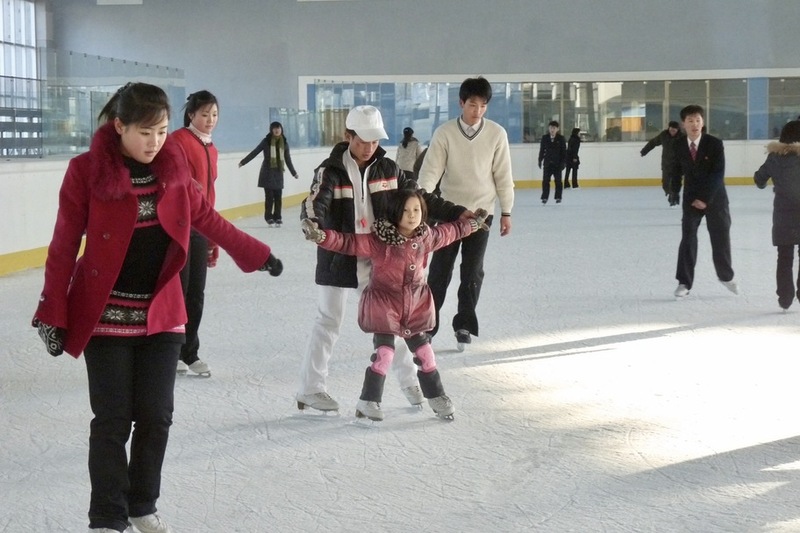
People's Open Air Ice Rink, Pyongyang
Alongside these residential projects, new cultural facilities have been developed, including leisure parks (Rungna and Munsu water parks, Rungna amusement parks, a dolphinarium, a natural history museum and an outdoor ice rink).
In addition to the development of these facilities, there has been a significant increase in the number of semi-private businesses (particularly restaurants), which are helping to meet growing demand for services.
Reflecting the profound social changes triggered by the crisis of the 1990s, the urban transformations of Pyongyang over the last ten years also express the new needs of its inhabitants in terms of comfort, social interaction and urban practices.
Further Readings
- Valérie Gelézeau, Benjamin Joinau, 2023, “Fieldwork in North Korea, a challenging but necessary scientific field”, part 1 & 2, 38 North, 12 & 13 October 2023, https://www.38north.org/2023/10/fieldwork-in-north-korea-a-challenging-but-necessary-scientific-field-part-1/ et https://www.38north.org/2023/10/fieldwork-in-north-korea-a-challenging-but-necessary-scientific-field-part-2/
- Valérie Gelézeau, Benjamin Joinau, 2022, « French Social Scientists on « Doing Fieldwork in North Korea », Positions-Asia Critique, Fall 2022, en ligne https://positionspolitics.org/french-social-scientists-on-doing-fieldwork-in-north-korea/
- Pavel Em, Peter Ward, « City profile: Is Pyongyang a post-socialist city? », Cities, Vol. 108, 2021. https://doi.org/10.1016/j.cities.2020.102950.
- Manon Prud’homme, “Enjoy Socialist Paradise: How New Leisure Parks Have Improved the Urban Sustainability of Pyongyang”, in Pavel Em (ed), Pursuing Sustainable Urban Development in North Korea, Routledge, 2024, p. 95-106.
Koryo Tours
Experts
in North Korea Travel
Since 1993
Share