Living in Mongolia, you get used to certain things not going quite to plan. Roads disappear, weather changes without warning, and during summer, rumours start circulating that petrol is about to become very difficult to find. Normally, we manage. This time, my daughter and I spent more than eight hours in a queue, ran out of fuel while waiting for fuel, and were rescued by a stranger with a rope. Here is what happened.
Living in Mongolia, you get used to certain things not always going quite to plan.
The weather can change without warning, roads can disappear and, particularly during the busy summer months, rumours start circulating that petrol is going to become difficult to find.
Normally, we manage.
I'd spent much of the summer doing my usual tour routes around Mongolia and there had already been rumours of another petrol shortage. This isn't particularly unusual at this time of year, and working in tourism you learn to prepare for it.
One of the ways I do that is with Petrovis fuel vouchers.
Petrovis is one of Mongolia's bigger petrol station networks. These little pieces of paper are issued to people and organisations who need to keep moving when fuel becomes scarce. When stations start running short, a certain amount of fuel is kept available for voucher holders.
Working in tourism and knowing how dependent we are on our vehicles, I'd made sure I had a good supply before heading out.
At the time, I thought I'd prepared rather well.
As it turned out, those little pieces of paper were going to become considerably more important than I'd expected.
Heading West
I left Ulaanbaatar on one of my usual routes, travelling towards Mongolia's far west and eventually staying with a local family high in the mountains.
Afterwards, I began the long journey back towards Ulaanbaatar with two passengers on what was essentially an independent adventure.
By then, I was starting to notice that fuel was becoming more of an issue.
Queues were appearing at petrol stations and occasionally we'd hear that somewhere had run out altogether.
It wasn't particularly alarming at first. Fuel queues aren't completely unusual in Mongolia, especially at this time of year, and my Petrovis vouchers were doing their job.
Sometimes I'd drop my passengers at a coffee shop while I joined a queue and waited for fuel. It wasn't ideal, but it worked.
We kept moving.
A Smile, a Wink and ₮100,000 of Petrol
At one small town, the petrol station was limiting everyone to ₮50,000 worth of fuel per vehicle.
My guide was Chingun, a good friend of mine and a young student here in Mongolia.
Looking at the queue and knowing how much further we had to drive, I jokingly told him:
"Give the woman pumping the petrol a smile and a wink. You're young and attractive, she might give us a little more fuel."
Our passengers joined in with the joke, particularly as Chingun was looking a little shy about the whole idea.
Eventually, we reached the pump and Chingun was about to start his flirting when the woman looked over at me, laughed and, in perfect English, said:
"I'll give you 100."
Everyone laughed, it turns out she spoke great English (a rarity in the countryside) and had heard us nattering in the car!
We got our ₮100,000 worth of petrol and carried on down the road.
At that point, the shortage was still something we could work around. An inconvenience, certainly, but nothing we hadn't dealt with before.
What I didn't realise was how much worse things were becoming behind us.
Back in Ulaanbaatar and 8 Hours' queue
By the time we returned to Ulaanbaatar, things had changed considerably.
I'd seen my passengers off and, for the first time in weeks, my concern wasn't about getting customers around Mongolia.
It was simply about living here.
I live in Ulaanbaatar with my family. We need the car for normal everyday life, and suddenly getting enough petrol into it had become a major event.
The first time I went looking for fuel, I queued for around four hours. The next time it was six.
On another visit, it was getting close to eight hours.
This clearly wasn't the normal seasonal shortage I'd thought I was dealing with when I'd left Ulaanbaatar.
We Knew It Might Get Worse
By this point, we'd also been watching what was happening outside Mongolia.
The news was full of reports of Ukrainian strikes on Russian oil refineries, storage facilities and other parts of the country's fuel infrastructure.
As the attacks increased and Russia's own fuel situation came under pressure, supplies to neighbouring countries became another concern.
So we had an inkling that things in Mongolia might get worse before they got better.
 It's easy to say:
"Well, just buy your petrol from somewhere else."
For Mongolia, that's considerably easier said than done.
We're a landlocked country sitting between two enormous neighbours, Russia and China.
There isn't a tanker arriving at a Mongolian seaport because Mongolia doesn't have one. Historically, we've relied very heavily on Russia for refined fuel, so when supplies from that direction are disrupted, the effects here can be felt very quickly.
And for local people, that's a serious problem.
Mongolia is enormous.
Outside Ulaanbaatar, families, businesses, herders and communities are spread across huge distances. Public transport can be limited and for many people a vehicle isn't a luxury.
It's how you get to work.
It's how you move goods.
It's how you get your family around.
It's how much of the country functions.
In a place like Mongolia, not having petrol isn't simply inconvenient.
Odds and Evens
Eventually, the situation became bad enough that restrictions were introduced based on vehicle registration numbers.
My car ends in an even number, which meant there were certain days when I simply couldn't go and buy fuel.
Meanwhile, our tank was getting lower...
A 200-Car queue
For a couple of days, I'd been driving around Ulaanbaatar and passing petrol stations during various errands. Every time I saw one, I looked at the queue.
And kept driving.
They were crazy.
Eventually, on a Monday morning, I decided there was no avoiding it.
I'd get up early, leave home and join a queue.
As I was quietly getting ready to go, my young daughter heard me.
"Can I come?"
I warned her that I could be a long time.
She didn't care. She wanted to get out of the house and said she'd be fine.
So we put on our baseball caps, quietly snuck out of the house together and headed for our preferred petrol station.
I actually have preferences for petrol queues now.
This particular station doesn't have too many side roads or turnings approaching it, which matters because when queues become this long, people inevitably try to push in from the side.
When we arrived, I was surprised.
The queue was already enormous.
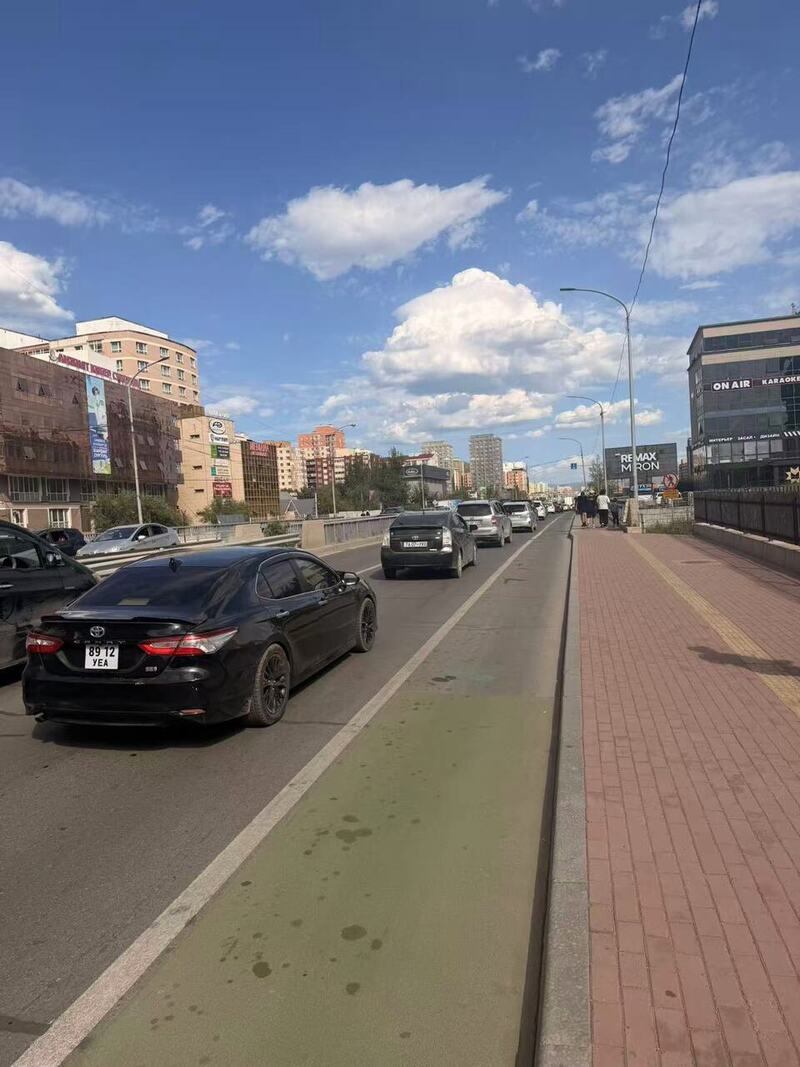
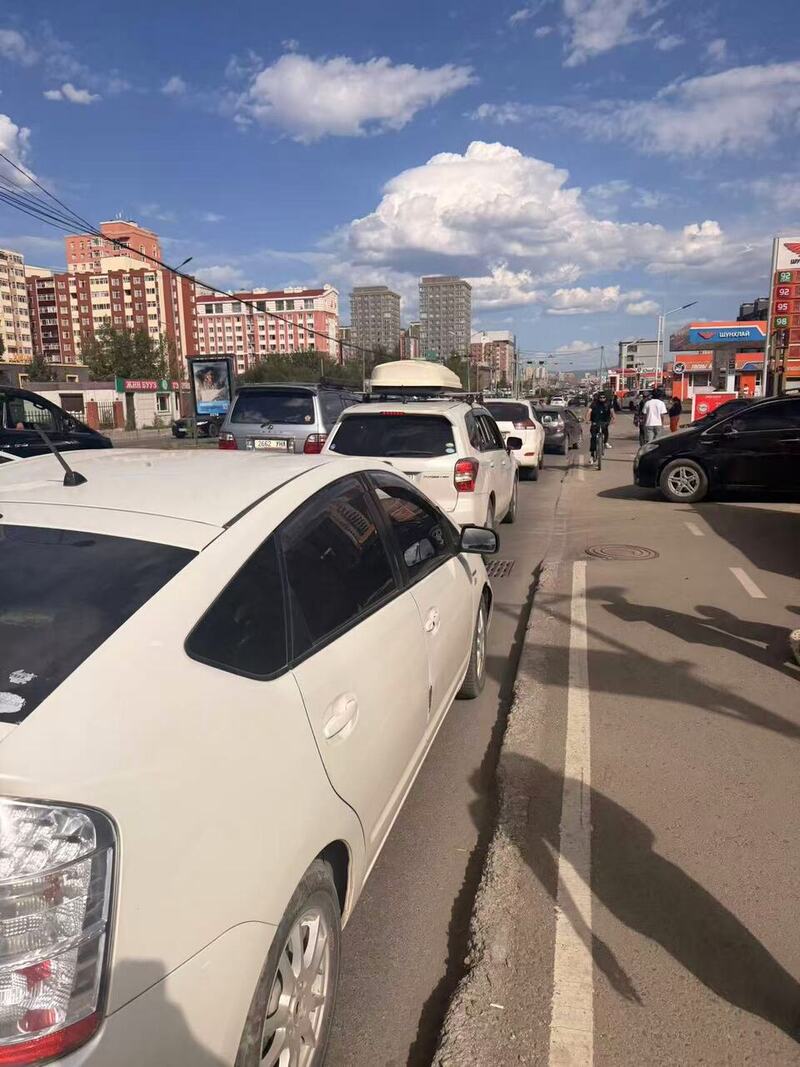
We joined it outside the Bayangol Hotel, where our tour groups normally stay, and looking down the road I guessed there must have been a couple of hundred cars ahead of us.
Still, we were in reasonably good spirits.
Music on.
Baseball caps on.
Father-and-daughter morning adventure.
We started rolling slowly forward.
At first, I thought perhaps it wouldn't be too bad.
Then the movement stopped.
And gradually I began to realise that we might be looking at another four-hour wait.
Or longer.
Does the Petrol Station Actually Have Petrol?
This sounds like a ridiculous question when you're sitting in a queue of hundreds of cars outside a petrol station.
But during a fuel shortage in Mongolia, it's an important one.
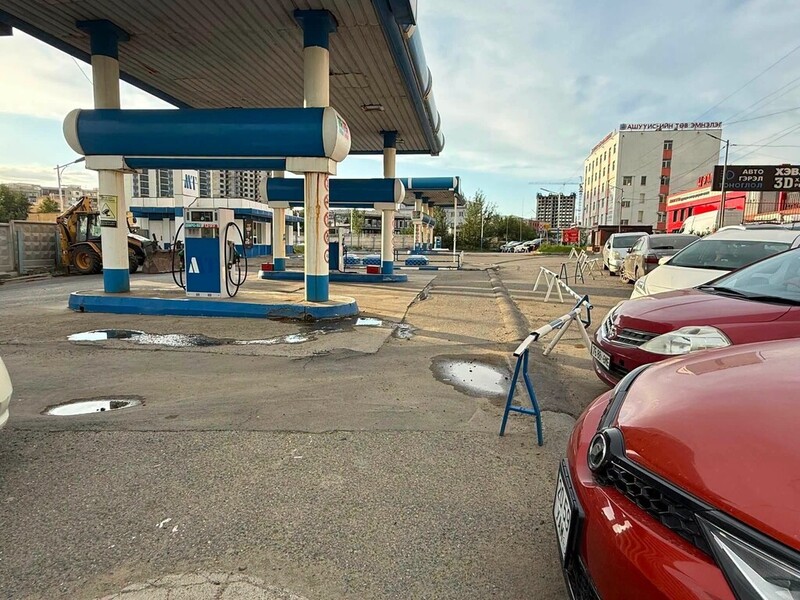
It's not uncommon for queues to form at stations that don't actually have fuel yet. People hear that a delivery is coming, cars begin arriving and suddenly you have hundreds of people waiting for petrol that may or may not appear.
A young guy in the car behind me eventually pulled out of the queue and drove towards the station.
A little while later, he returned and reclaimed his place behind us.
He'd gone ahead to check.
Did the petrol station actually have petrol?
It did.
That tiny piece of information immediately made sitting in the queue feel slightly better.
At least we were waiting for something.
Keeping Your Place
Every so often, the whole queue would suddenly roll forward.
When that happened, you had to be ready.
Leave too much of a gap, and there was always someone willing to nip into it.
After an hour or so, we'd made it onto the Peace Bridge.
There's probably some irony in what happened next.
A car suddenly pushed into the queue directly in front of me.
The guy ahead was, quite rightly, incensed. He got out, and an argument quickly started.
I joined the fray, as did another gentleman behind me, and thankfully, the couple who'd decided to take their chances eventually gave up and drove away.
The guy in front was particularly angry because he'd looked at their fuel gauge.
They had over half a tank!
He had quite a lot more to say about that in Mongolian, but I think I'll leave that part out of the blog.
And so we continued.
Move a few metres.
Stop.
Wait.
Move again.
Pizza, Fizzy Drinks, and a Very Long Queue
After another couple of hours, we'd finally reached a group of shops and, importantly, a coffee shop.
My daughter took my bank card and ran inside.
She returned with a slice of pizza for me, a brightly coloured fizzy drink for herself, the sort of drink we'd normally forbid, and a bottle of water for the driver in front of us.
At this point, I felt normal parenting rules could probably be relaxed.
We ate, drank, and continued slowly rolling forward.
Eventually, the queue took us around a sharp corner.
And then it happened.
The car gurgled.
Spluttered.
And stopped.
Only the second time in my life I'd managed it.
We had run out of petrol.
While queuing for petrol.
Start Pushing
There wasn't really much time to appreciate the ridiculousness of the situation because, of course, the queue started moving again.
So my daughter climbed into the passenger seat and helped steer while I started pushing.
With the engine off, there was no power steering, so even that wasn't particularly easy.
We developed a routine.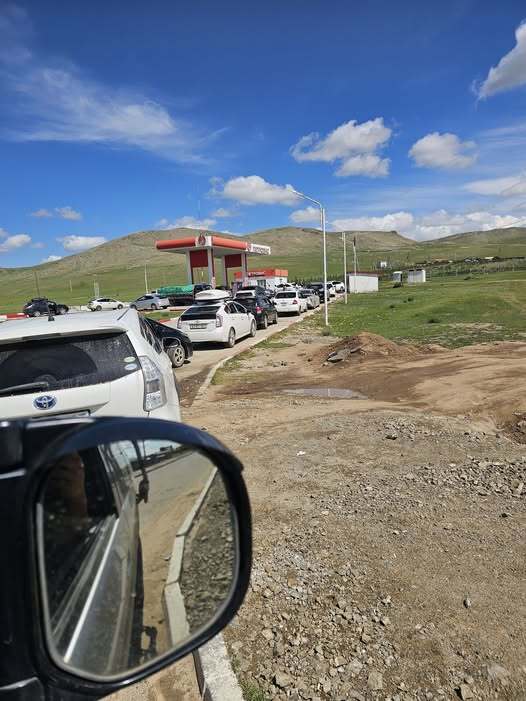
Sit for ten minutes.
The queue moves.
Push for two or five minutes.
Stop.
Wait.
Then push again.
Occasionally, when nothing was moving, my daughter would cross the road and play in a nearby park. As soon as the cars started moving again she'd come running back, jump into the car and we'd start our little pushing operation all over again.
We did this for about an hour.
Then we got lucky.
The driver in front finally realised what was happening.
He stopped and came back to help. Several other people around us joined in, and the driver behind produced a rope.
Within a few minutes, they'd connected our car to the vehicle in front.
We were mobile again.
Not under our own power, admittedly.
But at this point, I wasn't going to be fussy.
Coca-Cola for the Rescue Team
Eventually, after hours of creeping through Ulaanbaatar, we could actually see the petrol station getting closer.
As we rolled towards the pumps, my daughter disappeared into another nearby shop to buy some more drinks.
This time, she came back carrying Coca-Cola for the drivers who had helped us.
It was a small gesture, but I liked that she'd thought of it herself.
These guys didn't know us.
They'd been sitting in exactly the same ridiculous queue for hours. They were tired, probably worried about their own fuel, and presumably wanted to get home just as much as we did.
But when they saw somebody needed help, they helped.
No drama.
Someone had a rope.
Someone had a car that still had petrol.
Problem solved.
And finally, after more than eight hours, we reached the pump.
I filled the tank.
Completely.
I don't think I've ever been quite so pleased to watch the numbers climbing on a petrol pump.
Bringing Home the Petrol
Then my daughter and I drove home.
We'd left the house early that morning in our baseball caps, thinking we were going on a slightly inconvenient father-and-daughter mission to buy petrol.
More than eight hours later, we'd listened to music, eaten pizza, consumed things we probably shouldn't have, argued with queue jumpers, run completely out of fuel, pushed the car through Ulaanbaatar, been rescued by complete strangers and eventually secured the prize.
A full tank of petrol.
Driving home, I felt strangely triumphant.
Rather like some ancient caveman returning to his family after a successful hunt.
Except instead of dragging a woolly mammoth behind me, I had a full tank of AI-92.
There's a serious side to all of this, of course.
For people outside Mongolia, a petrol shortage might sound like an inconvenience. When you actually live here, you realise how quickly it affects everything.
And for those of us working in tourism, there's another side that our passengers hopefully rarely see.
They see Mongolia's mountains, deserts, empty roads, ger camps, local families and enormous landscapes.
Behind the scenes, there are drivers, guides, and operators watching fuel gauges, phoning the next town, checking which petrol station has fuel and sometimes relying on a little piece of paper from Petrovis to keep everything moving.
That's our job.
The passengers shouldn't have to worry about it.
But once the tour is over, we still live here.
And I'm fairly certain my daughter will remember the day she came petrol hunting with Dad for quite a while.
Living in Mongolia can be like that sometimes.
Koryo Tours
Group Tours to Mongolia
Share
Rich Beal
Rich Beal is our International Tours Manager.
Rich is one of our most experienced tour leaders. He has led tours worldwide since 2004, specialising in Mongolia, Tajikistan, Turkmenistan, and the surrounding area. Currently living in Mongolia, he leads multiple specialised trips annually and has over 20 years of experience running and designing tours of the region.