How a grand old hotel at the foot of the Great Pyramid ended up playing a part in the modern history of the Korean Peninsula, and why it is worth a detour if you're travelling in Cairo.
When people think about the places that helped shape the modern history of the Korean Peninsula, names like Panmunjom, the 38th parallel, DMZ, or perhaps a government building somewhere in Seoul or Pyongyang always come up.
But have you ever thought that a historic hotel at the foot of the Great Pyramid of Giza could have played just as important a part in the history of the Korean Peninsula?
That's the Mena House in Cairo (well, in Giza, to be exact).
In November 1943, the Mena House hosted an international meeting that produced one of the most important sentences ever written about Korea's future, and one that Koreans on both sides of the border still learn about today.
The Mena House - A Very Significant Hotel of Egypt
The 1943 Cairo Conference
What Did the Cairo Declaration Say?
Specifically, what Did It Say About Korea?
Why It Still Matters in Korea
The China and Taiwan Controversy
Visiting the Mena House Today
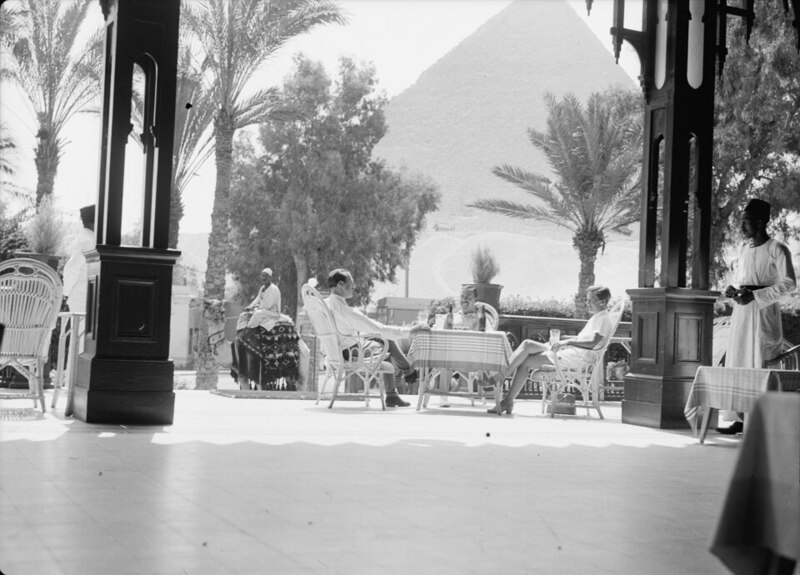
Mena House in the 1940s
The Mena House - A Very Significant Hotel in Egypt
The Mena House history can be traced back to the 1860s, when it was first built as a hunting lodge for the Khedive of Egypt.
An English couple bought the lodge in the 1880s, added a second floor and named it after Menes (the pharaoh credited with first uniting Egypt). It was turned into a hotel not long after.
Over the next 140 years, it became one of the most prestigious places to stay in Egypt. It hosted famous guests visiting the pyramids next door, from Arthur Conan Doyle and Agatha Christie to Charlie Chaplin, assorted royals and a few heads of state.
During the First World War, the hotel was used as a base and later as a hospital by Australian troops. Imagine being one of those soldiers, waking up each morning next to the only surviving wonder of the ancient world!
But in an already impressive history, its most significant moment came in November 1943.
The 1943 Cairo Conference
Between 22 and 26 November 1943, the "Three Great Allies", represented by Franklin D. Roosevelt of the United States, Winston Churchill of the United Kingdom and Chiang Kai-shek of the Republic of China (which is a complicated matter in today's world, more on that below!), met in Cairo to discuss how the war against Japan should be fought and what Asia would look like once the war was over.
The Mena House (and its surrounding villas) served as the headquarters of the Cairo Conference, housing some 1,500 delegates, staff and military chiefs of staff. The three Great Allies leaders themselves stayed in nearby residences.
It is worth noting that the Soviet Union was not yet at war with Japan at this point, so Stalin stayed away to avoid sitting down with Chiang Kai-shek (another history tale for later). He did, however, meet Roosevelt and Churchill in Tehran straight afterwards and gave the whole thing his blessing.
The outcome of this meeting was a short statement released to the world by radio on 1 December 1943, known as the Cairo Declaration.
A fun fact: although it is often described as having been "signed" at the Mena House, the declaration was actually a joint statement, and nobody put pen to paper in the traditional signing way.
What Did the Cairo Declaration Say?
The key part of the declaration reads -
The several military missions have agreed upon future military operations against Japan. The Three Great Allies expressed their resolve to bring unrelenting pressure against their brutal enemies by sea, land, and air. This pressure is already rising.
The Three Great Allies are fighting this war to restrain and punish the aggression of Japan. They covet no gain for themselves and have no thought of territorial expansion. It is their purpose that Japan shall be stripped of all the islands in the Pacific which she has seized or occupied since the beginning of the First World War in 1914, and that all the territories Japan has stolen from the Chinese, such as Manchuria, Formosa, and The Pescadores, shall be restored to the Republic of China. Japan will also be expelled from all other territories which it has taken by violence and greed. The aforesaid three great powers, mindful of the enslavement of the people of Korea, are determined that in due course Korea shall become free and independent.
With these objects in view, the three Allies, in harmony with those of the United Nations at war with Japan, will continue to persevere in the serious and prolonged operations necessary to procure the unconditional surrender of Japan.
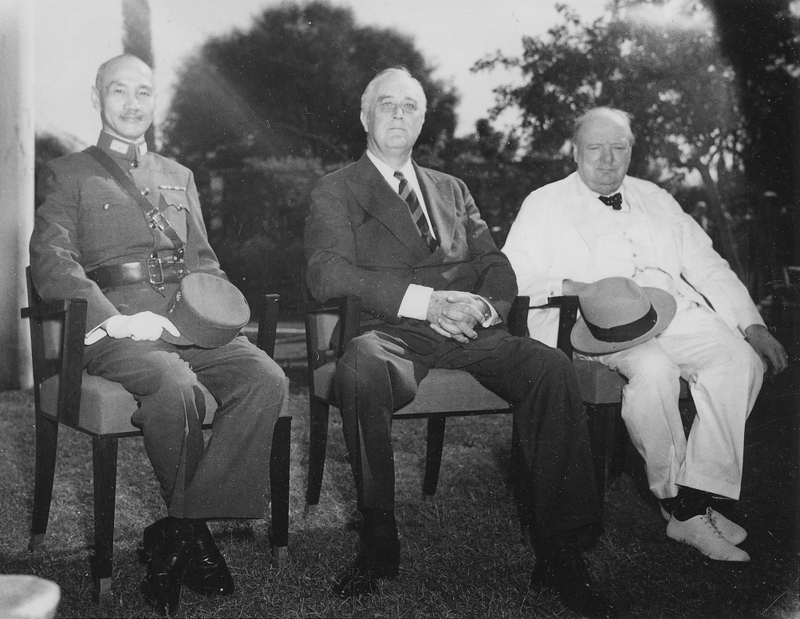
Chiang Kai-shek, Franklin D. Roosevelt, and Winston Churchill, 1943
What Did It Say About Korea?
Most of the Cairo Declaration deals with the war against Japan and what would happen with its seized territories. Manchuria, Formosa (Taiwan) and the Pescadores (Penghu Islands) to be returned to China, and Japan to be stripped of its Pacific islands.
And Korea gets just a single sentence, but it is a sentence that mattered enormously.
To give you some Korean context. In 1943, Korea was still under the harsh Japanese colonial rule that began in 1910. There was no division of the peninsula and no North or South Korea, and Pyongyang and Seoul were simply two Korean cities under the same oppressive rule of the Japanese Empire. Read more on the Japanese Rule over Korea - A Liberation Day of Korean History.
In the Cairo Declaration, the three powers declared that, mindful of the enslavement of the people of Korea, they were determined that "in due course Korea shall become free and independent."
This was the first time the major Allied powers had publicly committed themselves to Korean independence, after more than three decades of Japanese colonial rule.
Korea's Provisional Government KPG, which was based in exile in Chongqing at the time (the same as the Chinese Nationalist Government - Republic of China), had been lobbying Chiang Kai-shek to raise the issue, which essentially what got Korea into the text.
However, those three little words, "in due course", could be read as a hint that Korea would not be handed its independence straight away but would instead be placed under some form of international trusteeship first, and that is exactly where the next problem began.
When Japan surrendered in August 1945, instead of granting Korea its own independence as a whole, the United States and the Soviet Union divided Korea at the 38th parallel into two occupation zones, with the Soviets in the north and the Americans in the south. Later that year, the Allies agreed to place Korea under a trusteeship of up to five years, a plan that was fiercely opposed by many Koreans who had waited decades for their independence.
The two sides never managed to agree on a single Korean government, and in 1948 two separate states were founded. The Republic of Korea in the south and the Democratic People's Republic of Korea in the north.
The Korean War that broke out in 1950 then set that division in stone, which meant that "in due course" turned out very differently from what anyone in Cairo had pictured.
Why It Still Matters in Korea
For Koreans, the Cairo Declaration is a standard part of history lessons about the road to liberation in 1945, a rare example of history which both sides of the border agree to acknowledge.
The Mena House is a small but significant place in the Korean national story, which is why many Korean visitors to Egypt visit the site.
To this date, you can find historical photographs of the conference on display, and legacy names such as Winston Churchill Suite and Field Marshal Montgomery Suite have become the permanent rooms in the hotel.
The People's Republic of China and Republic of China (Taiwan) Controversy
As I mentioned above, Chiang Kai-shek's place at this very important conference has also become part of the complicated relationship between China and Taiwan today, although that issue deserves an in-depth blog post of its own some other time.
To give it some proper context, in 1943 Chiang led the Republic of China from its wartime capital in Chongqing, while Taiwan (then known as Formosa) had been a Japanese colony since 1895.
After losing the Chinese Civil War in 1949, Chiang and his government retreated to Taiwan, and Mao Zedong's Communist Party founded the People's Republic of China in Beijing.
Beijing points to the line about Formosa being "restored to the Republic of China" as proof that Taiwan belongs to China, with the People's Republic seeing itself as the rightful successor to that promise.
Taipei, on the other hand, can point out that it was Chiang's Republic of China that was named in the declaration, not the People's Republic of China, which did not even exist until six years later.
To make things even more complicated, in the 1951 San Francisco Peace Treaty Japan gave up its claim to Taiwan without saying to whom, which has left the question open to interpretation by both sides ever since.
In May 2026, Beijing unveiled a monument to the Cairo Declaration in the hotel grounds, with its message firmly focused on Taiwan, so don't be surprised if Korea is not quite the headline when you find it!
Visiting the Mena House Today
The Mena House is now run by Marriott International, and is still one of the most popular hotels to stay while visiting Cairo.
Only a few hotels anywhere in the world can offer a view of the Great Pyramid from the breakfast table while sipping your morning coffee!
Even if you are not staying there, stop by for a drink or a meal after a morning stroll at the pyramids, and think about that important week in 1943.
For those of us who spend a lot of our time travelling in and around the Korean Peninsula, the Mena House is a must visit site for the Korean history.
So if you are heading to Egypt, add Mena House to your list, and if you're really interested in the Korean history, you know where to find us!
Koryo Tours
Group Tours to Egypt
Share
Halef Gunawan
Halef is Social Media and Marketing Specialist at Koryo Tours
Born and raised in Indonesia, he moved to the U.S. for college and later pursued full-time travel in 2019. Stranded in Sabah, Malaysia, during COVID, he and his partner, along with their German Shepherd, Kana, embraced van life and have been exploring North America since 2020.
📷 Instagram | 🇮🇩 Instagram (Bahasa Indonesia)
My First Koryo Tours Adventure in Syria During Ramadan (and the Iran War)