Arrive in Timor-Leste and you will see 'Fretilin' everywhere. Here is what it is, what it did, and why understanding it makes a visit to Timor-Leste considerably richer.
When you arrive in Timor-Leste, you're bound to see this name everywhere in the country - on murals, in museum exhibits, in conversations about Timor-Leste's resistance.
Fretilin.
It's one of those names that comes up constantly on the ground but rarely gets explained anywhere before you arrive.
So, do you know what Fretilin is? Why is it so important in Timor-Leste's history?
Who Is "The Fretilin"?
A Quick History and Timeline of Fretilin
Fretilin Through Indonesia's Perspective
Fretilin in Timor-Leste National Leadership
Where to See Fretilin's History Today
Why Fretilin Matters for Visiting East Timor
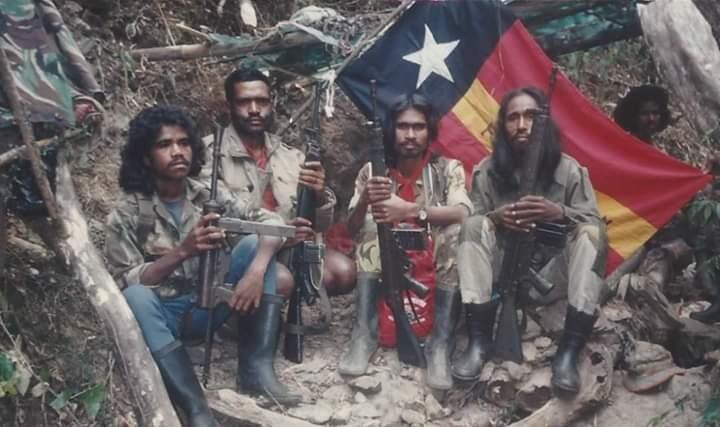
Fretilin Group
Who Is "The Fretilin"?
Fretilin stands for Frente Revolucionária de Timor-Leste Independente (a Portuguese acnomym), the Revolutionary Front for an Independent East Timor.
Fretilin began in 1974 as a political party, formed to push for Timor-Leste's independence from Portugal at a time when decolonization was sweeping across Portugal's overseas territories.
History had other plans for it, though, and the party was soon transformed into an armed resistance movement, fighting through its guerrilla wing, Falintil, against the Indonesian occupation that followed.
Fretilin has stayed a central part of the country's story ever since, one of the names most closely tied to Timor-Leste's long road to independence.
Its goal throughout remained the same: guiding Timor-Leste toward becoming a sovereign, independent nation.
A Quick History and Timeline of Fretilin
In April 1974, a military coup known as the Carnation Revolution (in Portuguese: Revolução dos Cravos) took place in Portugal, overthrowing the Estado Novo regime and ending the Portuguese Colonial War.
It affected all of Portugal's overseas colonies, including Angola, Guinea-Bissau, and Mozambique, as well as Timor-Leste.
A month later, on 20 May 1974, a group of young Timorese intellectuals formed the Timorese Social Democratic Association (ASDT), which was renamed Fretilin that September. It was originally created as a political party.
Portugal's sudden retreat in 1974 and 1975 left Timor in a rushed and chaotic transition, and Fretilin unilaterally declared the independence of the Democratic Republic of East Timor (in Portuguese: República Democrática de Timor-Leste) on 28 November 1975, with do Amaral as president and Lobato as prime minister.
That independence lasted nine days.
Indonesian forces invaded on 7 December 1975, took control of the territory, and declared it Indonesia's 27th province: Provinsi Timor Timur.
For the next 24 years, Fretilin, alongside its armed wing Falintil, served as the backbone of Timorese resistance to the Indonesian occupation, operating from the mountains and holding the independence movement together.
In December 1978, Indonesian troops killed one of Fretilin's founding fathers, Nicolau Lobato, another name you'll see often throughout the country.
The 1999 referendum finally ended Indonesian rule, and Fretilin transitioned from armed resistance back into a conventional political party.
In August 2001, ahead of formal independence, Fretilin won a strong majority in elections to the newly formed Constituent Assembly, taking 55 of 88 seats. Timor-Leste officially gained its independence on 20 May 2002.
Since then, Fretilin has moved in and out of government, generally trading places with its main rival, the CNRT (National Congress for Timorese Reconstruction), founded by fellow independence figure Xanana Gusmão.
As of the most recent elections in 2023, Fretilin sits in opposition, holding 19 of 65 seats in the National Parliament, with CNRT in government under Gusmão as prime minister.
Fretilin Through Indonesia's Perspective
Indonesia never used the modern legal category of "terrorist organisation" to label Fretilin. Instead, the Indonesian government and military (ABRI) officially labelled Fretilin and its guerrilla fighters as GPK (short for Gerombolan Pengacau Keamanan) or "Security Disturbance Gang" (sometimes translated as "security disruptor gang" or "security intruder movement/group").
It was a standard Suharto-era label, used specifically for armed separatist and resistance movements Jakarta didn't recognise as legitimate political actors, including the Free Papua Movement (OPM) in West Papua.
It wasn't unique to Timor, it was the government's general framework for delegitimising resistance movements by casting them as criminal gangs rather than political or military opponents.
A very smart move by the Indonesian government.
In practice, framing Fretilin as a criminal gang rather than a political or military force also helped Indonesia's image internationally, feeding into the broader dispute over whether the conflict constituted a war of occupation or an internal security matter.
The UN never recognised Indonesia's annexation of Timor-Leste.
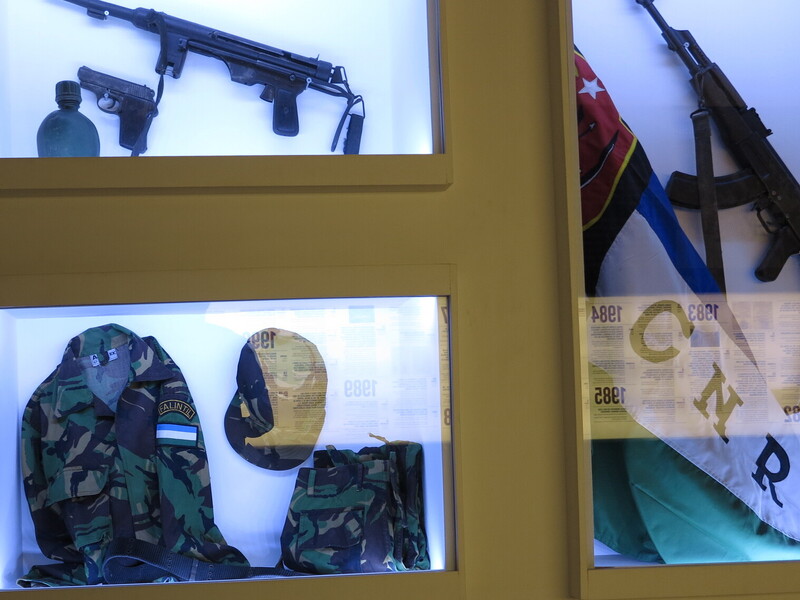
Falintil Uniform, The Resistência Timorense Arquivo e Museu (Resistance Museum) collection
Fretilin in Timor-Leste National Leadership
Several of Fretilin's founding generation went on to lead the country they'd fought for -
- Francisco Xavier do Amaral served as the first President of Timor-Leste and Nicolau Lobato served as the first Prime Minister when the country declared independence on November 28, 1975. The Indonesian troops killed Nicolau Lobato in 1978.
- Xanana Gusmão, who commanded Falintil through much of the 1980s and 90s, later served as Timor-Leste's first president in 2002 and, twice, as prime minister, including today.
- José Ramos-Horta, one of Fretilin's original founders, became president and shares the 1996 Nobel Peace Prize with Bishop Carlos Belo for his advocacy toward a peaceful resolution.
- Mari Alkatiri, also a founder, later served as prime minister too.
It's a big part of why so many street names, monuments, and public figures across Timor-Leste trace directly back to this one founding group.
Where to See Fretilin's History Today
A handful of sites in and around Dili honour Fretilin's history -
The Resistência Timorense Arquivo e Museu (Resistance Museum)
With weapons, communications equipment, and a life-size replica of a resistance leader's mountain shelter.
The Chega! Exhibition
Housed in a former Portuguese-era prison used to hold resistance figures during the occupation.
The Garden of Heroes at Metinaro
Where memorial ceremonies are still held every 20 August, FALINTIL Day.
The Dare Memorial Museum
Just outside Dili the capital.
The Xanana Gusmão Reading Room
This also displays memorabilia from his years leading the resistance.
Why Fretilin Matters for Visiting East Timor
Fretilin is not just a political party in Timor-Leste, it is the story of how the country came to exist at all.
Understanding Fretilin's story helps visitors engage with a richer, more meaningful experience of Timor-Leste.
Koryo Tours
Group Tours to Timor-Leste
Share