Every year on 15 April, North Korea marks its most important national holiday, the birthday of founding leader Kim Il Sung. It offers a rare and unscripted window into everyday North Korean life, celebrating the Day of the Sun holiday.
15th April marks the anniversary of the birth of Kim Il Sung, the founding leader of North Korea (Democratic People’s Republic of Korea).
This is a guide to Kim Il Sung's Birthday, one of the biggest holiday celebrations in North Korea. Previously known as 'The Day of the Sun' throughout North Korea.
Kim Il Sung Historical Background
Kim Il Sung Birthday Throughout the Years
Day of the Sun & Juche Calendar
What Happens in Pyongyang on North Korea’s Biggest Holiday?
Read more on Day of the Sun - Kim Il Sung's Birthday Travel Guide
Kim Il Sung Historical Background
Kim Il Sung was born during the Japanese colonial rule of Korea on 15 April 1912.
He was born as Kim Song Ju in the village of Mangyongdae on the outskirts of Pyongyang to a family of tenant farmers, and, according to North Korean historiography, a long line of anti-imperialist revolutionaries.
The name Kim Il Sung
The name Kim Il Sung was adopted in the 1930s as a nom de guerre meaning “to become the sun”.
The house, or its replica, where he was born, known as Mangyongdae Native House, is open for visitors and stands at the location of the former village.
True to the meaning of its name, ‘Ten Thousand Scenery Hill’, it is in a serene and beautiful environment near the Taedong River.
Kim Il Sung Birthday Throughout the Years
A few sources claim that on his 50th birthday, Kim Il Sung referred to his birthday as the “April 15 Holiday”.
It became a provisional holiday that year, and an official one in 1968.
60th Anniversary
The Mansudae Grand Monument, the bronze statue of Kim Il Sung in Pyongyang on Mansu Hill, was erected in 1972 for the 60th anniversary of the birth of Kim Il Sung.
This was the year when the April 15 Holiday became the nation’s most significant holiday.
70th Anniversary
The April 15 Holiday in 1982 that marked the 70th anniversary of Kim Il Sung’s birthday was celebrated with the building of a few new monuments in Pyongyang.
This includes the Juche Tower, made up of 25,550 granite blocks, each symbolising a day of Kim Il Sung’s life leading up to his 70th birthday.
The Arch of Triumph was also completed for this event and erected next to where he held his first speech in Pyongyang upon return after liberation in 1945.
The Grand People’s Study House too was completed for this occasion.
100th Anniversary
The 100th anniversary celebrations in 2012 saw such an influx of foreign visitors that some of the tour groups had to be accommodated outside Pyongyang.
This is how Koryo Tours’ groups ended up staying at the Jangsusan Hotel in Pyongsong that prompted the opening of Korea’s sci-tech center to foreign visitors, a popular one-night trip on many of our tours since then.
Pyongyang Marathon-relation
For decades, the Pyongyang Marathon was officially known as the Mangyongdae Prize International Marathon. This used the name of the sacred birthplace to identify this event clearly with the anniversary of Kim Il Sung’s birth.
Since 2025, the race has used the new name Pyongyang International Marathon.
Day of the Sun and the Juche Calendar
1994
Kim Il Sung died on 8 July 1994 and his passing was followed by a 3-year mourning period that concluded with a few changes in 1997.
North Korea introduced the so-called Juche calendar, designating 1912 as Year 1 (주체1).
1997
It was not until 8 October 1997 that Kim Jong Il nominally, and officially, became the head of the Workers’ Party of Korea, assuming the title of General Secretary.
The first immortality tower (a stone monument bearing the legend ‘The Great Leader Kim Il Sung will always be with us’) was erected in Pyongyang at the entrance of Kumsong Street leading up to the Kumsusan Palace of the Sun. This was followed by thousands of others that can be found all over the country and in every village.
1998
Just after the conclusion of the mourning period, in 1998 Kim Il Sung was named as the Eternal President of the DPRK in the constitution.
2024
In 2024, North Korea phased out the use of the Juche calendar and has been exclusively using the Gregorian calendar.
The official name of the day of the birth of Kim Il Sung, “The Day of the Sun” (대양철), was also phased out in 2024, although never officially abandoned.
What Happens in Pyongyang on North Korea’s Biggest Holiday?
15 April is a day off for Koreans and many of them will go out to celebrate.
Celebrate with Families
Many will head to municipal parks for a picnic with their family or neighbourhood/work unit. These outings will usually include barbecue, karaoke, and a seemingly unlimited flow of soju and beer.
Those who end up celebrating with their colleagues will often have volleyball tournaments either between different departments within the company or between companies.
Funfairs and waterparks (there are a few in Pyongyang) are also a popular destination on national holidays, and 15 April is no exception.
Places to visit
Those who celebrate within more formalised circumstances will visit sites of importance such as the Mansudae Grand Monument (to lay flowers and pay respects), the Mangyongdae Native House, or even the Kumsusan Palace of the Sun – the mausoleum where Kim Il Sung and Kim Jong Il lie in state.
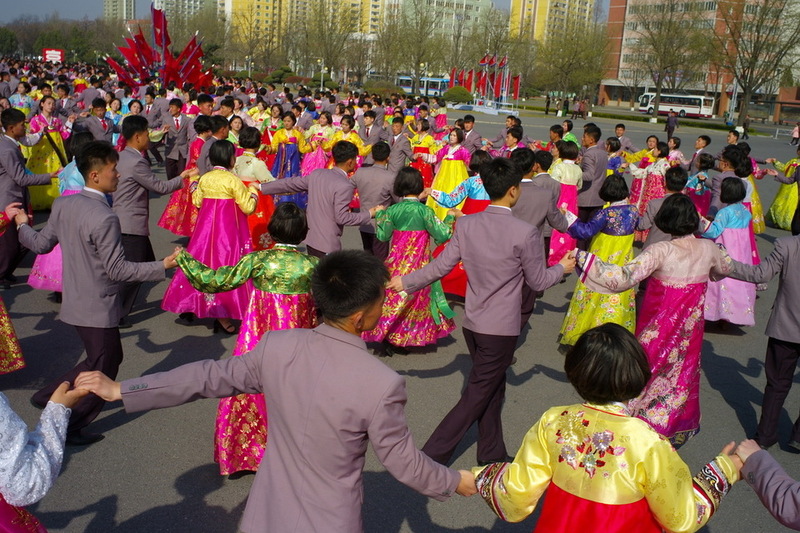
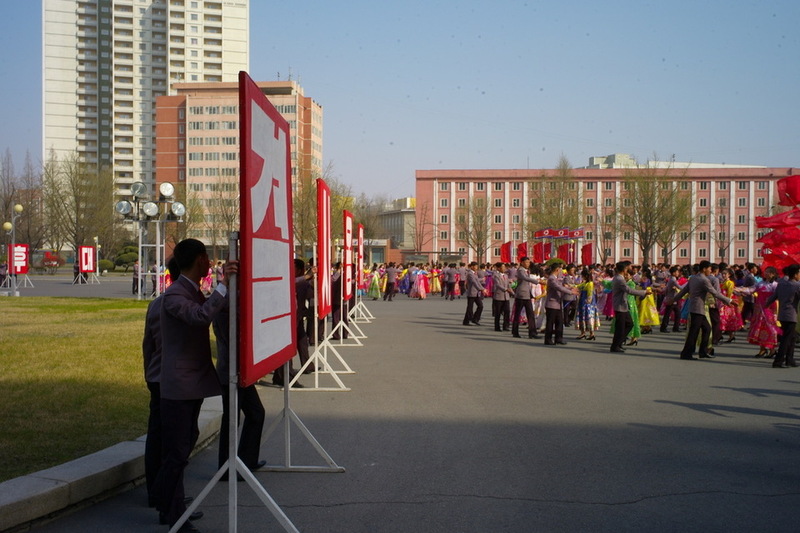
In the afternoon, students and members of the Socialist Women’s Union will organise mass dances on the major squares of Pyongyang.
These mass dances have always been a highlight for our tours visiting Pyongyang on 15 April.
Kimilsungia Flower Festival
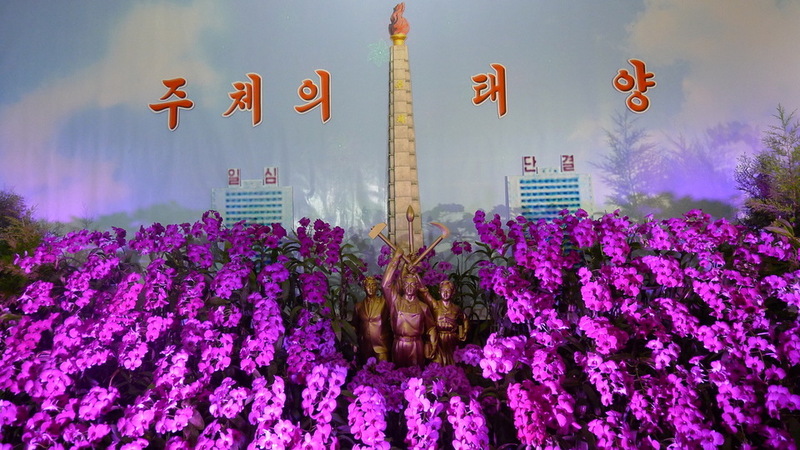
There are certain festivals that are usually held around the Spring Holiday in April, namely the Kimilsungia Flower Festival and the biannual April Spring Friendship Art Festival.
Kimilsungia is an orchid that was presented by Indonesian President Sukarno to Kim Il Sung in 1965.
Indonesia and North Korea Connection - The Unlikely Friendship?
At the Flower Festival that takes place at the Okryu Exhibition Hall several flower installations are on display, often presented by companies, and these installations are either representative of their trade (such as an exhibit featuring a tour bus for a travel company) or are a model of the Mangyongdae Native House.
April Spring Friendship Art Festival
The April Spring Friendship Art Festival returned in 2024 and is being held as of the writing this blog in April 2026.
Traditionally, “friendly nations” such as China, Russia, Mongolia, Cuba, and Southeast Asian countries send art troupes to perform at the festival.
Decadal or semi-decadal anniversaries might see military (the last one hold on 15 April was in 2017) or civilian (last one in 2022) parades.
The day usually concludes with a fireworks display on the Taedong River with the Juche Tower in the background.
Koryo Tours
Experts
in North Korea Travel
Since 1993
Share
Gergo Vaczi
Greg is the Koryo Tours DPRK Tour Manager.
He grew up in post-socialist Hungary and first travelled to North Korea as a tourist in 2016 following in the footsteps of his grandparents, who visited in 1988. He has since lived in the Netherlands, Israel, China, Korea and Iceland and holds a degree in Sociology and Anthropology. He has taken 26 groups to North Korea and lived in Seoul studying the Korean language full-time for two years. He also completed a long study course in Korean at a university in Pyongyang.
Read more about Greg's journey to become a North Korean Tour Leader here.