Thinking about visiting Socotra? Start here to understand this beautiful, remote island off mainland Yemen.
When they say Socotra is one of the most unique destinations in the world, they’re not exaggerating. After travelling to over 100 countries, with a focus on the more complex and unusual destinations, Socotra is without a doubt one of the most fabulous places I’ve ever been to.
Certainly a reason why I’ve been back over 5 times and have no plans to stop visiting Socotra.
However, travelling to Socotra is not a casual trip. And shouldn’t be seen as such. You are travelling to Yemen, technically, after all.
Sure, it is miles apart both literally and metaphorically from mainland Yemen, and the conflict that has plagued it for the last couple of decades. But there are some important considerations to be aware of before you plan your trip to Socotra.
The flights to Socotra are expensive. Its remoteness makes getting to Socotra difficult. Plus, you have to spend a whole week sleeping in tents.
So, is travelling to Socotra really worth it?
Absolutely yes. A thousand times yes. If you love beautiful landscapes, incredible people, and a raw travel experience - there’s hardly anything else that will compete with Socotra.
But raw it is.
If you’re contemplating a trip to Socotra and want to prepare in advance and know fully what you’re getting yourself into from someone who’s actually been there several times, this is the place for you.
What is a Tour in Socotra Really Like?
Camping & Hotels in Socotra
Socotri People
Government in Socotra
Is Socotra Really Safe?
Choosing a Tour in Socotra
Impact of Tourism in Socotra
Final Thoughts
What is a Tour in Socotra Really Like?
Over the years, travelling in Socotra has changed a lot.
When I first visited in 2023, there were flights only once a week, there was no internet for the whole week and the only way to charge your phone was during long drives with a USB cable plugged into the car. Before visiting Socotra, you had to prepare at least one or two power banks. Toilet roll. And let family and friends know you’d be offline for the week.
Now, things are completely different.
What has stayed a constant, however, is that you will generally drive with a team of several 4WDs which has your fellow travellers (3 per car), as well as a team of chefs, all of the camping equipment, and at least one local English speaking guide.
Internet in Socotra
A lot of companies travel with Starlink, giving you fast and strong internet for almost your entire time. Not just at campsites but also whilst driving (depending on if it’s your car that has the Starlink in it or not).
You may also find some campsites have their own WiFi (which you have to pay for).
Electricity in Socotra
Companies may also travel with generators to which they attach extension lead upon extension lead, meaning not just your phone - but also your camera, your drone, and your laptop can all stay charged.
Toilets and Showers in Socotra
Previously, Socotra was an entirely untouched destination. There were absolutely no toilets or showers on the whole island. Of course, this resulted in a lot of rubbish and litter being thrown around - all of which the tour guides had to clean up during the off-season during the summer months.
Now, this is a different story - the toilets at least, not necessarily the litter… Most campsites have showers and toilet facilities - but they are generally very basic. Depending on the campsite, the shower and toilet facilities may be a small brick structure with or without a door and limited running water. The running water also depends on how much rain there has been or how many people have used it recently. So, remember to use water sparingly.
When driving between locations, there are no toilet facilities. So, it is as nature calls!
Some companies travel with a portable toilet and shower for when these facilities aren’t available on-site. This is typical camping gear and very basic - basically a plastic toilet in a tent and a simple shower spray.
It’s a good idea to travel with baby wipes and presume that you won’t get to shower so much.
Driving and other practicalities
A Socotra tour usually involves a lot of driving as you make your way around the island. Some of the roads are very good especially near and around Hadibo. But most are pretty rough and some leave the concept of ‘road’ much to the imagination. A 4WD is an absolute necessity to get around the island.
And if you feel nervous driving on some more… complex terrain, it might be a good idea not to look outside the window sometimes…
Of course, things can change. Generators can break down, the Starlink might stop working, and the zip on the portable shower may have rusted.
So, in reality, it’s a good idea to prepare yourself for the original Socotra experience. Little to no internet, power banks, and no toilet or shower. Prepare yourself for long, uncomfortable drives that will probably result in at least one or two burst tire.
That way, you’ll be pleasantly surprised if and when you find these things all in working order..!
Camping & Hotels in Socotra
All of the above does presume you will be travelling in tents. Which is definitely the accommodation of choice in Socotra, although there are some hotels available.
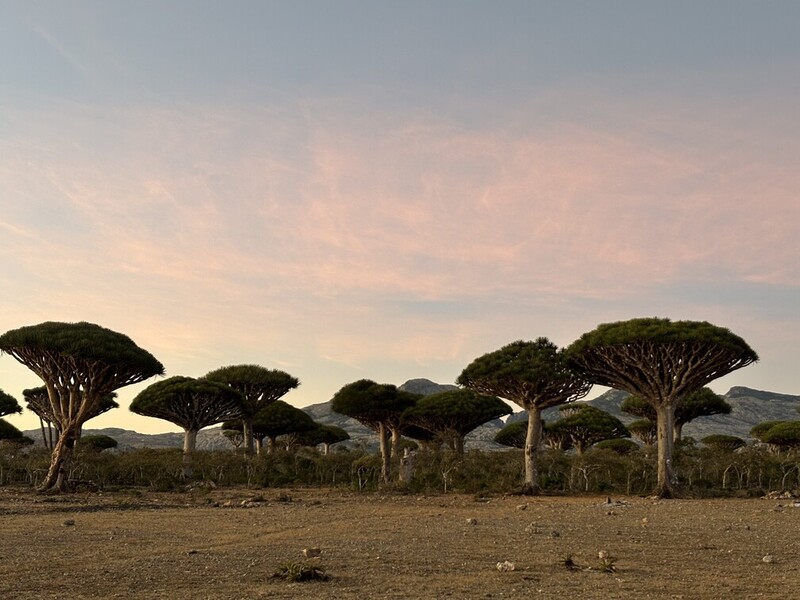
The reason why it works best with camping in Socotra is that tours often complete a full-island circuit covering the whole of the island, including the Diksam Plateau and Dragon Trees at higher altitudes in the middle. If you base yourself in Hadibo in the hotels, then it will mean a lot more driving and perhaps missing some of the itinerary items further away.
So, if you can, the camping is really worth it and honestly, as a camping experience, is one of the more pleasant you’ll ever have.
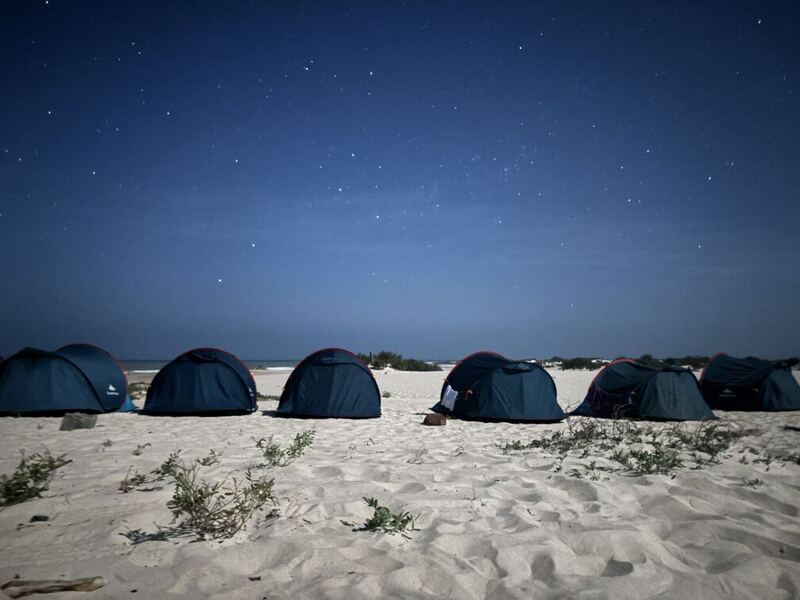
The team of local guides and drivers you’re travelling with set up these tents and campsites every day and every evening when you move campsites, which is most nights. You don’t have to lift a finger. The tents are usually pretty basic 2-man tents that pop open, no tent poles or pegs needed. Some you can stand up in, some are smaller.
Either way, the tent will be set up for you and adequate bedding provided. This includes a light mattress and a basic pillow and mattress. If you prefer, you can bring your own bedding or a sleeping bag, but all of it is washed before you use it.
Campsites in Socotra
The campsites themselves are basic but lovely and part of the charm. Plus, they vary a lot. Some may have a dining area set up made by local materials, some may be more authentic with nothing around but white sands. Either way, the local team will make sure to set up both your tents and a local area to relax and hang out in - without getting sand everywhere. Plus, a dining area with tables and chairs.
You will be travelling with a team of chefs, too, so you will always have freshly prepared local food.
Honestly, the food in Socotra is some of the best.
Hotels in Socotra
A night in a hotel is always my least favourite in Socotra, although the shower is usually very welcome.
There are a few limited options in Hadibo city which are incredibly overpriced, and there is also an airport hotel near the airport called Heathrow Hotel. This is always a nice choice for a last night in Socotra before a flight.
Spending a night in the hotel, you will absolutely miss the chef team when it comes to breakfast the following morning.
One thing to note is if you’re heat-sensitive, the hotels usually have AC. If you’re visiting at the start or the end of the season, the weather will be much warmer and at night it may be more difficult to sleep in tents. In winter months, you’ll be needing light blankets - so certainly no AC needed.
Socotri People
Socotri people are absolutely incredible. It’s like the hospitality of the Middle East meets the chilled and liberal nature of island vibes. Which makes sense entirely as that is literally what it is.
They’re incredibly friendly and won’t waste any time in welcoming you onto their island, and it won’t be long before you’re vibing together to 90s tunes in the 4WDs. They’re also very proud of what they have here in Socotra and very, very hard-working. Alongside the singing, dancing, and laughter coming from the kitchen tent that travels alongside you, you’re likely to hear the clatter of pots and pans at 4 am as they begin to prepare your breakfast.
Whilst Arabic is the official language of Socotra and Yemen, on Socotra they speak Socotri. It’s always a good idea to learn a couple of phrases from the get-go, and they will be eager to teach you and happy to hear you trying!
Government in Socotra
Socotra is ruled by Yemen, but there is a local government that manages business in Socotra. It is very aware of what it has. Above anyone, Socotra knows how incredible it is, and what it is that makes it so special. Until now, it has withstood investment projects and outside government involvement as much as possible.
The government in Socotra is very good and active on its tourism policies. There will often be meetings amongst the tour companies, and it is all very regimented - in a good way. Rules and systems are put in place to protect the island, its culture, its nature, and its people. It's always advisable to respect these rules.
Over the past few years, Socotra has been susceptible to outside influence from both Saudi Arabia and the UAE as they both fight over the area - also recognising its importance both strategically and in terms of its beauty.
The involvement from the UAE and Saudi is received with mixed feelings. You will see both Saudi and UAE-built schools and hospitals around the island, as well as other infrastructure such as well-needed roads. However, negative impacts include controlled imports on petrol, meaning incredibly high prices for locals, and an increasing desire for control of the region.
The situation today remains complex.
Is Socotra Really Safe?
Absolutely - Socotra itself is very safe. However, it is at the mercy of two things out of its control;
- International politics
- Extreme weather events
Socotra has remained completely separate from the conflict on mainland Yemen all these years. This makes it a very safe place to visit. There is no conflict on Socotra island itself. However, it is at the mercy of global politics which can be volatile in the region.
Previously, global politics has caused cancellations and changes in flights. For example, the pull-out of the UAE from Socotra meant that Abu Dhabi - Socotra flights were cancelled last minute, which left some tourists were stuck on Socotra for a few days.
Socotra is only open to visit during the tourist season. This is due to extreme weather events, including cyclones that make the island impossible to visit. Whilst the season is there for a reason, visiting at the start or tail-end of the season does make you more susceptible to freak weather that may cause cancellations or delays in flights.
So, whilst Socotra is safe to visit, you should know that the region is not stable and there is a chance that this may impact your tour to Socotra.
However, local tour companies are no stranger to last-minute flight cancellations and political changes. You won’t be stranded forever, and if you have chosen wisely in your tour company, there will be procedures in place meaning that you’ll be looked after and evacuated as soon as possible.
Choosing a Tour in Socotra
Over the past few years, the tourism industry in Socotra has been expanding. Indeed, you have to go on a tour if you want to visit Socotra. There’s no way to visit it independently. You have to buy your flight tickets through a local company and you must travel the island as part of a tour - either group tour or a private tour.
So, firstly, you must make sure you’re travelling with a registered tour company that can handle these requests.
The tourism industry is fairly well-established, and despite the ‘raw’ travel aspect, the tourist route is, too. All of the companies cooperate well with each other, and considering there is only one or two flights per week, they can do a good job of making sure to split up the tourist groups to make sure that the groups split evenly throughout the island during a week-long trip.
This means there isn’t too much variation in the companies or their itineraries. However, there may be a few factors to consider.
VIP Glamping
Some companies offer a more VIP glamping experience, whilst others have basic tents only. Some companies have Starlink and provide internet and charging equipment throughout. Companies travel with their own shower and toilet facilities for when these aren’t available. Other companies may offer the option to stay in a hotel throughout your whole time in Socotra. Whilst this isn’t recommended, it is still possible for those who absolutely want to visit Socotra but can’t stay in tents.
Socotra Itinerary
In terms of the itinerary, it works well for the flights once a week. There is little variation in this.
If you want a more cultured experience, Koryo Tours offer immersion-focused itineraries in Socotra, including activities like having the chance to visit a local school in Hadibo and visiting the only museum in Socotra. A Koryo Tours tour to Socotra adds in cultural elements to itineraries wherever possible and aims to give back to the community.
Overall, there is not too much variation in the companies, but travelling with a more well-established and highly rated company will often give you perks like better camping spots and more expert guides who have greater knowledge in the history, culture, or nature of the island.
Impact of Tourism & Respecting Local Culture and Customs
There have been some interesting developments in Socotra since its tourism industry started ‘booming’, if we can call it that.
The government in Socotra are very aware of the impact of tourism - both positive and negative - and over the recent years, there have been a few honestly well-thought-through changes in the policy.
Local Dress
As islanders, the Socotri people are much more liberal than the conservative mainland. Indeed, if you look at traditional Socotri dress for women, you will see that it is both colourful and revealing. A short-sleeved shimmering dress that falls beneath the collarbone. A light colourful headscarf placed on top. A world away from how women in mainland Yemen dress - with full black abayas, with a black hijab and niqab. I.e, full covered head to toe in black.
Over the years, influence from the mainland has risen, and now there are only one or two older women on the island that still dress like this - refusing to change their old ways and traditions. If you see a woman outside in Socotra now (emphasis on the if, as social norm dictates women generally stay inside the house), you will notice that they dress the same as those on mainland Yemen.
Behaviour
Since the influx of tourism in Socotra and the advent of social media - which pairs so well with the incredibly aesthetic backdrops of Socotra - local Socotris have often become looked down upon by mainland Yemen people for how they act with foreigners. In recent years, a number of videos and photos online have circulated showing local Socotri people singing and dancing alongside foreigners, women especially, and often wearing shorts and t-shirts, sometimes in bikinis or other swimwear.
Whilst this, from a Western perspective, is absolutely fine - taking photos and videos, having fun with local guides and drivers - from the perspective of one of the most conservative Muslim societies (Yemen), this is perceived as both shocking and shameful. This attitude comes from strangers, but also from local Socotri women, too, who may see their husbands or brothers acting in an inappropriate manner.
Because of this, it is now often requested from guides and drivers not to film or take photos of more intimate activities, such as dancing together or taking especially close pictures.
You will notice it yourself if you visit Socotra. The local team breaking out into dancing and singing is not uncommon, especially in the evening after dinner by the side of the fire. However, as soon as you get your phone out to film this fun interaction, you’ll notice the guides and drivers slowly sit down one by one.
Whilst entirely innocent, it certainly may be perceived differently depending on who might see it. As is always the case in these destinations, once you leave the country, you’re gone. However, the local people are the ones who have to deal with any negative consequences.
This does not stay on a personal level but has also impacted local government policy, seen in ‘suggestions’ to tour guides to not greet or say goodbye to tourists with a hug at the airport - which many travellers may find themselves wanting to do, as hanging out and having fun with a team 24/7 for a week does indeed bring you all close together as friends!
Lastly, a note on what to wear in Socotra.
What to Wear in Socotra
Socotra is an island. With great island vibes. Beautiful white sand beaches, turquoise waters, and enough photo opportunities to fill your entire Instagram feed for a whole year. Depending on what time of year you’re going, the weather is likely to be either warm, hot, or very hot. This means you should dress for the occasion - with many opting to wear t-shirts and shorts, dresses.
Whilst this is not a problem, there are a few things to remember. And bear in mind - this is not from the ‘rules’ of Socotra but rather based on respecting local cultural norms.
Socotra is not the south of France. It may not be the best place in the world for your smallest bikini. Although, there is no rule against wearing a bikini in the natural areas. If a bikini is 100% necessary, you may want to choose one with more material than less. You could also pack a more full swimsuit or wear a t-shirt over the top if you want to be more respectful.
You should be aware that swimwear is only acceptable when you are in areas of nature where it makes sense, and far away from any local town or village. It is not acceptable to wear such clothing when it doesn’t make sense contextually - for example wearing swimwear whilst hiking or posing with a Dragon Blood Tree.
For both women and men, wearing shorts above the knee, t-shirts, and short dresses etc is acceptable throughout the island (apart from in towns and villages, covered below) but again you may want to consider the cultural and religious context of where you are and not wear the most revealing attire you have in your wardrobe.
More practically speaking, you should think comfortable over anything else. A trip to Socotra is rather rugged, and you may not shower for several days. Lightweight, breathable clothing will be your best friend. You should bring sandals or flip-flops and more sturdy shoes for more involved hikes. Hiking shoes are highly recommended for the Hoqs Cave hike. (Although I personally do this in hiking sandals every time and have had no problem).
In Hadibo and other villages and towns, it is a requirement for both men and women to be covered appropriately. Men should wear long trousers and women should be covered in loose clothing down to their wrists and ankles as well as wearing a headscarf.
Women should also keep a headscarf handy for when you are travelling through a town or village or find yourself in a situation where you are meeting with locals for one reason or another.
Final Thoughts
Whilst Socotra is Socotra, and mainland Yemen is mainland Yemen, Socotra is still a part of Yemen. And with that, comes strict religious values. Socotra in general is on a whole new level of liberal compared to mainland Yemen, but the government is still eager to preserve traditions and values and that is something to be aware of if you want to make sure your visit is as a responsible traveller.
Despite what you might see online.
Being a responsible and ethical traveller plays a big role in travel to such complex destinations. And that means respecting cultural norms, not challenging them.
For destinations like Socotra that are fairly new to tourism, the industry is still fairly fragile. By respecting local customs as much as possible, you’re helping to ensure that tourists will be welcome on Socotra for a long time to come.
Challenging local customs will only result in more restrictive policies being put in place to try to prevent any negative impact on the local communities.
As always in muslim societies, it is also a good idea to remember how your actions may be perceived by locals.
This is important not just in respecting local culture but also for safety reasons, especially if you are a woman. A hug or dancing with a local with whom you’ve become close over the past few days may be entirely innocent for you but may give the wrong impression and invite unwanted behaviour.
Socotra is an incredible place. Let's leave it a better place than we found it!
Koryo Tours
Group Tours to Socotra
Share
Zoe Stephens
Zoe is the marketing manager and a tour leader at Koryo Tours.
Her love of meeting new people and exploring new cultures has led her to study several languages including German, Japanese, and Chinese. Having lived in several different countries across 4 continents, she often writes about languages and culture in her blogs and is very active on social media. During the COVID-19 pandemic, she was 'stuck' in Tonga for 1.5 years after a weekend away. Ask her for some stories!
🎥 Vlogs on North Korea
🎙 Discover North Korea Podcast
➤ Instagram | Facebook | TikTok | Twitter/X