The only travel companion you need for Uzbekistan. Plus, travel to Uzbekistan with the author himself!
The Only Book You Need for Uzbekistan? Travel There with the Author
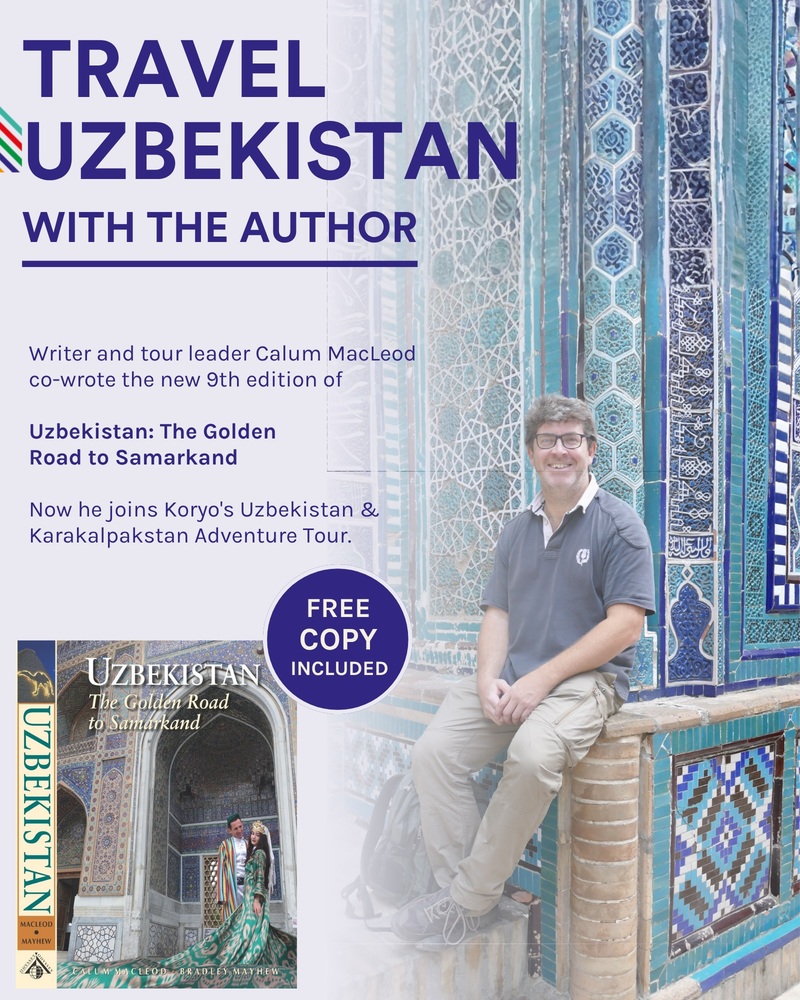
Uzbekistan: The Golden Road to Samarkand is out now. And for Koryo travellers, you're in for a treat.
Sure, it's another great guidebook on Uzbekistan, which is always welcome. But how about travelling together with the writer?
Few can call themselves more expert than guidebook writers.
Calum MacLeod is one of the world's leading Uzbekistan travel specialists. And this year, you can travel with him to his favourite country.
Uzbekistan Guidebook Introduction
This Uzbekistan guidebook is the result of three decades of journeys through the heart of Central Asia.
It is a 442-page labour of love, packed with 320 photos, 19 updated maps, hidden histories, forgotten corners, practical details and the kind of deep local context that makes a place come alive long before you arrive. It is also the most detailed English-language guidebook to Uzbekistan ever written.
And this October, you can travel through Uzbekistan with one of the people who wrote it.
Author Calum MacLeod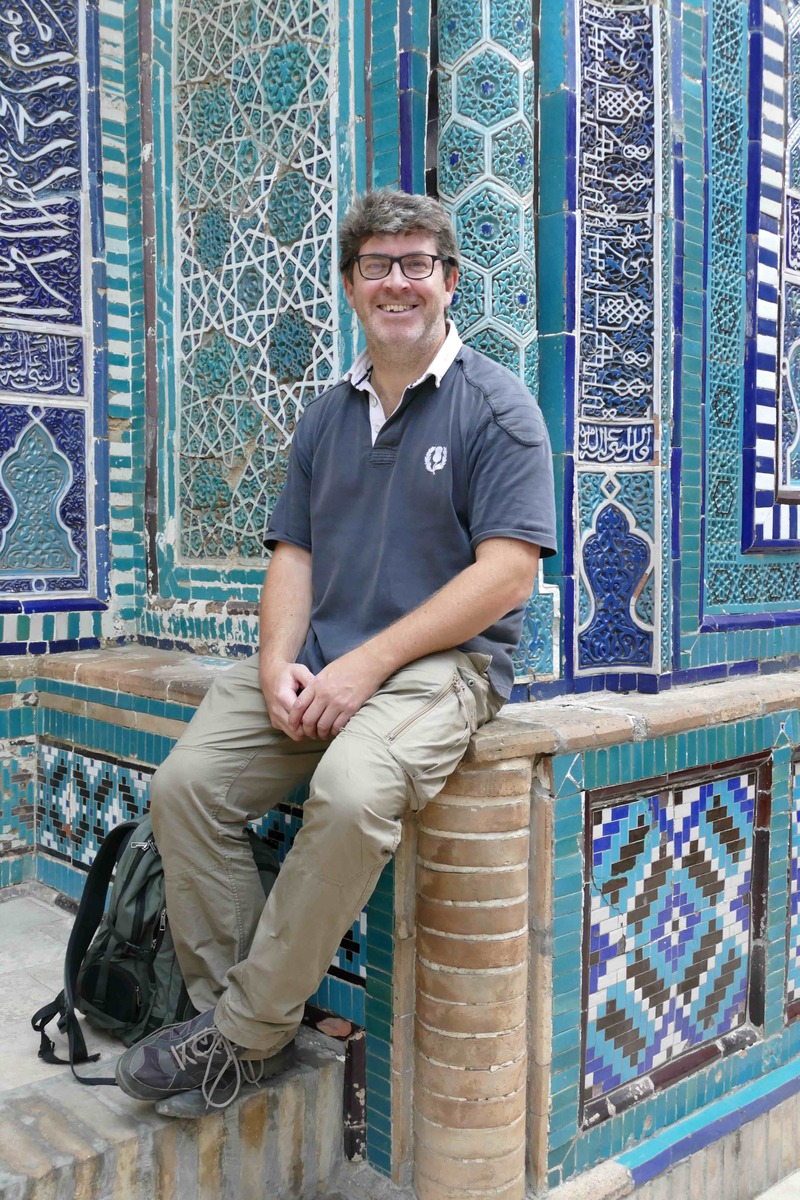
Calum first travelled through Uzbekistan in 1992, just after the collapse of the Soviet Union. It was a very different country then.
In Tashkent, one local host rushed him into a garden shed when KGB officers were on their way to search the house. The Soviet Union had disappeared, new nations had been born, but suspicion of foreigners had not vanished overnight.
The people, however, were already welcoming visitors with the warmth that has long defined life along the Silk Road. As Calum writes, in Uzbekistan, “the guest is the first person in the home”.
He has been returning ever since.
Across thirty years, Uzbekistan has changed dramatically. Tashkent has rebuilt, rebranded and rediscovered itself. Samarkand and Bukhara have become international icons. Khiva has retained the feel of a walled Silk Road city almost too perfect to be real. Karakalpakstan, far out in the country’s remote northwest, has emerged as one of Central Asia’s most haunting and fascinating regions.
The new guidebook captures all of this. Not just the tilework and minarets, but the politics, poetry, Soviet leftovers, ecological tragedy, local humour, backstreet shrines, village hikes, bold architecture, bazaar food and the strange survival stories that make Uzbekistan so much more than a beautiful backdrop.
Calum MacLeod, co-author of Uzbekistan: The Golden Road to Samarkand, will accompany our Uzbekistan and Karakalpakstan Adventure Tour, running from 26 October to 4 November 2026. The book is the perfect introduction to the country. The tour is a chance to step inside its pages.
Not just Samarkand. Not just the Registan.
Of course, Uzbekistan has its blockbusters. And they deserve their fame.
The Registan in Samarkand is one of the great architectural ensembles of the world. Bukhara’s minarets, madrasahs and caravanserais still carry the weight of centuries of trade and scholarship. Khiva’s walled old city feels like a Silk Road stage set, except it is real, layered, lived-in and full of stories.
But the joy of this new edition is that it pushes far beyond the obvious.
The book covers Tashkent Modernism, Soviet survivors, fallen idols, Sufi shrines, walking tours, boutique hotels, the best plov restaurants, high-speed train links, language tips and practical details for the modern traveller. It also introduces lesser-known historical figures, remote excursions and offbeat places that rarely make it into standard travel coverage.
This is exactly the kind of Uzbekistan Koryo loves.
Yes, we go to the famous places. We would never miss them. But we also go looking for the odd corners, the complicated histories, the quiet survivors and the things that make you stop and say, “how is this not more famous?”
Koryo's Uzbekistan & Karakalpakstan Tours
Koryo’s Uzbekistan and Karakalpakstan Adventure Tour follows the ancient Silk Road through the heart of Uzbekistan, but it also heads into the remote northwest, to Karakalpakstan, where the shrinking Aral Sea has left behind one of the world’s youngest deserts.
This is certainly not just a simple highlights of Uzbekistan tour.
Tashkent
We begin in Tashkent, peeling back the layers of the capital. Underground, the Tashkent Metro offers a decorative feast from the 1970s. Above ground, Hotel Uzbekistan stands as one of the great symbols of Tashkent Modernism, while Chorsu Bazaar bustles beneath its enormous Soviet dome. From there, we head to Parkent and the Institute of the Sun, a once top-secret solar furnace fired by thousands of mirrors. The tour description calls it a Bond villain lair, and honestly, that is hard to improve on.
Karakalpakstan
Then we fly to Nukus, the capital of Karakalpakstan.
This is where the trip becomes something very different.
Muynak
Karakalpakstan is the “Stan within a Stan”, a vast autonomous republic of deserts, drama and Soviet secrets. We travel to Muynak, once a fishing port and holiday town on the Aral Sea.
Today, rusting trawlers sit below a lighthouse on a dry seabed, more than 100 km from the current shoreline. The Aral Sea has shrunk by 90%, one of the world’s worst ecological disasters, caused by water-hungry cotton farming.
Mizdakhan
We also visit Mizdakhan, one of the oldest active necropolises in Central Asia, and the Igor Savitsky Art Museum in Nukus. The Savitsky is one of the great surprises of Central Asia, a remote treasure house of Russian avant-garde art rescued from Soviet authorities and hidden in the desert. From there, the journey continues overland through the ancient clay fortresses of Khorezm, the “Egypt of Central Asia”, before arriving in Khiva.
An Uzbekistan Tour with a Difference
Khiva is the kind of city that makes people reach for clichés, because sometimes the clichés are true. It really does feel like stepping into another world.
On Koryo’s tour, we walk through the UNESCO-listed inner city, passing the Kalta Minaret, Muhammad Rahim Khan Madrasah, Pakhlavan Mahmoud Mausoleum and the Juma Mosque, where more than 200 carved wooden pillars offer shade from the desert light.
But travelling with Calum means these places are not just pretty buildings... These places become stories. Rival rulers. Interrupted towers. Reformist poets. Pilgrims. Zoroastrian roots. Soviet archaeologists. Local jokes.
Things that are not obvious unless someone knows where to look.
That is the difference between seeing Uzbekistan and understanding it.
In Bukhara, we explore one of the great cities of the Silk Road, from the Ark fortress to the Kalyan Minaret, from old trading spaces to Sufi pilgrimage sites. In Samarkand, we end with the big hitters: the Registan, Gur Emir, Shah-i-Zinda and the layers of history that made the city a muse for travellers, poets and conquerors.
These are places you can read about in the book.
Or, in October, you can read about them, then stand there with the author.
Get the Guidebook
We know not everyone can join us in October.
If you cannot, then Uzbekistan: The Golden Road to Samarkand is the next best thing. It is available now on Amazon and at all good bookshops. If you want a signed copy please contact [email protected] and Calum will post one off to you- and it keeps the profit with the writer not Amazon!
The New York Times called it “one of those rare travel guides that is a joy to read whether or not you are planning a trip”. The Guardian described it as “erudite… exemplary”. Condé Nast Traveler praised it as “richly photographed and terrifically detailed”.
But if you are planning a trip, the book does something even better. It prepares you to notice more.
You will know why a Soviet hotel matters. You will understand why a desert museum in Nukus contains forbidden art. You will look at a metro station, a bazaar dome, a minaret, a mausoleum or a rusting ship in the desert and see not just the sight itself, but the story behind it.
Join Koryo in Uzbekistan
Koryo’s Uzbekistan and Karakalpakstan Adventure Tour runs from 26 October to 4 November 2026, from 2670 USD per person. It is accompanied by Calum, who will share guest lectures and insights along the route.
Think Tashkent Modernism. A top-secret solar furnace. The ships’ graveyard of Muynak. The forbidden art of Nukus. Desert forts. Khiva’s walled wonder. Bukhara’s sacred and scholarly past. Samarkand’s tiled splendour.
Read the book... Then travel with the author!
Koryo Tours
Experts in Uzbekistan Travel
Share