How did Koryo Tours start the Turkmenistan tourism industry?
Turkmenistan, the most mysterious and enigmatic of all the Central Asian republics, has never been much of a mass tourism hotspot.
Even now, in an age of travel influencers looking for a crazy story to explain to camera for the benefit of viewers (or for clicks, likes, & follows of course) it remains very much off the beaten-path.
Making it more attractive to some, and just another place associated with half-recalled rumours and claims by others – just our sort of place!
But how did it all start for Koryo Tours working in Turkmenistan?
Well, back in the early 2000s we were well-established as the primary experts in travel to North Korea already, and were interested in what else we could offer.
Flights from Beijing to Ashgabat were starting and I was in the position to get a seat on the very first one – which I did.
Making a recce trip all around Turkmenistan and returning fascinated with what an extraordinary place it was – with plenty of oddness and plenty of normality too; a place unlike any I had ever been.
I returned a few months later for another trip and to confirm details for bringing in our travellers. At that time the industry barely existed in Turkmenistan and it fell to Koryo Tours to lay the path that others would then choose to follow.
Our first group tour departed in May 2006, nearly twenty years ago at the time of writing.
On this tour we visited the highlights of Ashgabat, many of which remain the same today and many of which have changed, moved, or simply stopped existing: The Independence Monument (still the same), the Ruhnama Monument (Which was working at the time, opening to a different page daily with a light show and reading of this key national text, now it just sits there inert), the Arch of Neutrality topped with a rotating gold statue of the President; Saparmurat ‘Turkmenbashi’ Niyazov (then: in the centre of the city, the focal point of Ashgabat. Now: relegated to the suburbs, and no longer rotating), and much more.
We also went out to a rural stud farm in the mountains, the massive Gypjak Mosque, the also-massive Geok-Deppe Mosque, the underground sulphur-heated lake of Kow-Ata, the northern city of Dashoguz and the nearby ruins of Konye-Urgench, the ruins of the Parthian fortress of Old Nisa, as well as the amazing and vast chaos of the Tolkuchka Bazaar, which at the time was a warren of stalls in the desert outside Ashgabat and now is a more organised newer site with the unmistakably Turkmen white-marble stylings much more present in the current era, and which could be found on only the few newer buildings (mostly governmental) in Ashgabat at that time.
At the time of the first tour Turkmenistan was deep in the era of Turkmenbashi (an honourific meaning ‘leader of Turkmen’) with the visage of the President everywhere from schools and public buildings, to each bill int eh vast piles of money needed to buy anything ($40 changed into Turkmen Manat at that time made one a millionaire, and with the largest denomination being a mere 10,000 you would need a bag rather than a wallet to go shopping in this then-cash-only society).
Statues abounded, many of which are still there, some removed or replaced now though, and the national slogans stating that the 21st Century is Turkmenistan’s Golden Age (which graces even the kilim on my office floor to this day), and Halk, Watan, Beyik Turkmenbashi! (Trans: The Nation, The People, the Great Turkmenbashi!) were everywhere.
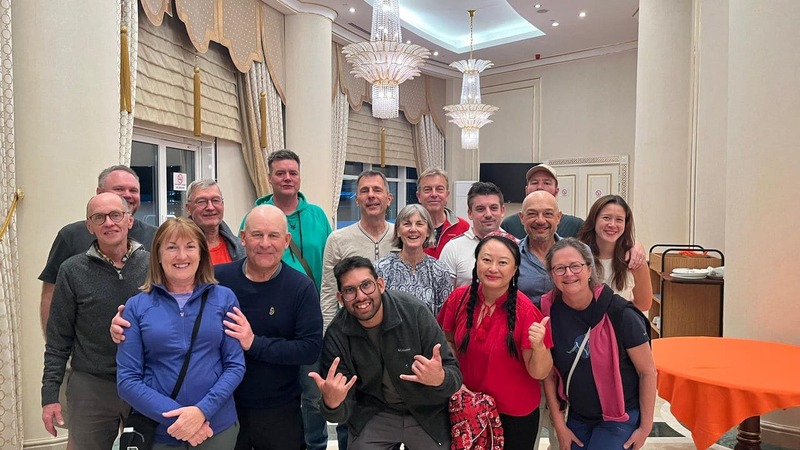
Different times, but how different?
On balance I can say that much remains recognisable from that era, and much has changed too.
Making repeat visits from 2004 to 2025 and beyond has been one of the great pleasures of my travel career.
An amazing first trip and a great way to set a mark for growing the industry of people visiting Turkmenistan for itself, rather than just landing to pass through (as often still happens).
Over time many things have improved greatly for visitors to the country: more places to visit, better accommodation options at various levels, improvements in the national and regional airports and train transportation, and a greater pool of tour guides and others involved in all factors of the industry.
Problems remain of course: the internet is barely more usable by visitors now than it was when I first visited, the visa process remains somewhat opaque and prone to arbitrary decisions (not as often as many suggest though, book with a reliable company with a good record!), and the roads in many areas are in worse condition in 2025 than in 2006 – although in some places they are excellent -it depends where you go.
Still, one fact remains constant – that Koryo Tours pay close attention to Turkmenistan and provide the best trip you can take there in terms of exploring as widely as possible.
Seeing the major sites and also getting real local engagement and access along the way. We work with partners we have known for decades; friends as well as colleagues, and we bring this friendship to the trips we continue to offer.
Much imitated, never exceeded, we would love to have you with us as we move into or third decade of offering adventure in the most unusual country in a little-known region: Turkmenistan.
Koryo Tours
International Tours
Share
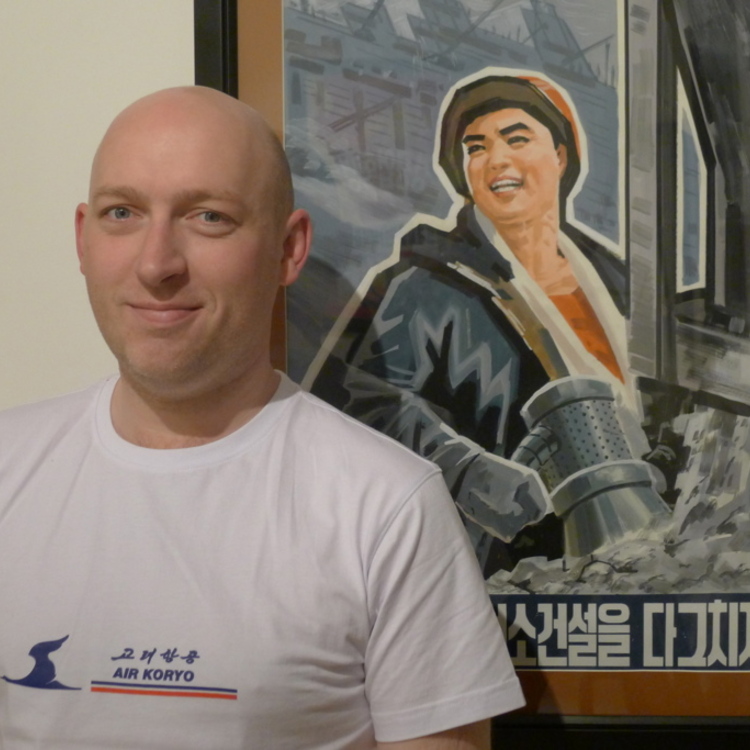
Simon Cockerell
Simon has been Koryo’s General Manager since 2002. He has travelled to North Korea more than 175 times and has probably been to the country more than any other Westerner. He is a respected speaker on the country and appears regularly in international media. He is also a tour specialist in Kazakhstan, Turkmenistan, and the Russian Far East where he has personally designed and led multiple tours over the years.