In May 1882, some of the world's best astronomers travelled to Sohag in Upper Egypt to watch a total solar eclipse, and came home with photographs of a comet that nobody had ever seen before and nobody would ever see again.
I'm sure you can relate to this. You line up the perfect group photo with your friends, only to find a stranger wandering through the background when you look at it afterwards.
Now imagine being one of the 19th-century astronomers who travelled thousands of miles with crates of telescopes and cameras to photograph the 1882 solar eclipse in Egypt.
Then, after all that effort, you find out that a comet had photobombed the whole thing.
Egypt is full of strange little stories from the history of astronomy, but this is definitely one of the most bizarre ones.
It all happened in Sohag, a very underwhelming small town on the Nile that most visitors to Egypt today skip on their way to Luxor.
The Very Exclusive Eclipse Party in Sohag
Who was attending this very exclusive solar party?
The Seventy Seconds Nobody Wanted to Waste
The Photobomb Nobody Planned For
The Sungrazer Theory
The Bigger Cousin Who Turned Up Later
The Khedive Had Other Things on His Mind
Things to Do in Sohag Today (Beyond Looking for Comets)
The 2027 Solar Eclipse in Egypt (A Rematch With Much More Time on the Clock)
Why a 70-Second Comet Still Matters
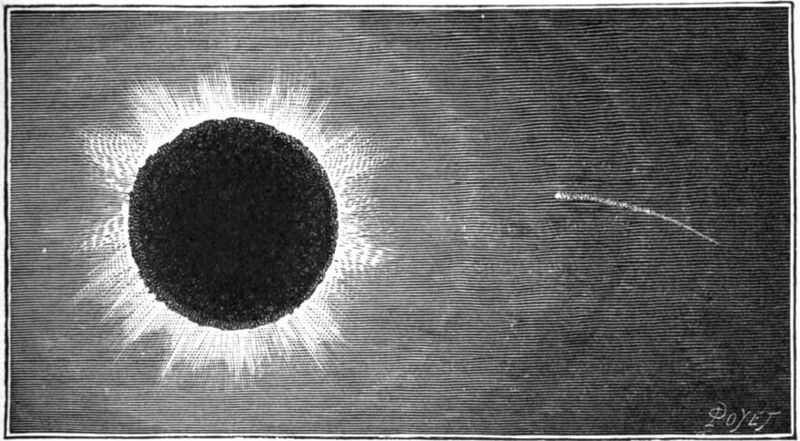
The epic photobomb
The Very Exclusive Eclipse Party in Sohag
In the 19th century, a total solar eclipse was about as exciting as it got for astronomers.
It was the only chance they had to study the Sun's outer atmosphere, the corona, which is normally hidden by the Sun's glare (and, of course, impossible to look at on a normal bright day).
So, whenever an eclipse was on its way, scientists would pack up their instruments and head to wherever the path of totality happened to fall.
This often meant long sea or land voyages from home, a lot of nervous waiting around, and a great deal of praying for clear skies.
In 1882, the path of totality crossed Africa and Asia and passed right through Upper Egypt.
The place chosen to watch it from was the small town of Sohag, on the west bank of the Nile, roughly 400 kilometres south of Cairo.
Who was attending this very exclusive solar party?
The guest list was quite impressive.
From Britain came Sir Norman Lockyer, the founder of the journal Nature and one of the scientists behind the discovery of helium in the Sun's spectrum in 1868, together with Arthur Schuster, a young German-born physicist from Manchester who specialised in photographing eclipses.
From France came Charles Trépied of the Algiers Observatory, along with Louis Thollon and Pierre Puiseux, and from Italy came Pietro Tacchini.
It must have been quite a sight for the people of Sohag, as their quiet town on the Nile suddenly filled up with European scientists, delicate and unusual-looking equipment, and a lot of people staring anxiously at the sky.
The Seventy Seconds Nobody Wanted to Waste
The total solar eclipse took place on the morning of 17 May 1882, and it was not a particularly long one.
The longest totality anywhere along the path lasted only around 1 minute and 50 seconds, and in Sohag, the Sun was completely covered for barely 70 seconds.
Not a lot of time, especially when you have travelled halfway around the world for it!
That gave each team just over a minute to take their photographs, make their measurements and, if they were lucky, actually look up and enjoy the view for a moment before the Sun reappeared.
The Photobomb Nobody Planned For
As the Moon covered the Sun and the sky darkened, the astronomers noticed a bright, curved streak of light just to one side of the Sun.
It sat a little more than half a degree from the Sun's edge and did not look like any part of the corona they had come to study.
The French astronomer Trépied spotted it during totality and noted that it looked completely out of place compared with the rest of the corona.
But with only 70 seconds to work with, nobody had time to work out what it actually was.
It was only around an hour later, when Trépied looked at one of Schuster's photographs, that the mystery was solved.
The streak had a bright head and a curved tail, and it was clearly a comet, one that nobody had spotted before the eclipse and that nobody, anywhere in the world, would ever see again.
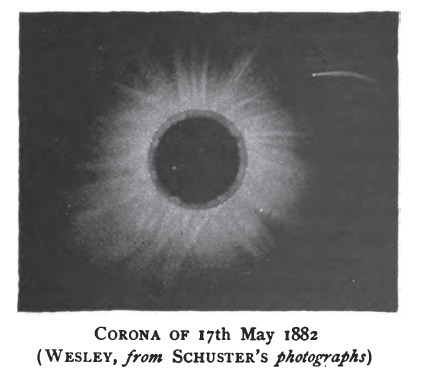
Schuster's Photo
The Comet Gets a Royal Name
That evening, the excited astronomers got together and decided to name their photobomber after the ruler of Egypt, Khedive Tewfik Pasha, as a thank you for his hospitality during their stay.
So the comet became known as Comet Tewfik, or officially as X/1882 K1 (it is also sometimes called the Eclipse Comet of 1882).
As thank-you gestures go, naming a comet after your host is certainly more memorable than sending flowers.
Schuster's photograph also earned its own place in the history books, as the first time a comet had ever been photographed during a total solar eclipse.
The Sungrazer Theory
The big question, of course, was where Comet Tewfik had come from and why nobody had seen it before, and astronomers have been puzzling over it for well over a century.
What we do know is that it was spotted when it was extraordinarily close to the Sun.
Its closest approach is estimated at only around 800,000 kilometres from the Sun's centre, which in astronomical terms means it was practically skimming the surface, and the photographs suggest it was travelling at close to 500 kilometres per second.
Astronomers now believe it was a Kreutz sungrazer, one of a family of comets thought to be fragments of a single giant comet that broke apart long ago.
These comets plunge extremely close to the Sun, and many of them don't survive the experience, which may explain why Tewfik was never seen again.
It may have been destroyed by the heat, or it may simply have faded into the Sun's glare before anyone had the chance to look for it.
The comet was only ever seen by human eyes for those 70 seconds in Sohag.
Even today, we simply don't know the answer.
The Bigger Cousin Who Turned Up Later
Comet Tewfik wasn't the only piece of that giant broken-up comet passing close to the Sun in 1882.
Just four months after the eclipse, in September 1882, another fragment from the same Kreutz family appeared in the sky, and this one was impossible to miss.
Known as the Great Comet of 1882, it became one of the brightest comets ever recorded, so bright that people around the world could see it in broad daylight without a telescope.
So while Comet Tewfik was only ever seen by a handful of astronomers for 70 seconds in Sohag, its much bigger cousin put on a show for millions, which rather put the little Sohag comet in the shade.
The Khedive Had Other Things on His Mind
What makes the story even more remarkable is the timing, because in May 1882 Egypt was in the middle of a serious political crisis.
Khedive Tewfik was struggling to hold on to power against a nationalist movement led by the army officer Ahmed Urabi, who wanted an end to foreign control over Egypt's finances and government, while Britain and France watched closely and began sending their warships towards Alexandria.
In June, riots broke out in Alexandria, and in July the British fleet bombarded the city.
By September, the British army had defeated Urabi's forces at the Battle of Tel el-Kebir, and Egypt came under British occupation for the next seventy years.
So while a group of foreign astronomers in Sohag were naming a comet in the Khedive's honour, the Khedive himself was about to lose control of his country, and I suspect a comet was fairly low on his list of priorities that week.
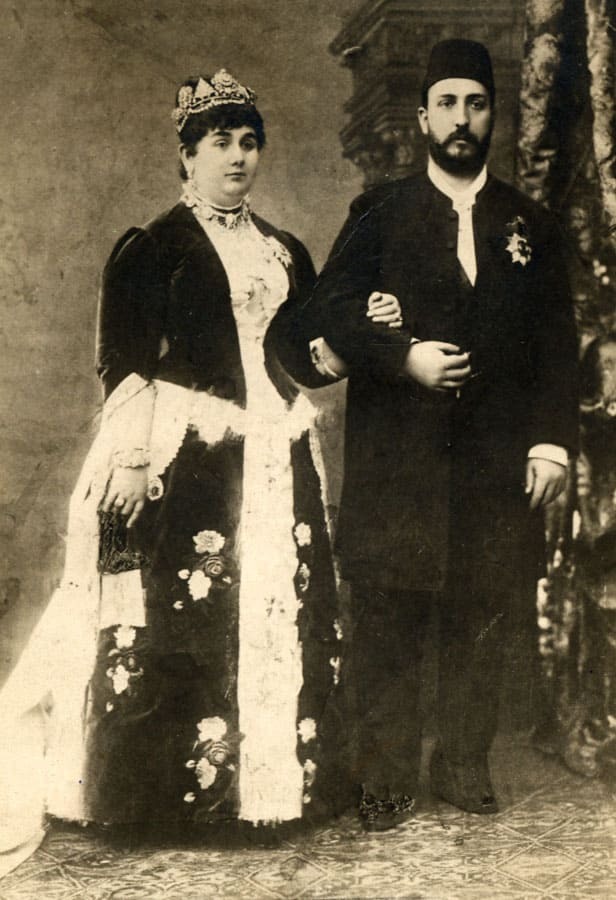
Khedive Tewfik Pasha Wedding Day, January 1873
Things to Do in Sohag Today (Beyond Looking for Comets)
Sohag is still well off the main tourist trail, and as far as I know, there is no plaque or monument to the 1882 eclipse or the comet, but there are plenty of things to do in Sohag for anyone willing to stop.
Sohag Governorate is home to Abydos, where the beautiful Temple of Seti I has some of the finest carved reliefs in Egypt, as well as the famous Abydos King List.
Just outside the city are the White Monastery and the Red Monastery, two of the oldest and most important Coptic monasteries in the country, and the painted interior of the Red Monastery is worth the trip on its own.
Across the river in Akhmim, you can also see a huge statue of Meritamun, the daughter of Ramesses II.
The 2027 Solar Eclipse in Egypt (A Rematch With Much More Time on the Clock)
If you missed the 1882 eclipse (and I'm assuming most of you did), you're in luck, because on 2 August 2027 another total solar eclipse will cross Egypt, and this one is a much bigger affair.
The path of totality for the 2027 solar eclipse runs through the Nile Valley, including Asyut and Luxor, with Sohag sitting in between.
Near Luxor, totality will last around 6 minutes and 22 seconds, which makes it the longest total solar eclipse over easily accessible land this century.
It has already been nicknamed the "eclipse of the century", as a longer one won't come along until 2114.
That is more than five times as long as the astronomers had in 1882, which should leave plenty of time to take photographs, have a proper look, and keep an eye out for any comets hoping to sneak into the background.
Koryo Tours
Group Tours to Egypt
Share
Halef Gunawan
Halef is Social Media and Marketing Specialist at Koryo Tours
Born and raised in Indonesia, he moved to the U.S. for college and later pursued full-time travel in 2019. Stranded in Sabah, Malaysia, during COVID, he and his partner, along with their German Shepherd, Kana, embraced van life and have been exploring North America since 2020.
📷 Instagram | 🇮🇩 Instagram (Bahasa Indonesia)
My First Koryo Tours Adventure in Syria During Ramadan (and the Iran War)