Egypt Profile
To most people, Egypt means a few things. Pyramids. Pharaohs. The Nile River.
And fair enough. The Great Pyramid of Giza has been drawing visitors for roughly 4,500 years, and the ancient Greeks were already writing travel notes about it before Rome was anything more than a hilltop village. But the pyramids are only the opening chapter of a story that runs, almost without a break, from the first dynasties to the present day.
Egypt is where Alexander the Great founded a city and Cleopatra lost a kingdom. It is where Coptic Christianity took root and where medieval Cairo became the largest and richest city in the Islamic world. It is a country of Roman forts, Ottoman mosques, Belle Époque boulevards and Soviet-built dams, all strung along a single river.
That river is the whole point. The Nile runs the length of the country, and around 95% of Egyptians live within a few kilometres of its banks. Step a short distance away and you are in the Sahara, which covers almost everything else. Egypt has always been a narrow green line through a vast desert, and that geography has shaped every civilisation that ever ruled here.
Egypt today is not a hidden destination. It welcomed a record 19 million visitors in 2025, and the long-awaited Grand Egyptian Museum finally opened its doors beside the Giza plateau in November of that year.
But the classic Egypt circuit only covers a fraction of what the country holds. Beyond the cruise boats and the coach parks are desert oases, Coptic monasteries, half-forgotten temples in Middle Egypt and the crumbling grandeur of Alexandria, places that most visitors never get near.
That is the Egypt we want to show you.
Egypt History
The story of Egypt is, in many ways, the story of the Nile, and of everyone who ever wanted to control it.
People were farming along its banks thousands of years before the first pharaoh. The annual flood dumped rich black silt across the valley each summer, and the ancient Egyptians called their land Kemet, the Black Land, in contrast to the red desert on either side. Get the flood right and you could feed an empire. That basic equation never really changed.
c. 3100 BC: Unification
Around 3100 BC, Upper Egypt in the south and Lower Egypt in the Delta were united under a single king, traditionally named as Narmer or Menes. It was the beginning of a state that would last, in one form or another, for close to three thousand years. Hieroglyphic writing, a centralised bureaucracy and a god-king at the top of it all were in place remarkably early.
Old Kingdom & the Age of the Pyramids
The Old Kingdom (roughly 2686 to 2181 BC) is when Egypt built big. Djoser's Step Pyramid at Saqqara came first, then the experiments at Dahshur, then the Great Pyramid of Khufu at Giza. For nearly 4,000 years it was the tallest man-made structure on earth. It was built not by slaves, as the old story goes, but by organised, fed and housed labour gangs who left their own graffiti inside.
New Kingdom & the Valley of the Kings
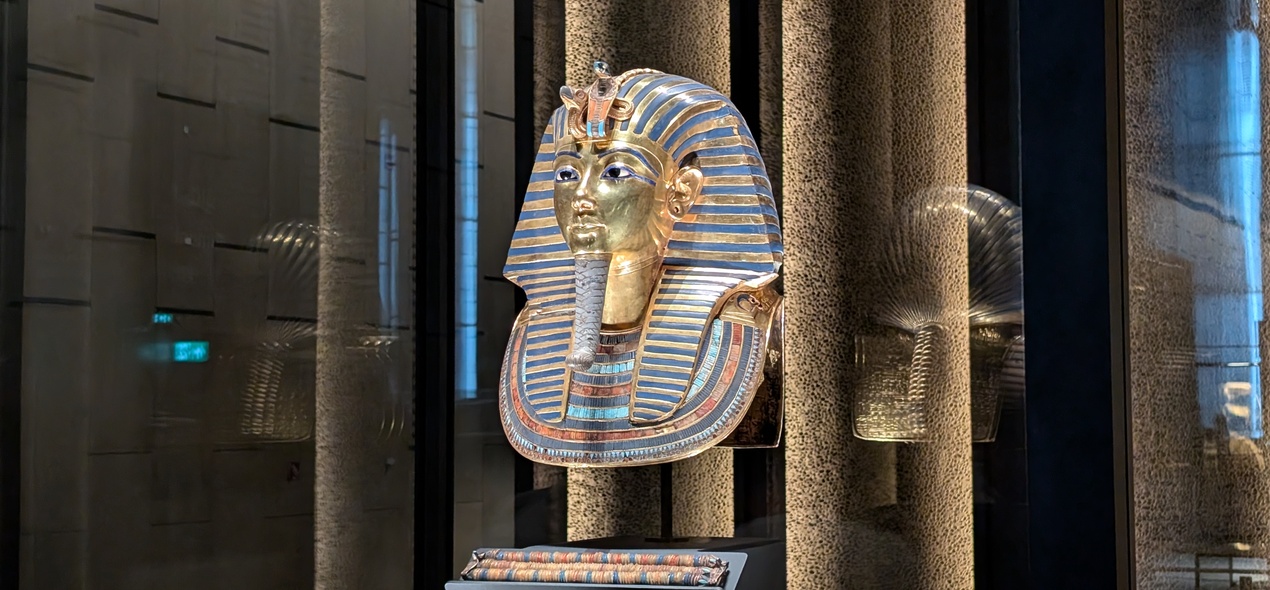
After periods of collapse and recovery, the New Kingdom (roughly 1550 to 1070 BC) was ancient Egypt at the height of its power. The capital shifted south to Thebes, modern Luxor, and the pharaohs stopped building pyramids and started hiding their tombs in the Valley of the Kings. This is the era of Hatshepsut, Akhenaten, Tutankhamun and Ramesses II, and of the temples of Karnak, Luxor and Abu Simbel.
332 BC: Alexander & the Ptolemies
Alexander the Great arrived in 332 BC, was welcomed as a liberator from Persian rule, and founded Alexandria on the Mediterranean coast. After his death, his general Ptolemy took Egypt, and his descendants ruled for three centuries as Greek kings dressed as pharaohs. Alexandria became the intellectual capital of the ancient world, home to the Great Library and the Pharos lighthouse. The last of the line was Cleopatra VII, whose alliance with Mark Antony ended at the Battle of Actium.
30 BC: Rome & Byzantium
Egypt became Rome's breadbasket, shipping grain across the Mediterranean to feed the imperial capital. Christianity spread early here, and Egypt gave the world monasticism: the Monastery of St Anthony in the Eastern Desert is among the oldest functioning monasteries anywhere. The Coptic Church, which traces its foundation to St Mark, remains the faith of roughly one in ten Egyptians today.
641 AD: Arrival of Islam
Arab armies under Amr ibn al-As took Egypt in 641 AD and founded Fustat, the seed of modern Cairo. Over the following centuries Arabic and Islam became the dominant language and faith. In 969 the Fatimids built Cairo proper and founded Al-Azhar, one of the oldest continuously operating universities in the world.
1250: The Mamluks
The Mamluks, a caste of enslaved soldiers who seized power for themselves, ruled Egypt from 1250. They stopped the Mongols at Ain Jalut in 1260, drove the last Crusaders out of the Levant, and filled Cairo with the domes and minarets that still define the skyline of the old city. For a time, Mamluk Cairo was the greatest city between Morocco and China.
1517: The Ottomans
The Ottomans conquered Egypt in 1517 and held it, at least on paper, for four centuries, though Mamluk grandees continued to run much of the country in practice.
1798: Napoleon
Napoleon invaded in 1798, bringing an army and a team of scholars. The military campaign failed. The scholarly one did not: his soldiers turned up the Rosetta Stone, and Europe's obsession with ancient Egypt began in earnest.
1805 to 1882: Muhammad Ali & the Suez Canal
An Albanian officer named Muhammad Ali Pasha took control in 1805 and set about modernising Egypt at speed. His successors built railways, cotton plantations and a European-style downtown Cairo, and in 1869 the Suez Canal opened. It made Egypt strategically priceless, and it also pushed the country deep into debt.
1882: British Occupation
Britain occupied Egypt in 1882, ostensibly to secure the canal and Egypt's finances. Nominal independence came in 1922, but British troops and influence remained. In the same year, Howard Carter opened the tomb of Tutankhamun.
1952: Revolution
In July 1952 the Free Officers, led by Gamal Abdel Nasser, overthrew King Farouk. Nasser nationalised the Suez Canal in 1956, survived the British, French and Israeli invasion that followed, and became the leading voice of Arab nationalism. The Aswan High Dam, finished in 1970, ended the annual flood for good, and the temples of Abu Simbel and Philae were cut up and moved to higher ground to save them from the rising lake.
1970s to 2011
Anwar Sadat led Egypt through the 1973 war and then signed a peace treaty with Israel in 1979, a decision that led to his assassination in 1981. Hosni Mubarak ruled for the next 30 years.
2011 & After
In January 2011, protests centred on Cairo's Tahrir Square brought down Mubarak in 18 days. Mohamed Morsi won the 2012 election and was removed by the military in 2013. Abdel Fattah el-Sisi has led the country since 2014. Tourism, badly hit through those years, has since recovered to record levels.
Travelling Egypt Today
Egypt has been a tourist destination for longer than almost anywhere on earth.
Greek and Roman visitors scratched their names into the legs of the Colossi of Memnon. Thomas Cook was running Nile steamers in the 1870s. By the early 20th century, a winter season in Cairo and Luxor was a fixture of European high society.
The modern era has been more of a rollercoaster. Tourism collapsed after the 2011 revolution and the instability that followed, and again during the pandemic. The recovery since has been dramatic. Egypt welcomed around 15.8 million visitors in 2024 and broke that record with roughly 19 million in 2025, and early 2026 numbers are running higher still.
Much of that momentum comes from the Grand Egyptian Museum, which opened fully in November 2025 after more than two decades of construction. Set just over a kilometre from the pyramids, it is the largest archaeological museum in the world, and for the first time it displays the complete Tutankhamun collection together. New flight routes, an expanding e-visa system and a wave of hotel building are all part of the same picture.
It is worth being honest about what that success means on the ground.
The headline sites are busy. Giza, the Valley of the Kings and Abu Simbel draw serious crowds in peak season, and the hassle from touts and hawkers at the big sites is real. Egypt rewards travellers who go with people who know when to arrive, which entrance to use, and how to say no politely.
It also rewards those who go further. Most visitors never see Middle Egypt, where the temples of Abydos and Dendera are among the best-preserved in the country and the city of Amarna is where Akhenaten tried to reinvent religion. Few make it out to the White Desert, with its chalk formations rising out of the sand, or to the oases of the Western Desert. Alexandria, once the greatest city of the Mediterranean, is a short train ride from Cairo and still feels underexplored. And Islamic Cairo, with its Mamluk mosques, medieval gates and the old caravan streets around Khan el-Khalili, deserves days rather than an afternoon.
Security is visible. Police checkpoints are common on intercity roads, and in some areas tour vehicles travel with a police escort or in convoy. This is routine rather than a cause for alarm, and in practice it is handled for you.
And then there are the Egyptians themselves: funny, talkative, endlessly hospitable and generally delighted that you have come. Accept the tea. You will be offered a lot of it.
If it is on your list, we would love to take you there.