In April 2008, a group of cricket-mad expats from the Shanghai Cricket Club organised a full Twenty20 cricket tournament in Pyongyang, North Korea. Three teams, 800-plus runs, cucumber sandwiches, a marching band, and one very unfortunate golden duck. This is the only story of cricket in the DPRK.
Cricket. A sport of tradition, colonial history, and the quiet rituals of tea breaks and cucumber sandwiches. It thrives at Lord's, the MCG, or the dusty maidans of Mumbai.
But... North Korea?
The DPRK is one of the most isolated nations on Earth. Sports here serve propaganda purposes. Think mass gymnastics displays or football triumphs broadcast as victories for the regime.
Cricket, with its British Empire roots and bewildering rules, seems like the last game that could ever take hold.
Yet, for one remarkable day in April 2008, cricket did arrive in Pyongyang.
It was fleeting. It was surreal.
And it remains the only recorded instance of organised cricket on North Korean soil.
Origins of Cricket in North Korea
Twenty20 Tournament in North Korea
Meet the Teams
North Korea's First (& Only) Cricket Match
A Tour in North Korea
A Future of Cricket in North Korea?
Origins of Cricket in North Korea
The story begins not in Pyongyang, but in a Shanghai bar.
Jon Newton, then president of the Shanghai Cricket Club (SCC), was chatting with friends Ainsley Mann, a Scottish businessman, and Denzyl Allwright, the club's secretary.
Over drinks, they hatched a wild idea. Organise a cricket tour to one of the world's most inaccessible countries.
Newton bet they couldn't pull it off.
If they succeeded, he'd personally ship a roll-up matting wicket from England. Mann, determined not to lose, took the challenge seriously.
Putting together Cricket in North Korea
What followed was eight to nine months of painstaking diplomacy, paperwork, and logistics.
The organisation was handled solely by Koryo Tours. We worked with our partners in Pyongyang to make it all happen.
An especially tricky task given that cricket was a sport entirely unknown to the North Koreans.
Visas were arranged as standard tourist visas, with 21 players secured through Koryo Tours' established channels.
Equipment, including the precious matting pitch, was imported.
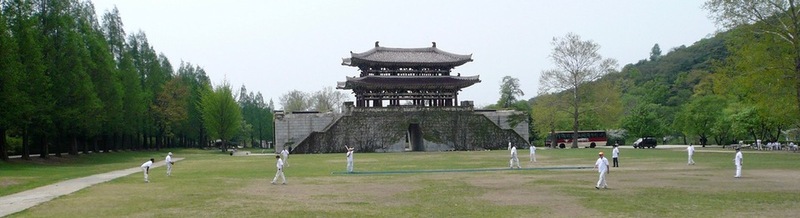
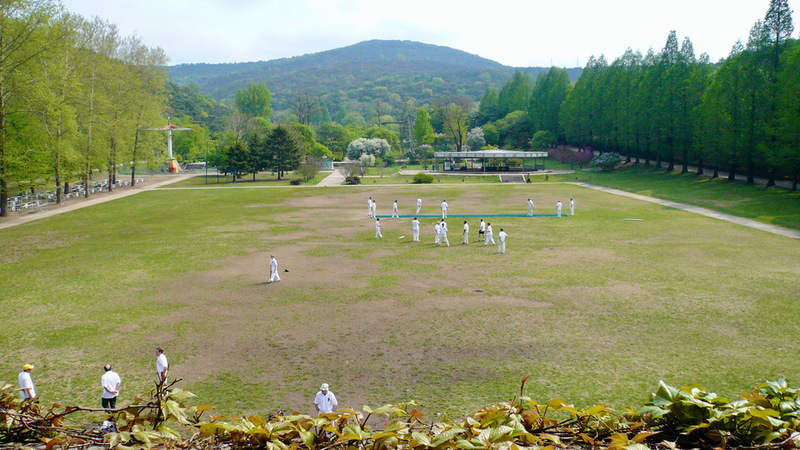
The venue was Taesongsan Park on the outskirts of Pyongyang. We chose this area because it is the only flat, usable piece of grassy land in the city.
The park wasn't designed for cricket, and the boundaries were comically short, but it would have to do.
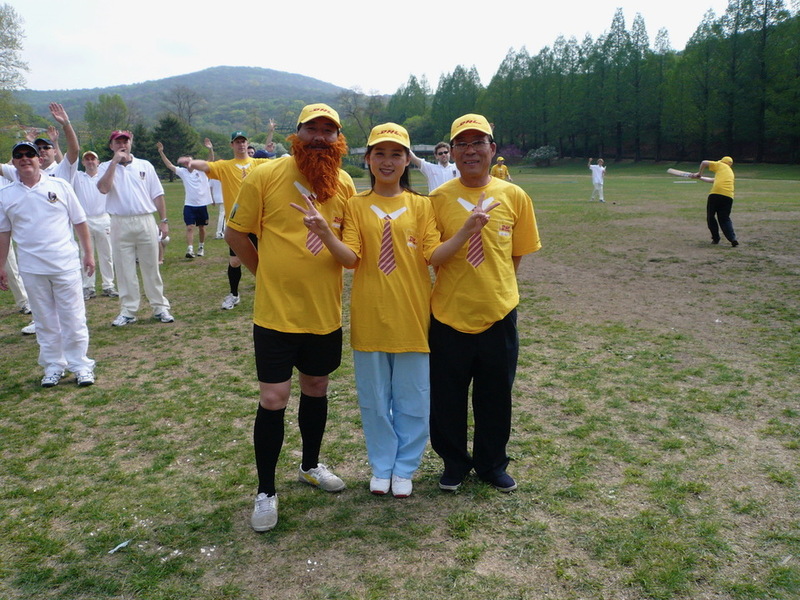
The event was dubbed the DHL Pyongyang Cricket Friendship Cup, sponsored in part by DHL, and framed as a gesture of friendship rather than competition.
Twenty20 Tournament in North Korea
On 25 April 2008, just days before North Korea's May Day celebrations, the teams assembled for a full triangular Twenty20 tournament.
For those unfamiliar - a Twenty20 match limits each team to 20 overs (an over being six deliveries), so each game consists of 40 overs in total, assuming no side is bowled out before their allotment is up.
Three teams, all playing each other, means three matches. It's very possible to fit that into a single day if you keep things moving, and they did.
The three sides taking the field were two teams from the Shanghai Cricket Club, diplomatically named Juche and Reunification after core pillars of Kim Il-sung's political philosophy, and the hastily formed Pyongyang Cricket Club (PCC).
The SCC sides were stacked with Commonwealth expats. British, Australian, South African and others living in Shanghai, including staff from the British Embassy in Pyongyang.
The embassies of other cricket-playing nations in the DPRK, namely India and Pakistan, were invited but declined the chance to make history.
Meet the Teams
The PCC team was a fascinating mix.
It included local tour guides, a coach driver who had played softball during his time in the Korean People's Army and therefore at least knew which end of the bat to hold, two young lads from the tour company, and a DHL representative.
The North Korean players had been given some brief lessons the day before, but cricket remained largely a mystery to them.
That said, as the day unfolded, some genuine talent emerged, with a few of the locals picking up the basics surprisingly quickly.
North Korea's First (& Only) Cricket Match
The matches were lively. Over 800 runs were scored across the three games as the short boundaries encouraged big hitting.
The SCC Juche team ultimately lifted the inaugural DHL Pyongyang Cricket Friendship Cup. A marching band even paused to watch the spectacle, likely the first time they had seen foreigners playing this peculiar sport.
At lunch, the visitors served traditional cucumber sandwiches, embracing the full spirit of the gentleman's game in one of the most geopolitically unusual settings imaginable.
Players walked through a victory gate to bat, adding a touch of local flair.
A Tour through North Korea
The five-day visit offered the touring party a rare, tightly controlled window into North Korean life.
They stayed at the Yanggakdo Hotel, a 47-storey tower on an island in the Taedong River reserved for foreign visitors. The hotel bars and restaurants had plenty to drink, though the small casino on site was notably free of both music and alcohol. Roads were wide and relatively empty.
The group visited the DMZ from the northern side, feeling the full weight of the armistice that has defined the Korean Peninsula since 1953.
They also hosted what is thought to be North Korea's first-ever pub quiz in the bar at the since-demolished Yanggakdo Island pitch & putt golf course.
Cricket in the DPRK had one earlier precedent of sorts, back in 2002, when British Embassy staff in Pyongyang engaged in a bit of bat-and-ball play during a picnic, apparently in an attempt to get North Korea mentioned in Wisden, the venerable cricketing almanac.
It was a charming effort, but it hardly constitutes an actual match.
A Future of Cricket in North Korea?
After 2008, nothing followed.
The Friendship Cup continued as an annual SCC event back in Shanghai, but North Korea has no domestic cricket league, no national team, and no cultural footprint for the sport.
Whether cricket is somehow ideologically incompatible with the DPRK is perhaps overstated. After all, fishing is enormously popular in North Korea, and that is not exactly a regimented mass-participation propaganda event.
The more straightforward answer is simply that cricket isn't played there, and there has been no sustained push to change that.
Why did the 2008 event happen at all?
It was imagined and requested by the Shanghai Cricket Club, and developed and implemented by Koryo Tours in collaboration with their partners in Pyongyang. Simple as that.
The Friendship Cup stands as a testament to what a determined group of cricket enthusiasts, a specialist tour operator, and a willingness to embrace the thoroughly absurd can achieve.
As the sun set over Taesongsan Park that April day, the players packed up their gear, exchanged handshakes, and returned to their respective worlds. The matting pitch was rolled away, the cucumber sandwiches long since devoured.
Cricket had briefly lit up one corner of the Hermit Kingdom before vanishing back into the shadows.
For those who were there, it was unforgettable. In the annals of the sport, it may be a footnote.
But it happened.
And in a country where almost nothing unexpected ever does, that is more than enough.
A note on terminology. A golden duck in cricket means being dismissed on the very first ball you face. It is unambiguously the worst way to get out.
Our boss Nick was bowled for a golden duck in this event. Many of the Koreans present, hearing the word 'golden', assumed this must be some great honour. It is not.
Koryo Tours
Experts
in North Korea Travel
Since 1993
Share
Simon Cockerell
Simon has been Koryo’s General Manager since 2002. He has travelled to North Korea more than 175 times and has probably been to the country more than any other Westerner. He is a respected speaker on the country and appears regularly in international media. He is also a tour specialist in Kazakhstan, Turkmenistan, and the Russian Far East where he has personally designed and led multiple tours over the years.