For more than a century, Tutankhamun's treasures were scattered across old wooden cases in a crowded building in Tahrir Square. Since November 2025, the entire collection is together for the first time, in a building two kilometres from the pyramids that is now the largest museum dedicated to a single civilisation on earth.
The Grand Egyptian Museum, often shortened to GEM, is the new home of ancient Egypt's greatest treasures, sitting just 2 kilometres from the Great Pyramids of Giza and the Sphinx.
For more than a century, anyone hoping to see Tutankhamun's gold mask had to visit the old Egyptian Museum in Tahrir Square, a wonderful but famously crowded building with objects packed into old wooden cases.
Since November 2025, King Tut's treasures have a new home, and for the first time since the tomb was opened in 1922, the entire Tutankhamun collection is on display together.
If you're visiting the pyramids anyway, the Grand Egyptian Museum is the natural next stop, and it's well worth giving it the time it deserves.
Grand Egyptian Museum Introduction
A Brief History of the Grand Egyptian Museum
What to See in the Grand Egyptian Museum
Getting to the Grand Egyptian Museum
Opening Hours and Tickets
Practical Tips
Frequently Asked Questions (FAQs)
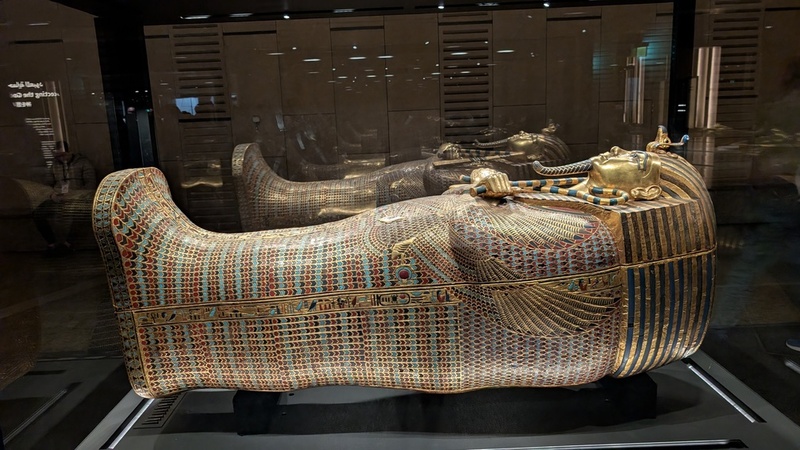
King Tutankhamun Collection
Grand Egyptian Museum Introduction
The Grand Egyptian Museum is on the edge of Giza on the western side of greater Cairo, with the main building designed so that its lines point straight towards the pyramids next door.
The site covers around 500,000 square metres (which is bigger than the entire Vatican City!) and the collection runs to more than 100,000 artefacts from around thirty dynasties of Egyptian history.
The building was designed by the Irish firm Heneghan Peng Architects and cost around a billion US dollars to complete.
Inside, the museum is laid out over several levels, with the Grand Staircase leading visitors from the entrance hall up to the main galleries, the Tutankhamun galleries and the views over the pyramids.
A Brief History of the Grand Egyptian Museum
Twenty Years in the Making (2002-2025)
The foundation stone was laid in 2002 and construction began in 2005, but the project then went through funding problems, the 2011 revolution, the COVID-19 pandemic and many postponed opening dates.
Moving the Treasures
Some of the biggest objects had to be moved across Cairo before the building was even finished. The giant statue of Ramesses II was moved from a busy roundabout outside Cairo's main railway station in 2006, and in 2021 Khufu's Solar Boat was moved from beside the Great Pyramid in one piece on a remote-controlled vehicle.
The Grand Opening (2025)
Parts of the museum opened to visitors in October 2024, and after a grand ceremony on 1 November 2025, the full museum, including the Tutankhamun galleries, opened to the public on 4 November 2025.
What to See in the Grand Egyptian Museum
With more than 100,000 objects, nobody sees everything in one visit, so here are the highlights not to miss:
The Hanging Obelisk
Before you even go inside, look out for the world's first "hanging" obelisk, an 87-tonne granite obelisk of Ramesses II from the ancient city of Tanis.
It's raised up on supports so that you can walk underneath and see the inscriptions on its base, which would normally be hidden in the ground.
The Ramesses II Colossus
The first thing you'll see in the entrance hall is an 11-metre (36-foot) granite statue of Ramesses II, around 3,200 years old, which for decades stood surrounded by Cairo traffic before finding a much more fitting home here.
The Grand Staircase
A six-storey staircase lined with around 60 statues of kings, gods and officials, leading up to the main galleries.
You can walk, use the moving walkway alongside it or take the lift, and at the top a huge window frames the Pyramids of Giza, one of the best photo spots in the museum.
The Tutankhamun Galleries
This is the main event for most visitors, with more than 5,000 objects from the boy king's tomb on display, many of them for the first time. Highlights include:
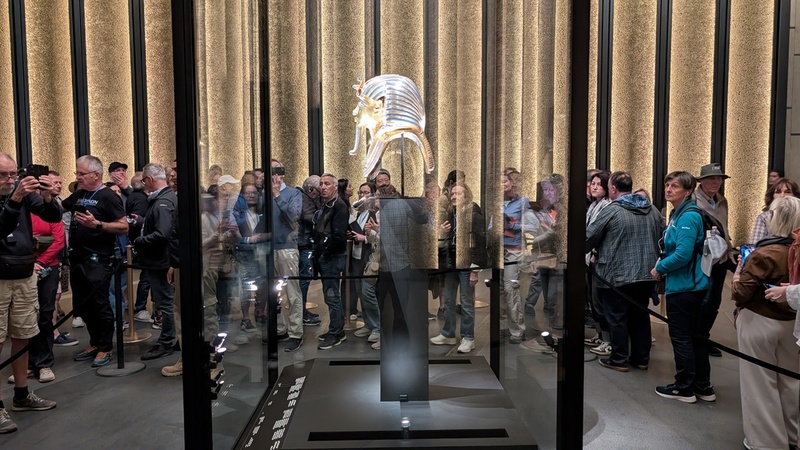
- the famous gold burial mask
- the golden throne
- the gilded shrines that once surrounded his sarcophagus
- all six of his chariots, displayed together for the first time
Give yourself at least an hour in these galleries alone.
Khufu's Solar Boat
The 4,600-year-old cedar boat of King Khufu, the pharaoh who built the Great Pyramid. At around 43 metres (140 feet) long, it was found in pieces in a pit beside the pyramid in 1954 and painstakingly reassembled. A second boat found nearby is still being restored.
The Main Galleries
Twelve galleries take you through Egyptian history from prehistoric times to the Roman period, arranged by era and by theme (society, kingship and beliefs). Look out for the kneeling statue of Hatshepsut, the female pharaoh who had herself shown as a man, and the painted wooden soldier figures from the Middle Kingdom.
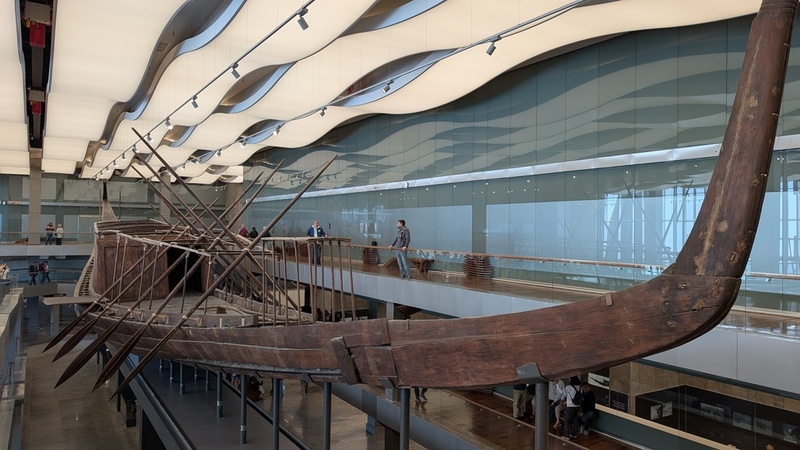
King Khufu's Solar Boat
Getting to the Grand Egyptian Museum
The museum is on the Cairo–Alexandria desert road, around 2 kilometres from the Giza Plateau and around 18 kilometres (11 miles) from Tahrir Square in downtown Cairo.
- From downtown Cairo, a taxi, Uber or Careem takes anywhere from 35 minutes to more than an hour, depending on Cairo's famously unpredictable traffic.
- From the pyramids it's only around a ten-minute drive, so most visitors combine the two in the same day.
Opening Hours and Tickets
- Opening hours: At the time of writing, the galleries are open from 9am to 6pm on most days, with late opening until 9pm on Wednesdays and Saturdays. Last entry is one hour before closing, and hours can change during Ramadan and public holidays.
- Tickets: At the time of writing, a foreign adult ticket costs around 1,450 Egyptian pounds (roughly USD 30), with discounts for students and children aged 6 to 12, and free entry for children under 6.
- Tickets need to be booked online in advance through the museum's official website, as prices have changed several times since opening.
Practical Tips
A few things worth knowing before visiting the Grand Egyptian Museum:
- Book ahead. Don't count on buying tickets at the door, and book a time that gives you plenty of hours before closing.
- Go early or late. The first hour after opening and the late afternoon are the quietest times, while midday, Fridays and public holidays are the busiest.
- Head to Tutankhamun first. The Tutankhamun galleries fill up quickly once the tour buses arrive, so see them early and come back to the main galleries afterwards.
- Allow enough time. Plan for at least three to four hours to see the highlights, and a full day if you're a real Egyptology fan.
- Photography. Phone photos are allowed in most areas, but flash is not, and some parts of the Tutankhamun galleries have stricter rules. Professional cameras and tripods may need a separate permit.
- Travel light. Large bags aren't allowed in the galleries, but there is free bag storage at the entrance.
- Food and drink. There are cafés and restaurants on site (including a proper Starbucks!), including one with views towards the pyramids, so there's no need to leave the museum for lunch.
- Accessibility. The whole museum is wheelchair accessible, with ramps and lifts throughout.
Frequently Asked Questions (FAQs)
- Is the Grand Egyptian Museum fully open? Yes, the full museum, including the Tutankhamun galleries and Khufu's Solar Boat, opened to the public on 4 November 2025.
- Is Tutankhamun's gold mask in the Grand Egyptian Museum? Yes, the gold mask is now displayed at the Grand Egyptian Museum together with the rest of the Tutankhamun collection.
- How far is the Grand Egyptian Museum from the pyramids? About 2 kilometres, or around a ten-minute drive, so it's easy to visit both on the same day.
- How long do I need at the Grand Egyptian Museum? At least three to four hours for the highlights, or a full day to see the collection properly.
- Can I buy tickets at the door? Tickets should be booked online in advance through the official website, so it's best not to rely on buying them on the day.
- What's the difference between the Grand Egyptian Museum and the Egyptian Museum in Tahrir Square? The Tahrir Square museum is the original Egyptian Museum, opened in 1902. It's still open and well worth a visit for its historic atmosphere, but the Tutankhamun collection has now moved to the Grand Egyptian Museum.
Koryo Tours
Group Tours to Egypt
Share