Tbilisi has been Georgia's capital for around 1,500 years, squeezed along a river valley between the great empires that have fought over it ever since. Orthodox churches, Islamic mosques, Persian architecture and Jewish synagogues all sit within walking distance of each other in the old city, which tells you everything you need to know about this place and its history. Here is your complete guide.
Tbilisi is the capital of Georgia, one of the three countries that make up the region known as the Caucasus.
The city is by far the most important political, cultural, and economic centre of the country, and has held its role as the national capital for around 1,500 years.
The city stretches along the banks of the Mtkvari River, and is famous both for its naturally hilly geography, traditional neighbourhoods (which make for a fantastic walking tour!) and the many church buildings and stunning architecture which defines this region of the world.
The city has long stood at the crossroads of trade routes criss-crossing the mountains of the Caucasus and Central Asia between Europe and the Far East, as such the city itself feels like a melting pot of different cultures; Georgian orthodox churches rub shoulders with Islamic mosques, Jewish synagogues, and buildings derived from Persian traditional architecture.
Tbilisi is a city where geography has played a major role in defining its heritage. A narrow capital squeezed along a river valley, sandwiched between great empires.
The Name ‘Tbilisi’
Tbilisi Location
History of Tbilisi
What to See in Tbilisi
Weather in Tbilisi
The Name ‘Tbilisi’
The name of the city ‘Tbilisi’ can be a headache for foreign travellers to spell, however, the history and etymology behind the title of this capital dates back centuries.
The name is connected to the old Georgian word ‘Tbili’ which means warm.
Historians suggest that this moniker is derived from the many hot springs that pepper the natural landscapes around the city. Such warm water and hot springs would have driven ancient peoples to cluster in the region, eventually establishing settlements that would grow into the modern city.
The legend of the name Tbilisi dates back to King Vakhtang I Gorgasali. The myth tells a tale of his hunting exploits during the 5th Century. He was supposedly hunting in the area, sending off a falcon to pursue an escaping pheasant, although during the chase, the two birds fell into a hot spring. Having discovered these hot springs, the king decided to found a city on the site, which would later become Tbilisi.
In older European or Imperial Russian/Soviet texts, you might come across the alternative name Tifilis.
Tbilisi Location
The city of Tbilisi sits in Eastern Georgia along both sides of the Mtkvari River. The city is surrounded by high hills and mountains, which has forced the city to expand along the river valley, rather than uniformly outwards from its centre.
The historic centre of Tbilisi is concentrated around the river, whilst the more modern neighbourhoods of the city have expanded considerably further out.
It’s worth noting that Tbilisi is much more of a hilly city than it might appear on a map.
For travellers planning a jaunt around the Georgian capital, be prepared for walks on foot to involve some challenging inclines as the roads criss-cross around the hillsides.
The mountain of Matsminda sits immediately west of the old city, and roughly translates to ‘Holy Mountain’. It overlooks the city and is home to a park, restaurants and viewpoints.
It’s possible to get up to the top using the Tbilisi funicular railway.
History of Tbilisi
As previously mentioned, the city is said to have been established by King Vakhtang I Gorgasali of Iberia in the 5th century, although there have been settlements in the area much longer than that.
The city historically sat on a major crossroad of the Silk Road. Travellers from Europe heading to the oriental states and China often needed to traverse the rough Caucasus region before venturing across the Caspian Sea and Central Asia. As a result, the settlement at Tbilisi was both a very commercially and strategically important city.
As a result of its significance, the city has been fought over by empires and kingdoms numerous times, especially between the Sasanian Persian Empire and the Byzantine Empire.
Arab forces reached Georgia by the 7th century, and by the 8th, Tbilisi become the heart of the Emirate of Tbilisi, ruled over by an Islamic Emir.
The rule of the Emirate over modern day Georgia lasted for several centuries until 1122 when it was captured by King David IV of Georgia, known as David the Builder, and kickstarted the Georgian Golden Age.
This period of calm was crushed by the Mongol invasions of the 13th century, the invasions of the 14th and 15th centuries by the armies of Tamerlane, and then the ongoing feud between the Persian and Ottoman Empires, in which Tbilisi was caught in the midst of.
By the 19th century, Tbilisi was firmly under the control of the Russian Empire, which would go on to become the Soviet Union, naming Tbilisi as the capital of the Georgian Soviet Socialist Republic until 1991.
During the Soviet era, the capital of Georgia expanded and industrialised rapidly, gaining huge new residential districts, and new factories and infrastructure. The Tbilisi metro opened in 1966.
After independence from the Soviet Union, the city began to modernise into the economic and cultural hub that it is today, seeing a huge influx of new tourism and becoming and unmissable highlight of any visit to the Caucasus region.
What to See in Tbilisi
Old Tbilisi
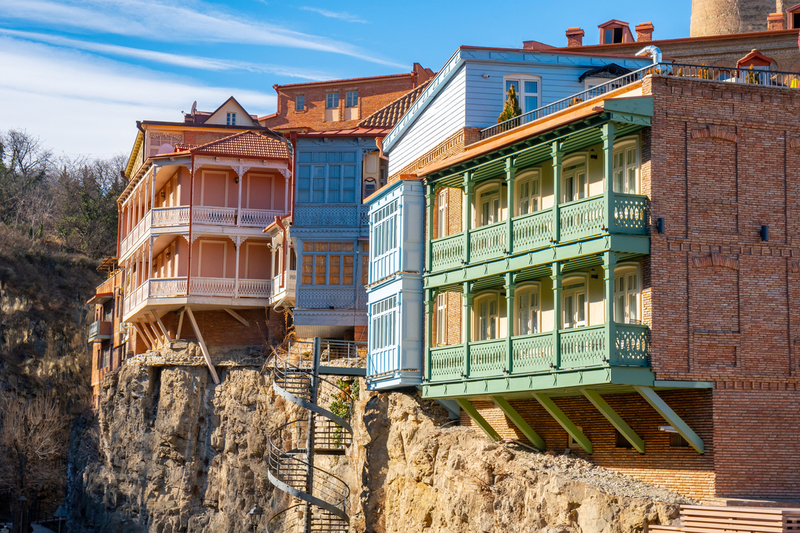
Old Tbilisi is the historic core of the city, home to narrow winding streets, traditional wooden houses, Georgian orthodox culture, and the traces of centuries of multicultural diversity which has come to define the city.
The main appeal of a visit to the old city is just wandering the streets, finding hidden alleyways, rubbing shoulders with local people, and appreciating the atmosphere of a city which has grown up organically over the centuries.
Abanotubani and the Sulfur Baths
One of the most important (and name-defining) highlights of the Georgian capital is Abanotubani, the name given to the historic bath district. The area is defined by rows of low brick domes with many bathhouses being built underground.
The sulphurous hot water is naturally occurring from the nearby hot springs, and bathing remains a local tradition and pastime, rather than a historical relic. Here you’ll have a chance to experience some local Georgian bathing alongside local people.
One unmissable building here is the Chreli Abano, a distinctively Persian building with its blue tiled façade putting one in mind more of Tehran than Tbilisi.
Narikala Fortress
The Narikala Fortress is one of Tbilisi’s defining landmarks. The site has a very long history, hence, its design has been influences over the centuries by subsequent rulers. However, one unchanged element is its commanding position on a hillside high above the rest of the city.
Historically, this was a defensive measure, although today it allows for some incredible views over the capital city and can be visited on foot or via a local cable car up the side of the mountain.
Weather in Tbilisi
Tbilisi has traditional seasons, with very cold winters, and very hot summers. Its location within a river valley can serve to exacerbate the weather throughout the year.
During springtime, the weather can remain fairly cool and unpredictable, warming towards the end of the season, but with cool evenings and occasional rainy showers. April-May is probably the most ideal time for sightseeing, as the venturing around the city on foot can get tiring in the high heat of summer.
Between June to August, the summer weather brings high heat, often around the mid-30s during the daytime. During summer trips, plan your sightseeing in the early or later hours and avoid the intense heat of the early afternoon.
Later in the year, the weather cools again for autumn. For similar reasons to spring, a trip during the September-November period means walking the city’s streets becomes much less strenuous, although the weather remains warm to mild throughout the periods. Autumn also coincides with the traditional grape harvesting season, so for those keen to experience some Georgian wine, this is the perfect time to travel.
During the winter, temperatures are a few degrees above freezing, although overnight temperatures often dip below. The city sees much less tourism, which could be seen as a positive, making the city more atmospheric (and a chance to make use of the hot baths!), but there is also the disadvantages of walking around the old city on foot in cooler temperatures.
Koryo Tours
Group Tours to The Caucasus
Share