Socotra is the rare destination where the money chapter is genuinely simple. Almost everything is prepaid before you land, cards are not an option, and your wallet's main job for the week is tips, honey and dragon's blood resin. Here is everything you need to know.
Here's a travel-planning sentence you don't read often: on Socotra, the money chapter is the easiest one in the book. An island with no functioning card network, no reliable ATMs and a currency most people have never held sounds like a financial obstacle course, but the reality of a Socotra trip flips it: nearly everything is paid before you land, and your wallet's job shrinks to tips, souvenirs and honey.
Still, the details matter, especially on an island where the nearest backup plan is a flight away. Here's the complete guide to money and currency in Socotra.
Socotra Money Quick Answers
The Currency in Socotra, The Yemeni Rial
Using USD in Socotra
Cash vs Card payments in Socotra
The Dragon Blood Tree Money
How Much Money do I Need in Socotra?
Socotra Money Quick Answers
Socotra uses the Yemeni rial. Rates fluctuate, so trust your guide.
Cards and ATMs are a no.
Bring clean US dollars.
USD is widely accepted on the island and much easier than exchanging into local currency. Bring small notes.
There isn’t much to buy. 50 - 100 USD for a week in Socotra will generally cover souvenirs, snorkelling rental and tips for the local guides.
The Currency in Socotra, The Yemeni Rial
Socotra belongs to Yemen, so the local currency is the Yemeni rial (YER).
The rial has weakened substantially through years of mainland conflict, exchange rates run deep into four figures per US dollar and move around constantly, and rates can even differ between regions of the country.
Ignore any specific number you read online, including in this post if I were foolish enough to quote one, and rely on your guide for the fair rate on the ground during your trip.
You can exchange small amounts as needed, usually in Hadibo, the capital, where the island's modest cash economy is centred. The rial comes in well-travelled notes, and even modest exchanges produce satisfying bricks of currency.
Using USD in Socotra
You can of course change money into the local currency if you want. However, much more practical is simply using USD.
USD is accepted widely throughout Socotra. And, where it isn’t, your local guide will help you do small local payments.
You really have no need to exchange money.
Carry a sensible mix of denominations: larger bills exchange efficiently, smaller bills handle tips and minor purchases without requiring change nobody has.
Split your cash between a couple of secure spots in your kit, standard practice anywhere, and note that the camping convoy environment of a Socotra tour, with the same trusted local team around you all week, is about as low-stress a cash-carrying scenario as travel offers.
Cash vs Card payments in Socotra
The operating rule for Socotra is identical to mainland Yemen - this is a pure cash destination, and the cash to bring is US dollars.
Leave your expectations about plastic at home.
International credit and debit cards have no role in Socotri daily life, and ATMs that talk to foreign banks are not something to count on existing at all.
The island's banking links to the outside world are minimal.
So the playbook is simple. Bring clean, undamaged, recent-series US dollar bills, since worn or marked notes can be refused by money changers anywhere in this region.
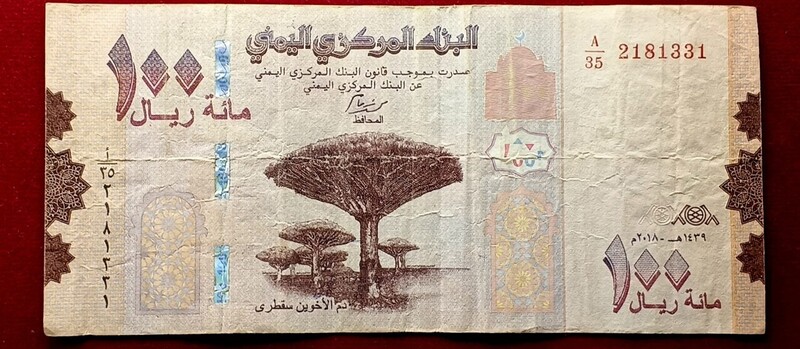
The Dragon Blood Tree Money
If you don’t exchange your USD into local Yemeni Rial, make sure you ask your local guide to help you to source a ** note.
This note features the famous Socotra Dragon Blood trees, and make the perfect souvenir.
How Much Money do I Need in Socotra?
Budgeting in Socotra is pretty simple as generally speaking, your tour to Socotra will include everything you need.
Food, transport, any permits, entry fees, accommodation…
You just need to bring some money for optional extras, of which there aren’t that many either.
There are a couple of souvenir shops - some run by women and a great initative to support.
And otherwise, you might want to splurge $20 on a fresh lobster from local sellers on the beach or on renting some snorkelling equipment (around 10-20 USD).
Here's a realistic framework for a week.
Tips are the main planned expense. The crew that makes a Socotra circuit run, guide, drivers, and the chef team responsible for grilled lobster on a beach, genuinely earns them.
Souvenirs are concentrated and special. The big three are dragon's blood resin, the deep-red sap of the island's signature tree; Socotri honey, produced in tiny quantities and priced like the treasure it is; and frankincense, echoing the ancient trade that once made this region rich. The women-run craft centre in Hadibo is the best place to buy, with woven goods and pottery alongside, and your money there supports the makers directly.
Small spends cover snorkel rental at Dihamri, snacks and drinks in Hadibo, and the odd market impulse. These amount to very little.
Top tip: You can’t get any more once you’re there. Bring comfortably more than your estimate.
Koryo Tours
Group Tours to Socotra
Share