Yerevan is older than Rome, sits at 1,000 metres above sea level with Mount Ararat visible on the horizon, and takes its nickname from the pink volcanic stone used to build much of the city centre. Here is your complete guide.
Yerevan is the capital and largest city of Armenia, nestled amidst the mountains and valleys of the Caucasus region alongside Georgia to the north and Azerbaijan to the east.
Yerevan has served as the Armenian capital since 1918, becoming the principle political, economic, and cultural centre of the country. The city hosts around a third of the entire population of the country, with approximately 1.1 million people who call Yerevan home.
The city is located in western Armenia, on the northeastern ridge of the Ararat Plain. The city has grown up along the banks of the Hrazdan River, sitting approximately 1,000 metres above seal level and surrounded by dry hills and mountains.
Most notably, Mount Ararat is visible on clear days from the city, although it sits just across the border in Turkey.
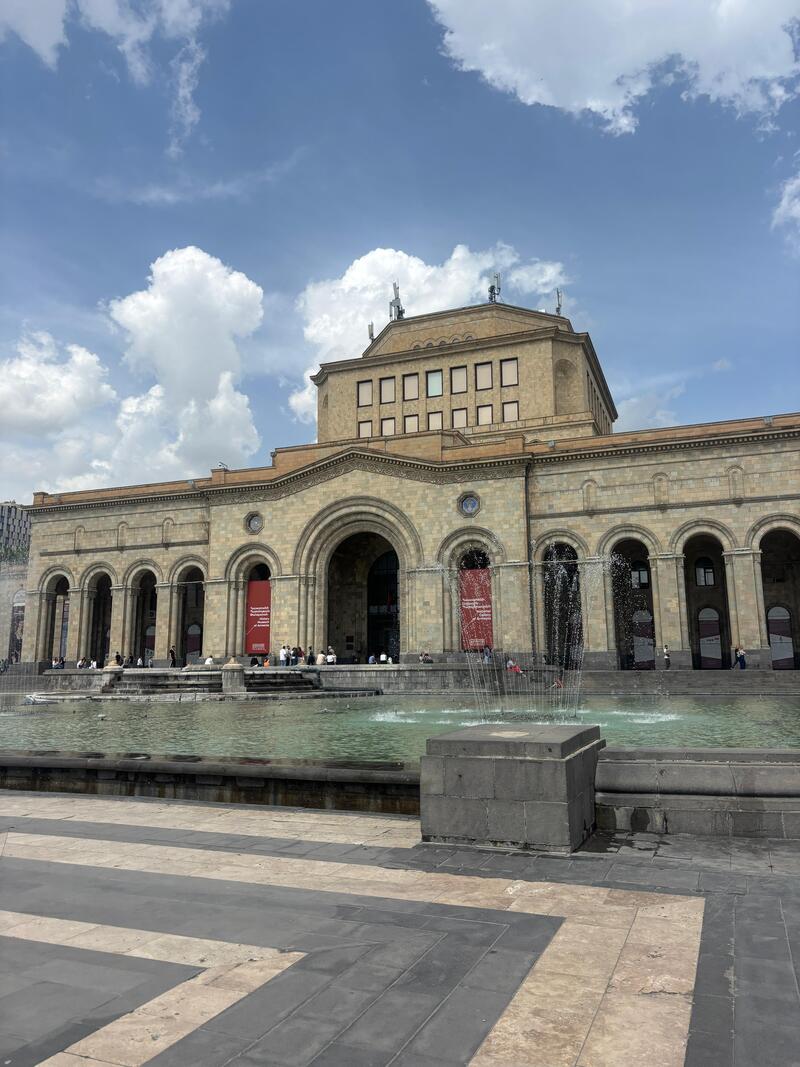
The city takes its nickname ‘The Pink City’ from the huge amount of volcanic material used in its construction, leaving a distinctive pinky orange hue on many buildings.
Yerevan as a city traces its heritage back to the Erebuni Fortress, established by King Argishti I in 782 BCE, making Yerevan 29 years older than Rome as a settled city. The city has, of course, changed significantly since them, with much of the city centre dating back to the period when Armenia was a Soviet Socialist Republic within the USSR.
The result of this is a mixture of ancient heritage, traditional Armenian architecture, and strict Soviet urban planning.
Historically, the city lay on the Silk Road routes which connected the Russian states of the north with the regions around Anatolia, Persia, and then the far east over the Caspian Sea.
Yerevan underwent periods of control by Persian Empires, Arab Caliphates, and the Russian Empire.
The Name ‘Yerevan’
Yerevan Location
What to See in Yerevan
Yerevan Weather
The Name ‘Yerevan’
The city’s name ‘Yerevan’ is generally associated with the fortress which preceded it on the site, Erebuni.
Over the centuries as languages came and went and empires rose and fell, its believed the name evolved into the moniker we know today, leaving a direct connection between the modern settlement and the ancient fort which first stood on the banks of the river.
There is an alternative theory; Armenian traditions connect the name with the biblical story of Noah. The legend goes that Noah saw dry land from his ark and exclaimed “Yerevats!” which roughly means “It has appeared”.
Mount Ararat nearby is also closely associated with the story of Noah, with myths declaring that the ark came to rest on the mountain.
Yerevan Location
The Armenian capital is situated in western Armenia and dominates the northeastern part of the Ararat Plain. The city lies relatively close to the border with neighbouring Turkey and is surrounded by the Armavir, Aragatsotn, Kotayk, and Ararat Provinces.
The main geographical landmark is the Hrazdan River which runs north to south through the capital city, rising from Lake Sevan, and running south through Yerevan into the Aras River.
There are bridges criss-crossing the river as it flows through the city, cutting a deep gorge as it goes. Unlike nearby Tbilisi, the capital of Georgia, also situated on the banks of a river, the city isn’t centered over the river, instead, most of Yerevan sits east of the river valley.
The city stands 1,000m above seal level, although elevation varies across the capital. Central Yerevan is relatively easy for a walking tour, although roads begin to rise as you head towards the northern neighbourhoods.
The dominating presence on the skyline is the aforementioned Mount Ararat which, despite being in Turkey, has become an important symbol both of Yerevan and Armenia, appearing on the national coat of arms.
When visiting the Armenian capital, the central area is compact enough to easily explore on foot with sites such as Republic Square, the Opera House, Northern Avenue, and the Cascade being major sightseeing highlights.
Other areas such as Erebuni Fortress are noticeably further out and may require transport to reach.
What to See in Yerevan
Republic Square
Republic Square is Yerevan’s main public square and the symbolic heart of the capital city. The square was designed as part of the Soviet-era city planning project and as such is surrounded by monumental buildings including Government House, the History Museum and National Gallery of Armenia. With grand fountains and the oval design and stonework, it’s clear to see the Soviet influence on the square and the city plan more broadly.
The Cascade
The Cascade Complex is a monumental staircase built out of limestone in the northern part of the city centre. The stairs connect the city’s main square with the Victory Park Area and contains terraces, sculptures, fountains, and gardens.
For those not keen on walking the whole thing, outdoor escalators mean visitors don’t need to traverse every step!
Erebuni Fortress
The Erebuni Fortress and Museum is an archaeological site which is traditionally considered the birthplace of the city.
Excavated remains of the ancient fortress include grand halls, foundations, and temples from the original construction. The adjoining museum provides travellers with context on the significance of the fortress both for Yerevan as a city, and Armenia as a country more broadly.
Armenian Genocide Memorial & Museum
Tsisernakaberd and the Armenian Genocide Museum is the principle memorial complex commemorating the victims of the Armenian Genocide. The complex was opening in 1967 and consists of twelve inward-leaning stone slabs all centered around an eternal flame.
The museum is dedicated to recording the events of the genocide and is an important site to visit whilst travelling through Armenia given the significance of the genocide to Armenian national society and culture.
Vernissage Market
The Vernissage Market sits close to the central Republic Square home to stalls selling arts, crafts, and souvenirs. The market is especially active at weekends and is a great place to pick up carpets, jewellery, ceramics, and other artworks. It is especially renowned for traditional Armenian handicrafts.
Yerevan Weather
The general climate in Yerevan is dry, with hot sunny summers and relatively cold winters.
The altitude of the city can create significant differences between daytime and overnight temperatures. Rainfall is limited in the city, with most of the rain coming in the spring, otherwise, skies often remain clear which can cause strong sunlight which visitors should be aware of especially if walking the streets of the capital.
The Spring in Yerevan sees the transition from colder temperatures in March to a warmer and milder climate in May. Spring is one of the wetter periods weather-wise, although it’s more typical to see short burst showers rather than continued rainfall. April and May are good months for sightseeing around the city before the intense summer heat arrives.
Summers are hot and dry in Yerevan with daytime temperatures often exceeding 30 degrees Celsius. July and August are the hottest months in the capital, so any visits to the capital during these months need to take the temperature into account. Mornings and evenings are often cooler, so this makes for the best opportunity to explore the city on foot. Summer evenings in Yerevan are lively with many cafes and restaurants staying open later into the evenings, especially around squares and public spaces.
In Autumn, the weather remains warm and dry, but less intensely sunny than during high summer. The temperature remains as such through September and October, which makes for the perfect sightseeing climate, not to mention the grape harvest which creates the opportunity to find out more about the wine industry in the country. By November, temperatures drop sharply.
During the Winter, departures are cold with daytime temperatures hovering around freezing which leads to lower tourist numbers. This can be seen as a positive for some travellers who are keen to explore the city without the number of foreign travellers typical during the warmer months.
Koryo Tours
Group Tours to The Caucasus
Share