Shibam is Yemen's headline attraction and most of the world has never heard of it. Five hundred mud-brick tower houses, up to ten storeys tall, packed onto a rock above the Wadi Hadhramaut.
What is Shibam?
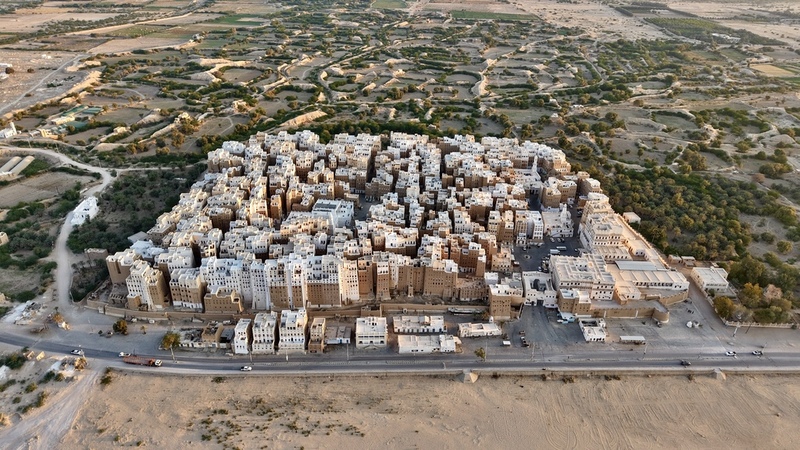
Shibam is a walled city of roughly 500 mud-brick tower houses, eight to ten storeys tall and rising up to 40 metres, packed shoulder to shoulder on a rock above the Wadi Hadhramaut.
It's a UNESCO World Heritage Site. And one of the oldest examples of high-rise urban planning on earth. People still live in it!
Every country has its headline attraction. Egypt has the pyramids, Cambodia has Angkor, Peru has Machu Picchu.
Yemen has Shibam - the headline attraction of any tour to Yemen.
And the wild thing is, that most of the world has never heard of it.
This guide covers everything you need to know to visit Shibam yourself. And provide you with enough context to fully understand what you’re seeing when you actually do visit.
Shibam History
Shibam Architecture
Why Shibam Matters
What to See in Shibam
When to Visit Shibam?
How to Visit Shibam
Tips when Visiting Shibam
Shibam History
Shibam owes its existence to two forces - money and trouble.
The Hadhramaut sat on the ancient incense routes that carried frankincense and myrrh from southern Arabia toward Rome and India, and the kingdoms that controlled this trade, Sheba and Hadramaut among them, grew rich on it.
Riches need protecting, and Shibam's answer was to build a fortress city on high ground. Safe from both raiders and the wadi's flash floods, and to build it upward rather than outward.
The towers you see today date mostly from the 16th century, raised after a great flood, though the city itself is far older.
Shibam Architecture
Each tower house traditionally held a single extended family, with animals and storage at the bottom, living quarters above, and the social rooms with the best breeze at the top.
The upper floors get a coat of white lime wash, which protects the mud below and gives Shibam its distinctive two-tone look, earth-brown bodies with bright white crowns.
The miracle is the maintenance.
Mud-brick is durable but needy. It must be re-rendered and repaired, generation after generation.
Shibam still stands because the families who inhabit the towers, descendants of the original builders, have never stopped doing exactly that for five hundred years.
Why Shibam Matters
Plenty of places are old. Plenty of places are beautiful.
What makes Shibam singular is that it's an idea proven across five centuries… that ordinary mud, shaped by extraordinary skill and maintained with stubborn love, can stand taller and last longer than anyone has a right to expect.
UNESCO calls it outstanding universal value.
Shibam is what happens when a community decides its home is worth keeping, and then keeps it, through droughts, floods, empires and wars, for five hundred years and counting.
The ‘Manhattan of the Desert’ has no crowds, no queues and no souvenir gauntlet.
Just towers, palms, light and the quiet astonishment of being one of the few people on earth who has seen it in person.
What to Do (and to See) in Shibam
Give yourself at least the afternoon in Shibam, firstly to walk around and then to enjoy the sunset view.
Walk the Shibam alleys
The city is best experienced on foot, drifting through lanes so narrow the towers nearly touch overhead.
Look for the details: carved wooden doors with ancient chunky locks, rows of shuttered windows climbing the facades, decorative parapets against the sky.
The shade between the towers keeps the alleys surprisingly cool, which was, of course, the point.
Visit the Shibam museum.
A small museum inside the city walls gives context to what you're walking through, covering the architecture, the history and the daily life of the tower houses.
It's a quick visit and worth every minute, especially since you get to see the local architecture from inside, too.
Meet the residents of Shibam
Shibam isn't a preserved relic or museum town, it's a working town. Kids play in the squares, men chat in doorways, goats patrol with administrative confidence.
Visitors are rare enough to be interesting, and a guided walk usually dissolves into a series of small, warm encounters.
Ask before photographing people, and you'll almost always get a yes.
Climb to the sunset viewpoint of Shibam
This is the non-negotiable.
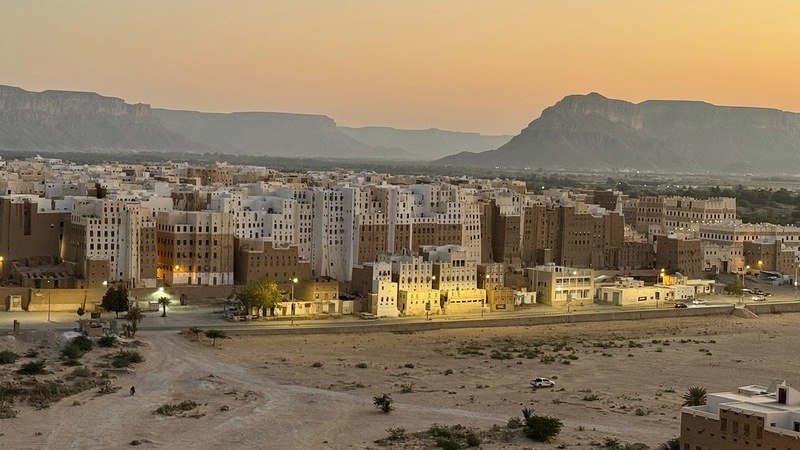
Across the wadi from the city, a viewpoint on the rising ground gives you the full skyline at golden hour.
As the sun drops, the towers shift from brown to honey to gold to rose, shadows stretch across the palm groves, and the call to prayer rises from the minarets.
It's one of the great sunset views on the planet, and you'll likely share it with nobody but your own group.
When to Visit Shibam?
Plan your visit for the late afternoon.
Midday light flattens the towers into a brown smudge and the heat saps the joy out of alley-wandering.
From around three o'clock onward, the angles sharpen, the colours warm, and the city becomes the most photogenic version of itself.
Plus, you’ll have the perfect amount of time left for that killer sunset finale.
Seasonally, the cooler months from roughly October to April are the comfortable window for Hadhramaut travel generally, with mild days perfect for exploring on foot.
Summer brings serious desert heat, which makes the timing of any visit, even within a day, matter much more… Summer is definitely not recommended.
How to Visit Shibam
How to get there
Shibam is a short drive from Seiyun, the capital of the Hadhramaut and home of the region's airport (GXF), usually reached via flights from Cairo.
The Hadhramaut has remained largely stable for years, and Shibam is a fixture of every southern Yemen itinerary.
On a typical route, Shibam comes as the climax of a Seiyun-based day, often paired with the palaces of Tarim or the souks of Seiyun in the morning.
Entry fees and permissions are handled by the local tour operators, so no need to worry about that.
Tips when Visiting Shibam
Here are some things to note when you plan your visit to Shibam:
- The alleys are uneven and the steps ancient, so watch your footing while gawking upward.
- Carry water, even in cooler months the desert air is thirsty work.
- Wear the traditional Yemeni outfit, both for cultural ease and because the photos of you in a thobe or abaya against the towers are frankly spectacular.
- Give the visit at least two to three hours, including the sunset. There’s no rushing in Shibam!
Koryo Tours
Group Tours to Yemen
Share