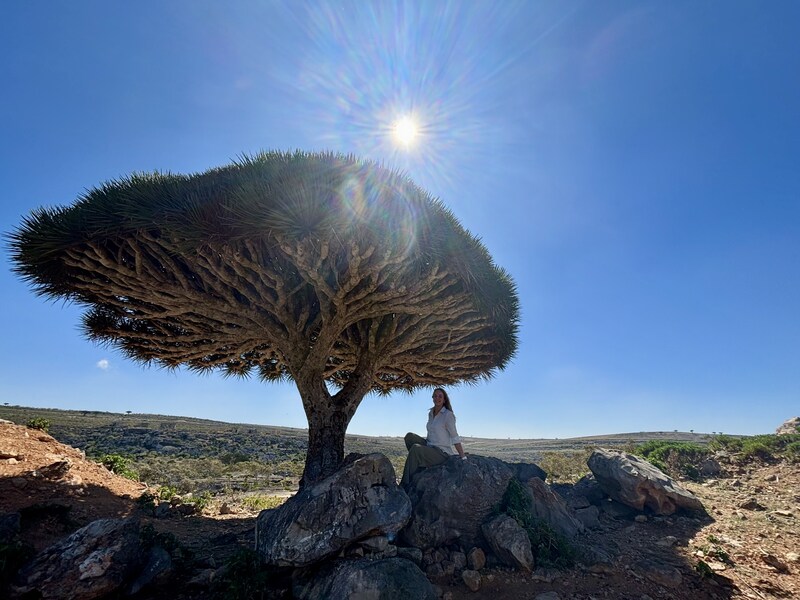
Ask anyone who has been to Socotra what they picture and they will describe the same thing. A high plateau covered in thousands of inverted-umbrella trees, mountains behind, the sea glittering in the distance. That place is the Dixam Plateau, and it is unlike anywhere else on earth.
Ask anyone who has been to Socotra to close their eyes and picture the island, and nine out of ten will see the same thing.
A high, wind-brushed plateau studded with thousands of inverted-umbrella trees, mountains behind, the distant glitter of the sea beyond.
That picture has an address. It's the Dixam Plateau, the centrepiece of Socotra and one of the most extraordinary landscapes on the planet.
And the thing that Google will most likely showcase when you type in ‘Socotra Island’.
The Dragon Blood Trees are iconic. And for good reason.
Here's everything you need to know about visiting it the Dixam Plateau, home of the Dragon Blood Trees.
Dixam Plateau Introduction
Sites at Dixam Plateau
The Dragon Blood Tree
Visiting Dixam Plateau
Camping Under the Dragon Blood Trees at Dixam Plateau
Practical Tips for Travelling to Dixam Plateau
Dixam Plateau Introduction
Dixam is the high limestone plateau of central Socotra, rising inland from the coast into a cooler, mistier world several hundred metres above the beaches.
This altitude is the secret ingredient. The fogs and moisture that brush the highlands are what the dragon blood tree evolved to harvest,
So it's here, on Dixam, that Dracaena cinnabari - the Dragon Blood Trees - grow most densely and most dramatically anywhere on earth.
And since this tree exists in this form only on Socotra, the Dixam Plateau is the dragon blood capital of the universe.
The plateau offers the finest views of the forest set against the mountains and the sea, with trees ranged across every ridgeline like a botanical army at parade rest.
Sites at Dixam Plateau
The plateau experience comes as a trio, Dixam itself provides the panoramas.
Wadi Dirhur
This spectacular canyon that cuts past the plateau, adds limestone walls hundreds of metres deep with dragon blood trees clinging to the rims and freshwater pools below.
Fermahin Forest
This forest delivers the immersion you will want.
One of the densest dragon blood tree forests on the island. You walk beneath the canopies rather than admiring them from afar.
Fermahin is one of the densest dragon blood forests on the island, and in the late afternoon light it becomes pure theatre.
Low sun streaming between the trunks, every canopy rimmed in gold, shadows stretching long across the red earth.
Walking here feels like being shrunk and placed inside a bonsai forest arranged by someone with impeccable taste.
The Dragon Blood Tree
A quick word on the tree itself.
The dragon blood tree's flat-topped canopy is formed by a repeated branching pattern.
Each limb divides again and again until the crown becomes a dense, self-shading dome that captures fog moisture and shelters the tree's own roots, an architecture refined over millions of isolated years.
Cut the trunk and it bleeds the deep red resin that gave the species its name and its legend, a substance traded along ancient incense routes as dye, medicine and varnish.
Over a third of Socotra's plant species exist nowhere else.
This is a level of endemism that earned the island UNESCO World Natural Heritage status in 2008, and the dragon blood tree is the flagship of that fleet.
Visiting Dixam Plateau
When travelling Socotra, you usually do so as a whole crew with 4WDs.
In fact, you need 4WDs to tackle the roads in the central islands. Ordinary vehicles will not make it. At all.
You climb in 4WDs from the coast into the highlands, the air freshens, and the first scattered dragon blood trees appear beside the track like outriders. You’ll never forget your first site of one.
Then the plateau proper opens up, and the convoy stops at viewpoints where the full spectacle lands. Forest, ridgelines, mountains, sea, and a horizon that seems borrowed from a larger planet.
The route then drops through or alongside Wadi Dirhur, the great canyon, where the scale flips from panoramic to vertiginous: sheer limestone walls, green pools far below, and trees silhouetted on the rim against the sky.
Camping Under the Dragon Blood Trees at Dixam Plateau
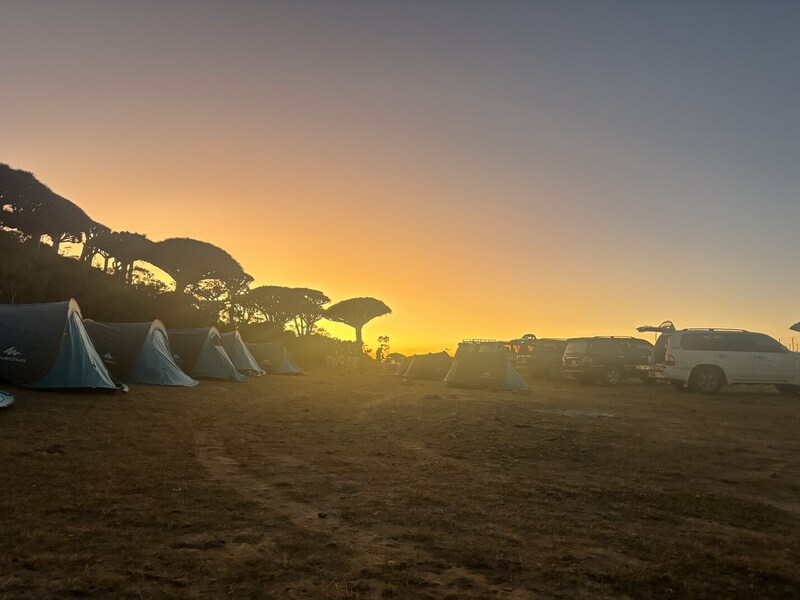
If you’re lucky, your itinerary on your tour to Socotra will include a night camping underneath these incredible Dragon Blood trees.
You can go for an afternoon or sunset walk amongst the forest (try not to get lost) and hit a sunset viewpoint that overlooks the incredible plateau.
Tents go up among the trees, dinner emerges from the chef team's kitchen, and after dark the plateau plays its trump card, dragon blood silhouettes against a Milky Way so bright it barely seems plausible.
Of all Socotra's campsites, and the competition includes turquoise lagoons and dune-backed beaches, the night among the trees is the one you will truly remember.
Because you’re literally never going to get it anywhere else.
Top tip for the perfect picture with stars and the trees - get a friend to hold a torch or phone pointing at one of the trees, all other lights off. Use your phone camera in night mode or camera on long exposure to take a picture as the tree lights up against the starry sky.
Practical Tips for Travelling to Dixam Plateau
Dress for the altitude.
The plateau runs noticeably cooler than the coast, especially after sunset.
The warm layer you packed and haven't touched all week earns its place tonight. Honestly, depending on when you visit, you might even need several layers or blankets - or even find yourself huddling by the fire.
Wear real shoes.
Plateau ground is rocky, wadi paths are rough, and the best viewpoints reward a short scramble. Trainers minimum, light hikers ideally.
Chase the light.
Don’t miss a sunset walk through the forest and to a viewpoint seeing the whole of the plateau.
Bring both lenses.
Wide for the ranks of trees against the mountains, long for isolating a single perfect silhouette.
Tread gently.
Young dragon blood saplings are rare and the forests regenerate slowly, which is precisely why the area is protected and visits run with local guides under the island's permit system.
Koryo Tours
Group Tours to Socotra
Share