Baku is a city where you can walk from a 12th century walled old city past the mansion of a 19th century oil baron and arrive at a glass tower covered in LED flames, all within a few minutes. Sitting on the Caspian Sea at the edge of the Caucasus, it is one of the most layered and least visited capitals in the region. Here is your complete guide.
Baku is the capital city of Azerbaijan, nestled on the shores of the Caspian Sea which separates the Caucasus region from Central Asia.
The city sits on the Absheron Peninsula, projecting out inside the Caspian, which historically made the city a vital centre for trade routes across the waves.
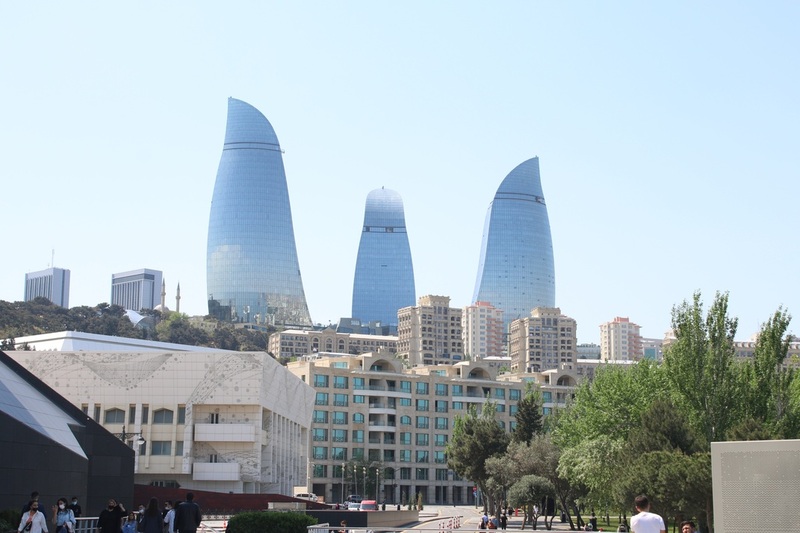
Baku city centre is hold to the Icherisheher, or the Old City, teeming with nineteenth century boulevards and traditional architecture, whilst the rest of the capital is characterised by Soviet-era city planning, and extremely conspicuous contemporary buildings like the famed Flame Towers or the Heydar Aliyev Centre.
Baku is an oil city, with the extraction and production of natural oil and gas seepages from the earth below known about since the days of Silk Road travellers, many of whom knew Baku for its natural fires.
Since then, the nineteenth century oil boom and industrial revolution transformed the city drastically, eventually becoming the modern capital we see today.
Visiting Baku today, one finds themselves travelling through centuries of change and progress in mere metres, as the relatively small city centre is home to medieval caravanserais, 12th Century city walls, the mansions of oil barons, the distinctive apartment blocks of the Soviet Union, and modern 21st century skyscrapers.
A mixture of ancient Islamic and Persian architecture, alongside Russian Imperial, Gothic, Neoclassical, Soviet, and Modern are what has come to define the city.
Despite its development, Baku is still one of those cities nestled in the heart of a region which hasn’t yet hit the tourist trail, and so an adventure through Azerbaijan isn’t complete without a few days in the capital.
The Name “Baku”
Baku Location
History of Baku
What to See in Baku
Weather in Baku
The Name “Baku”
The Azerbaijani name for the city is Bakı, and a rumour persists that the modern name derives from the Persian word Bādkūba, which means ‘wind-beaten’. Being a coastal city, this etymology is not unfounded, since the city does have an exceptional association with the wind.
Some have suggested however that the name derives from something close to Bagawān, or "God's place”. This is potentially linked to the aforementioned natural fires which formed a worshipping place for many ancient fire cults across the region.
Despite the unproven heritage of the name, the modern tourism slogan for the city is ‘City of Winds’.
Baku Location
Baku sits on the Absheron Peninsula, jutting out into the crystalline waters of the inland Caspian Sea.
The historic part of the city grew up around an area now known as ‘Baku Bay’ on the southern side of the peninsula.
Today, the waterfront is a major part of the city, with a large pedestrian boulevard making the coastal area into a major commercial and tourist attraction. Further in from the coast since the central city, developed during the oil boom, and the Icherisheher Old City. Sitting further back behind the old city are the upland parks and Flame Towers which have become a defining landmark in the city.
It’s worth noting that in many travel guides, highlights marked as being in Baku are actually located further out on the Absheron Plain. Places such as Ateshgah, Yanar Dag, and many oil fire related-sites will require travelling outside of the city.
The landscape surrounding Baku is starkly different from many other regions in the Caucasus. The semi-arid, mostly treeless landscape around Azerbaijan’s capital, coupled with its distinctive sandstone old city and barren oil landscape makes the city unique amongst its regional counterparts.
History of Baku
The origins of Baku date back as far as the Palaeolithic era, however, the permanent settlement we know today sprung up during the Medieval period.
By the 10th century, Baku was being regularly recorded by travellers, merchants, and historians for two clear reasons; its oil, and its harbour, elements that remain key to its identity today.
Baku was party of an area known as Shirvan. The Shirvanshahs were a dynasty which ruled over the area for centuries, helping to craft the modern city, and the broader country during the middle ages.
The Shirvanshahs even transferred their capital to Baku in the 15th century, the palace complex of which still exists inside the Old City.
The ruling dynasty battled and conceded control of the city, which would go through periods of Safavid/Persian control, periods of rule by the Ottomons and the Russians, until finally ending up firmly within the sphere of influence of Moscow and its expanding Russian Empire.
Baku however, was still a relatively small city, but the firs toil boom of the nineteenth century quickly saw to that. In the second half of the 19th century, Baku became one of the world’s great oil producing centres, bringing money, industry, rapid urbanisation, and European architects to the city.
Great oil magnates established operations in the city, with the Rothschilds and the Nobel brothers among major foreign investors. Grand mansions were commissioned , with new theatres, civic and cultural buildings, and a mixture of European, Russian, and Persian architectures taking over the city; so much so it took on the nickname ‘The Paris of the Caucasus’.
In 1920, the Soviet Red Army entered Baku following the Russian Revolution, briefly establishing the Azerbaijan Democratic Republic, subsequently becoming the Azerbaijani Soviet Socialist Republic within the newly formed Soviet Union.
The city remained the capital of the SSR until 1991 when the country became independent and Baku became the capital of the new Republic of Azerbaijan. Since then, the city has seen a flurry of activity with a distinct new era of modern architecture and culture now deeply embedded in the capital.
What to See in Baku
The main highlights of Baku can be easily split into the Ancient, the Modern, and the Oil-Boom Town.
Icherisheher - The Old City
The Old City of Baku is the main historical attraction in the city. The name literally means ‘Inner City’ and it was listed in 2000 as a UNESCO World Heritage Site.
The defensive walls around it date back to the 12th Century, and it is characterised by narrow avenues, limestone buildings, mosques, hammams, and caravanserais.
The main sites within the old city are the Maiden Tower, probably Baku’s most recognisable medieval landmark, with its precise origins and functions still up for debate by historians.
The Palace of the Shirvanshahs is also a major highlight, located on the highest point in the Old City, it was home to the ruling dynasty when Baku became their imperial capital in the 15th Century.
Baku Boulevard & Flame Towers
The most noticeable aspect of modern Baku are the Flame Towers. These three glass towers dominate the hillside above the city, symbolising more than just modernity, but also the city’s long association with natural fire.
At night, LEDS covering the buildings produce large animated displays.
The Baku Boulevard is also a major highlight. A long promenade running along Baku Bay which has become fundamental to the city’s identity. Modern buildings run along the waterfront making the boulevard perfect for an evening stroll as the sun sets below the horizon.
Nizami Street and City Centre
The Oil-Boom Town, or so it’s known, surrounds the old city and makes up much of the modern city.
As Baku became a major petroleum centre, huge urban development projects were put in place turning Baku from a small port town into a major industrial centre.
The city centre around Nizami Street and Fountain Square is perfect territory for simply wandering around and admiring the facades of the buildings in a unique mixture of different styles. Major highlights here include the Ismailiyya Palace, the Palace of Happiness, Azerbaijan Philharmonic Hall, and the mansions built for the old oil elites.
Weather in Baku
Baku has a dry, semi-arid climate, influenced by its position on the Absheron Peninsula and the Caspian Sea. Rainfall is relatively low throughout the year, summers are hot and dry, and winters are generally cool rather than severely cold.
The defining factor is wind. Baku is famously windy, something reflected in its long-standing association with the nickname "City of Winds."
Because much of the city is exposed to the Caspian, wind can substantially change how the temperature feels, particularly during winter.
- Spring in Baku is generally cool and changeable weatherwise, becoming progressively warmer as the summer approaches. April and May are the most comfortable months for sightseeing, particularly for walking around the city centre and the old city.
- Summers in the capital city are hot, sunny, and dry, with hotter periods pushing into the mid-30s in high summer. The breeze from the Caspian can make this period more bearable, but light clothing and sun protection are vital for daytime sightseeing.
- Autumn is another particularly good time for sightseeing. The warm weather, but less intense heat make it similar to Spring in terms of general sightseeing and exploration.
- In winter, the weather cools, but are relatively mild compared to other cities of the same latitude. Snow is possible, but not a regular occurrence in the city. However, the wind is the main concern since they can make the temperature feel a lot cooler than it really is.
Koryo Tours
Group Tours to The Caucasus
Share