Traditional reed housing, sunrise boat cruises, and fresh buffalo milk
As someone who has travelled and lived abroad for over 15 years, I’ve had my fair share of nights away from home.
Most generally unremarkable, whilst others involve waking up to sunrise in the Iraqi marshes amongst the buffalo and sounds of the water hitting the reeds.
I may not remember every night away, but there’s one thing I know for sure. Chain hotels have nothing against some of the more bizarre nights of my life. A night at the Intercontinental may be comfortable, but it is the unique (and often largely uncomfortable) that remain the most memorable.
Much like my night in refugee tents at the Band-e-Amir in Afghanistan, a night at the Iraqi Marshes ticks all of those boxes.
(Unique, rather unconformable, but entirely unforgettable).
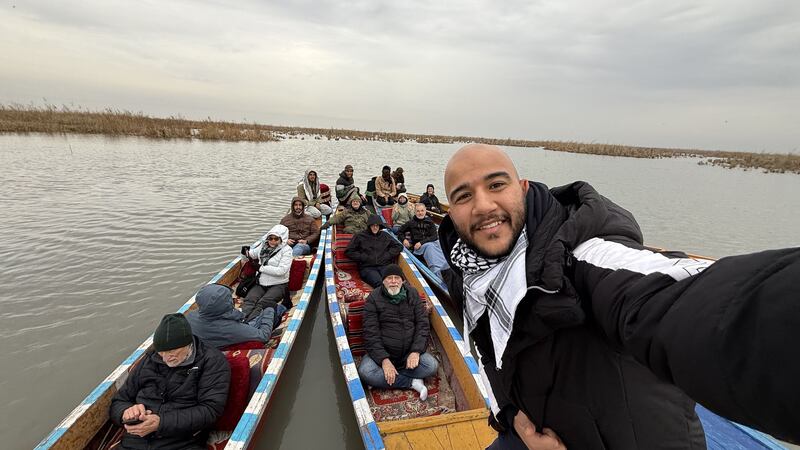
Basra, Iraq
A trip to the Iraqi marshes starts generally in Basra, Iraq’s southern city not far from the border to Kuwait with a beautiful river running right the way through the city and into the Persian Gulf. It is into here that the Tigris and Euphrates rivers empty.
The city of Basra itself isn’t all too exciting with few sites to see and fairly conservative. But I’m a sucker for wide open spaces and water and I love wandering along its corniche - or at least the mile or so that was recently renovated - and often describe Basra as one of my favourite cities in Iraq.
More of a place to feel the vibe than anything else and worth a one or two night stay if you have time.
The main reason for being here, though, is that Basra is the gateway to the Iraqi marshes.
From Basra it is just a short 2-3hr drive and on the way you can stop at Adam’s Tree, the supposed tree from which Eve ate the apple in the story of Adam and Eve, and the meeting point of the Tigris and Euphrates rivers.
Getting to the Iraqi Marshes
From here, it’s a fairly ordinary drive out of the city and into the marshlands.
It’s easy to forget that the Iraqi marshes are incredibly integrated into normal local life.
There are some incredibly remote places in the marshes - after all, the area is around 10,000 km² - but around the outskirts of the marshes is easily accessible by car or bus.
In fact, after wondering if we’d have to carry all of our luggage through marshlands and water, our bus managed to pull up right next to our home for the evening.
Despite being right next to a road, however, as soon as you enter the marsh area you get an extreme sense of calm and remoteness.
The roads nearby may exist, but few cars ever pass by and those that do, do so behind the scenes, behind the reeds and behind the traditional houses standing fair tall above the water.
When you think of Iraq, you don’t generally think of snow and wrapping up warm.
But this was January. And we were lucky enough to have a cold spell as we spent our night in the Iraqi marshes.
As soon as we stepped out of the bus, the cold, fresh air hit pretty sharply and we moved fast to get extra layers on.
All of our layers.
I’d love to say this added to the thrill of things, but in reality, we spent our time wishing for sunlight and warmth. Although it did mean we got to sit by the fire at night.
Life in the Iraqi Marshes
Right after getting our jackets, scarves and hats on, a slight rain started to drizzle down on us. Just enough to hands and feet shivering, but not enough to prevent us from wandering around our camp that would be our home for the evening.
Another misconception about the Iraqi marshes may be that they are just that - marshlands and nothing else, reeds and water with houses built on top.
However, there are actually quite a few areas in the marshlands that allow for quite comfortable living.
And these guys here have an incredible set-up.
We found ourselves at a rather large flat area with several reed houses and even a few building made of concrete where they host guests, that’s also repurposed as a place of prayer when needed.
Behind this was a concrete toilet block and sinks to wash up.
The different areas of the community were split using the walls nature provided - the reeds that stood long and tall made to form natural barriers and walls as we made our way through the community. Kitchens, bedrooms, places to host guests - and, of course, a stable for the buffalo and cows.
Food in the Iraqi Marshes
We arrived just in time to see the catch of the day - the famous masgouf fish that you will see all over Iraq, but mainly in the southern areas - being chopped up, seasoned, and put onto the fire to cook.
This provided some well-needed heat as we looked on at our marsh-Arab hosts prepare our apparently very fresh lunch and said hello to the buffaloes, all huddled up together inside the stables instead of out for grazing.
That’s certainly where I’d much rather be if I were a buffalo.
After a few minutes on the hot fire, the fish was already ready and I went to wash up before eating.
Perhaps the most surprising thing so far in the Iraqi marshes was turning on the tap expecting freezing cold water - and instead almost being scolded. A welcome surprise, indeed.
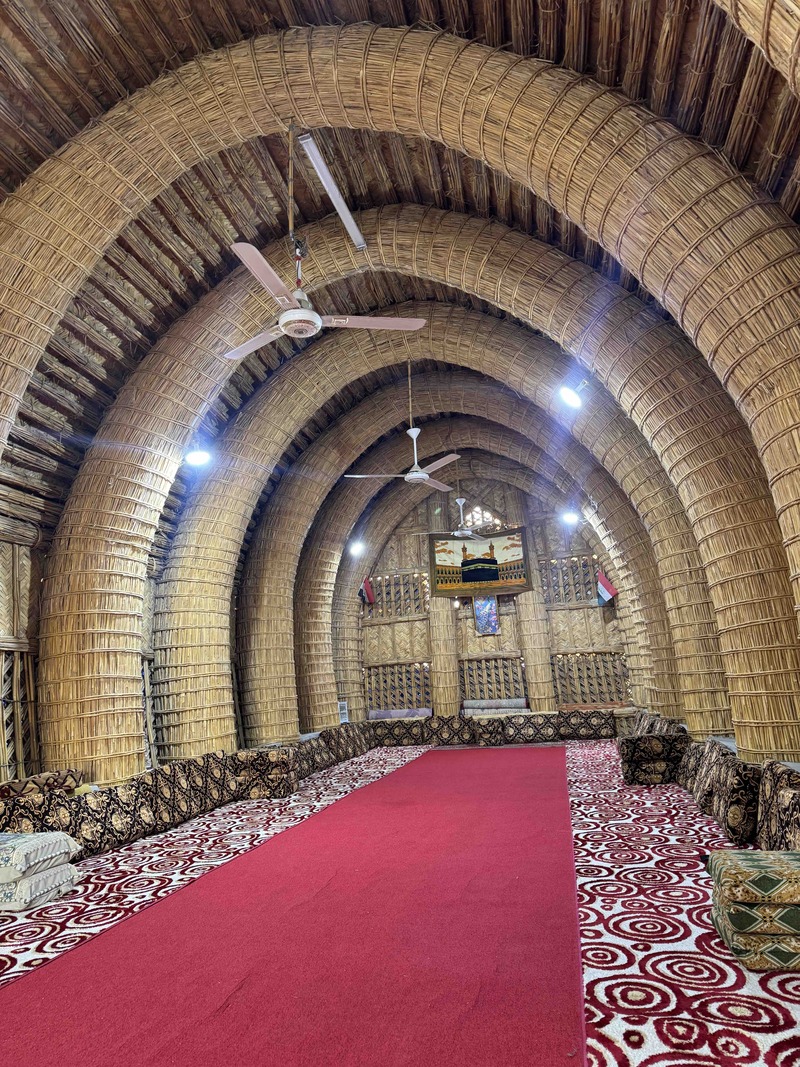
We made our way into the traditional reed houses, built using the same practices for thousands of years. The structure is incredibly sturdy and built to optimise the climate, dealing with the harsh summers that see over 50 degrees and cold winters that get below zero.
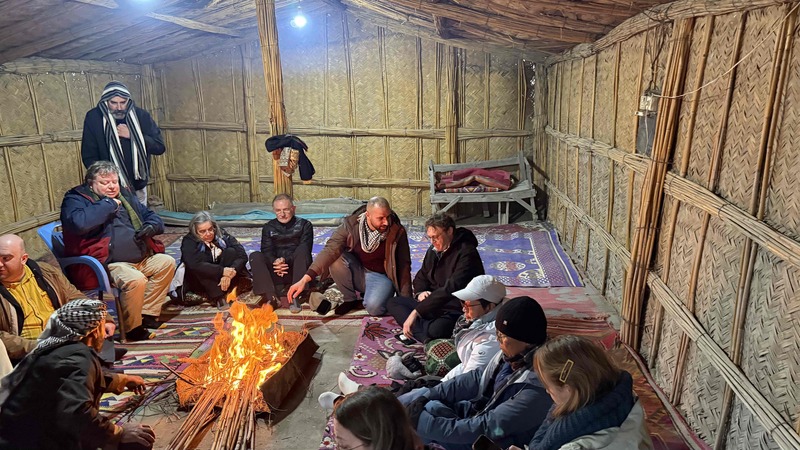
They don’t look small from the outside - but they are unexpectedly large on the inside, with room for even the tallest man to stand up straight, with at least a small child on his shoulders. These Sumerian reed huts vary in sizes but this one could have slept around 20-30 people happily, with pillows lining the side walls and the ground carpeted.
Generally, a rectangular shape, the huts stretch far back.
We sat along the sides, stretching ourselves out against the pillows whilst enjoying some tea and coffee as lunch was being prepared - the set-up for which in one of the corners was beautiful. Several small decorated teacups and a beautiful copper Arabic coffee pot, bubbling over a gas-powered stove.
In true Iraqi style at around 2 -3pm, lunch was then ready and we would be eating in the traditional way.
Sat on the floor. Sharing food. Cutlery optional.
The plastic mat was laid out down the middle of the house and the food placed on top. Fresh veg, freshly made bread and, of course, the fish - which truly could not have been fresher, with a taste and texture to reflect.
The fish we had seen prepared on the fire - but it was the bread I was stuck on.
Bread takes facilities and resources; none of which I’d seen on my exploration around the camp. But this bread was fresh. Piping hot. And became my cutlery with which to devour the perfectly-seasoned fish - the taste of which still lingers in my now-watering mouth.
A Boat Ride in the Iraqi Marshes
After lunch and some more tea and coffee, it was time for us to head out on the boats and get much deeper into the marshes.
We climbed into the boats and got comfortable with blankets and pillows, taking off our muddy marsh shoes as we did so, lay back and let the skill of the boatsmen and gentle waves carry us through the reeds and extensive marsh network until our camp was long gone and we were at the mercy of our drivers.
Mesopotamian Marshes
The people who live in the Iraqi Marshes are known as the Marsh Arabs, or Ma’dan. This is an Arab community that has inhabited the wetlands of southern Iraq for thousands of years, with lifestyles that many trace back to the ancient Sumerians around 4,000–5,000 years ago. Traditionally, they live in small villages built on artificial reed islands and rely on the marsh ecosystem for their livelihoods, particularly water buffalo herding, fishing, reed harvesting, and small-scale agriculture.
Before the marshes were drained in the 1990s, the population was estimated at around 400,000–500,000 people, making it one of the largest wetland communities in the world. The destruction of the marshes forced many to flee, and although parts of the wetlands have been restored since 2003, today only around 100,000–200,000 Marsh Arabs are believed to live in the region.
The marshes are considered one of the cradles of civilisation, lying close to ancient Sumerian cities such as Ur and Eridu, and have sustained communities and traditional ways of life for millennia.
They fluctuate in size depending on water levels but cover several thousand square kilometres and were recognised as the Ahwar of Iraq UNESCO World Heritage Site in 2016 for their ecological and cultural importance.
Despite their size, the knowledgeable boatsmen seemed to make their way with ease through the complex marsh system, navigating each turn with an ease that reminded me of how I would navigate myself by the palm trees and big rocks in the water when I lived on the small island of Tonga.
To us outsiders, the marshlands all looked the same - networks of rivers and streams broken up by lines of reeds and a few randomly placed huts and houses in between. But to the marsh Arabs who live and breathe this air, who travel by these waters every day, any slight change in the structure of the reeds would be noticed.
The Marshes Today & Climate Change
Today, the Iraqi Marshes face significant environmental and political challenges.
Climate change, rising temperatures, drought, and reduced water flow from upstream dams in Turkey, Syria, and Iran have all put pressure on the fragile wetland ecosystem, causing water levels to fluctuate and in some areas, become more saline.
The marshes were also dramatically altered in the 1990s, when Saddam Hussein’s government deliberately drained over 90% of the wetlands through canals and embankments following the 1991 Gulf War, displacing hundreds of thousands of Marsh Arabs and devastating the environment.
Since 2003, many areas have been partially restored as water returned and communities rebuilt, though the marshes remain smaller and more vulnerable than before.
Despite these challenges, the region remains one of Iraq’s richest ecosystems and an important stop on the Eurasia–Africa migratory bird route. As you float on by, you can spot wildlife such as herons, kingfishers, wild boar, otters, and the iconic water buffalo. Along with rare species like the Basra reed warbler and Iraq babbler!
After travelling through winding river networks, we ended up at a clearing where water stretched far and the sounds of waves hitting the reeds were distant. We turned off the engines and sat quietly, enjoying the peace and quiet and watching the birds flying softly overhead as the sun began to set over the vast marshlands.
Our journey lasted around an hour and by the time we were back in the camp, fingers and toes were frozen as the setting sun left us in the misty shadows of the Iraqi marshes.
A Night at the Iraqi Marshes
We set up a fire in one of the reed huts and warmed our hands up as we sat close to the flames that soon warmed the whole room. Sitting in traditional fashion on the floor, we relaxed and chatted with our local hosts and even got some shisha going around the group.
At some point, chicken was brought to put on the fire as our dinner - again, incredibly fresh and very delicious. Although we were still pretty full from the big, late lunch.
After dinner, we set up our individual tents for extra warmth and privacy within the reed huts and some blankets, a mattress and pillows made them extra cosy. We even had electric heaters for in the night when it got very cold.
There’s something about a cold night in nature that makes an 8pm bedtime seem completely understandable, so we retreated to our beds and the warmth of our blankets (and multiple layers) fairly early - the lack of wifi making an early night even more possible.
Good Morning from the Iraqi Marshes
I’m a morning person so I thoroughly enjoy getting up before everyone else and bathing in the luxury of having the sunrise to myself.
A morning in the Iraqi marshes is truly unlike any other. As I lifted the curtain to the reed house, I was greeted with a beautiful light blue sky tinged with yellows, oranges, and pinks as the sun slowly started to lift from the reed beds where a soft mist lay hanging in the cool air.
As much as I love waking up early I admittedly hadn’t had the best nights sleep of my life. Without coffee at hand, another wake-up call was in order.
Presuming the hot water would have run out by now, I turned on the taps at the sinks behind the reed house to give myself a refreshing morning wake up. Much to my surprise, and delight, steaming hot water came out of the taps as I washed my hands and face.
Instead of the shock of the cold water, the delight of the hot water that seemed to run through my whole body awakened all of my senses and I decided to take a short walk to see the buffalo and say good morning, before walking towards the boats - blanket Kindle in hand.
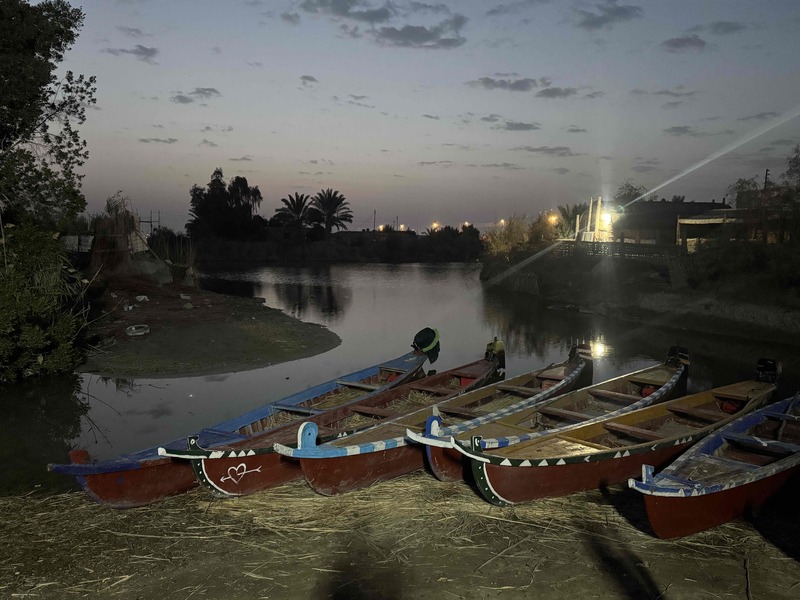
Sitting quietly on the boat moored ashore as the birds flew overhead and the sun rose behind me all cosy in my blanket reading my book was a level of peace that’s so hard to find these days. There’s something about being surrounded in nature that reminds you to slow down; even more so when the nature you’re sat in is so valuable - and ephemeral. A reminder to take nothing for granted, not least the little moments of peace like this.
I often find myself being envious of simple lives.
Do the marsh Arabs care about international politics? Global humanitarian crises? What will Trump’s next move be? Most likely their busy lives don’t afford them the luxury of contemplating such things. Instead, they preoccupy themselves with the lives and survival of the immediate family and wider community within the marshes.
Does it extend much further than that?
It probably doesn’t need to.
But this morning, at least, we added one more thing to their list of things to do, as we had requested a sunrise boat journey through the marshes before coming back to a camp bustling with the sounds of fresh food being prepared.
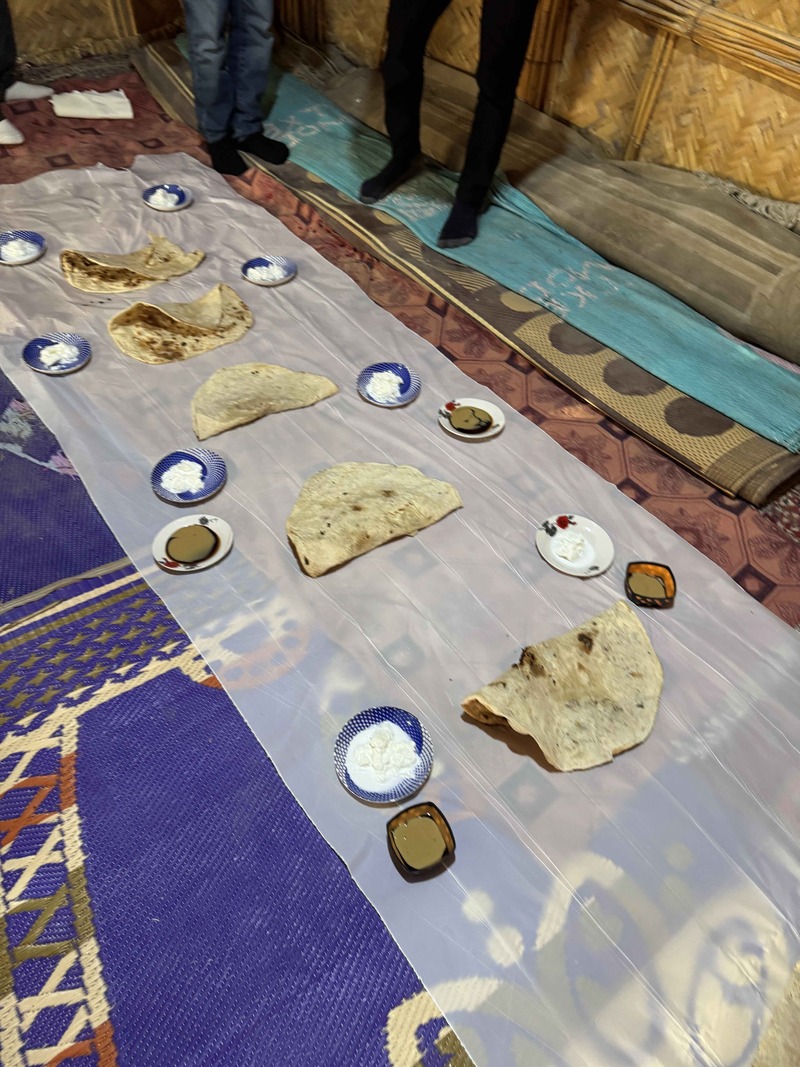
Buffalo Breakfast in the Iraqi Marshes
The fire from last night was re-lit and a plastic mat put along one side.
We all sat down in eager anticipation as several small dishes alongside huge pieces of bread bigger than our heads were put down in front of us. Tahini, date syrup, and - freshly made buffaloes cream. All served alongside a hot and piping glass of buffaloes milk.
We sat leaning over the mat, ripping large chunks of bread, eagerly dipping it into the mixture of date and tahini paste and washing it down with the fresh milk. The silence broken only by the occasional sigh of contentment as we filled our bellies and warmed our hands against the piping hot glasses.
After breakfast, it was, unfortunately, time to say goodbye to our hosts and our home in the marshes.
An overnight stay in the Iraqi marshes is not luxury.
It’s not glamping.
It’s too hot or too cold, depending on the season.
Maybe it’s raining, maybe it’s muddy underfoot. There’s limited tea and coffee, limited facilities and - no showers.
But spending a night here will definitely be one you don’t forget.
A glimpse into a lifestyle so unique and different to anything else you’ll find not just in Iraq, but indeed the rest of the world. A calm life amongst the water and the reeds, shared alongside water buffalo and birds.
Koryo Tours
Tours to Iraq
Share
Zoe Stephens
Zoe is the marketing manager and a tour leader at Koryo Tours.
Her love of meeting new people and exploring new cultures has led her to study several languages including German, Japanese, and Chinese. Having lived in several different countries across 4 continents, she often writes about languages and culture in her blogs and is very active on social media. During the COVID-19 pandemic, she was 'stuck' in Tonga for 1.5 years after a weekend away. Ask her for some stories!
🎥 Vlogs on North Korea
🎙 Discover North Korea Podcast
➤ Instagram | Facebook | TikTok | Twitter/X