Leptis Magna is one of the greatest Roman sites in the world, and it receives almost no visitors, sits largely unguarded, and should be on top of your bucket list.
Welcome to Leptis Magna, Libya!
Leptis Magna is simply one of the most famous destination in North Africa, with no tourists in sight.
Leptis Magna was once one of the most magnificent cities in the Roman Empire, and lost to the desert for centuries before being rediscovered in the 20th century.
Let's dive deeeper into what to do and to see in Leptis Magna.
A Brief History of Leptis Magna
What to See at Leptis Magna
Getting to Leptis Magna
When to Visit
Where to Stay
What to Bring
How Long Do You Need?
Day trip from Leptis Magna
Why visit Leptis Magna
A Brief History of Leptis Magna
Founding and Early Growth
In the 7th century BC, Leptis Magna was founded by the Phoenician colonists from Tyre as a trans-Saharan route and trading post.
The Numidians took over before being absorbed into the Roman Empire, who developed it into a more important commercial city.
The Severan Golden Age
Septimius Severus, an Emperor of Rome (193 AD) was born at Leptis Magna.
As a Roman Empire ruler, he exempted Leptis Magna from property and land taxes, and initiated tremendous development into the city. Architects and finest craftmen from across the empire were brought in to build a city of the first rank to rival Rome with a new forum, basilica, collonaded street and new harbour.
The Desert Preserves the City
By the 7th century, following the Arab conquest, the city had been largely abandoned. Shortly after, the desert sand covered over the streets, forums, bathhouses and temples and inevitably preserved the structures under the Sahara.
Fast forward to the early 20th century, the Italian archaeologists found a city in a state of preservation with structures largely intact with inscriptions, carvings and marbles.
What they uncovered is what you walk through today.
What to See at Leptis Magna
The Triumphal Arch of Septimius Severus
This is the landmark of Leptis Magna, and it's located at the intersection of the city's two main roads. Reliefs were carved celebrating Severus's military victories and the glory of his dynasty.
It is very well preserved after over two thousand years that you can still read the inscription carved into the stonework.
The Severan Forum and Basilica
The Severan Forum houses some of the finest examples of Medusa head sculptures anywhere in the world, surrounded by marble colonnades porticos.
Nearby, the magnificent Severan Basilica is a vast collonaded hall whose pilasters are carved with scenes from the Twelve Labours of Hercules and the Life of Dionysus.
The Hadrianic Baths
The Hadrianic Baths is often compared to the Baths of Caracalla in Rome due to its significance. It is one of the best-preserved bath complexes in the Roman world, with remnants of cold rooms, warm rooms, hot rooms, latrines, exercise courts, and changing rooms that survive to this day.
The system of underfloor heating channels is still visible.
The Amphitheatre
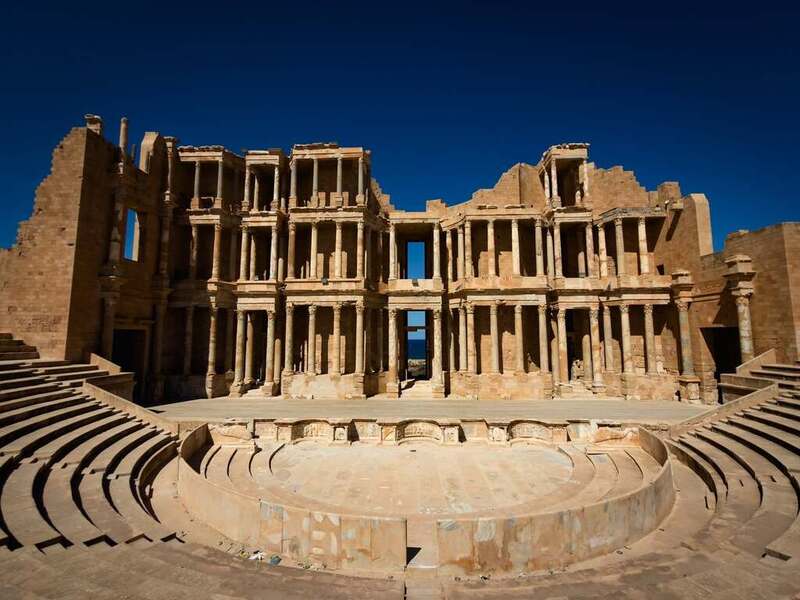
The amphitheatre was partially cut into the hillside overlooking the sea, a position that gave spectators a view across the Mediterranean as well as the arena floor with gladiators spectacle.
The Old Forum
The Old Forum was the original forum of Leptis Magna before Emperor Severus (1st century AD) came to power and rebuilt a much grander marble forum.
It was a modest civic centre that contained temples, market buildings, and public monuments, of which remnants can be seen today.
The Collonaded Street
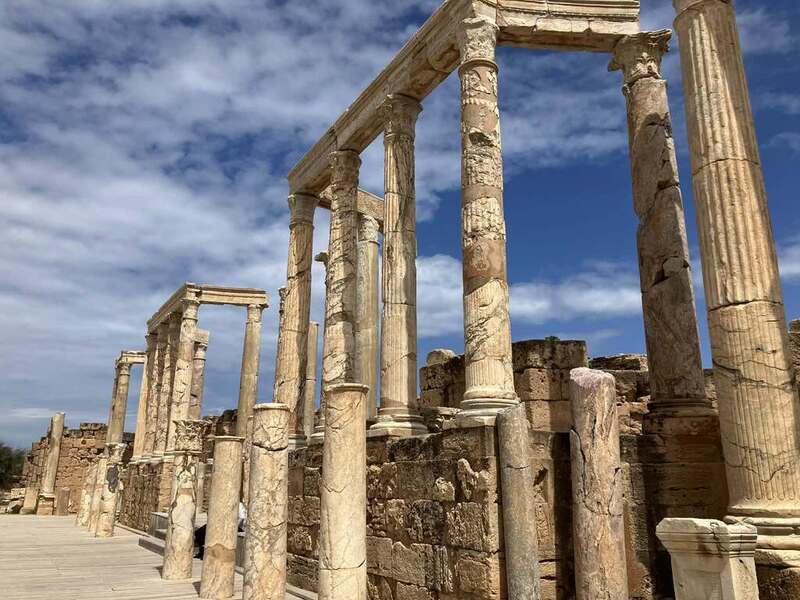
This landmark is the iconic Leptic Magna you've seen in tourist images.
The major collonaded street linked the Severan Forum to the harbour, of which many columns still standing at their full heights.
Getting to Leptis Magna
Leptis Magna is located 130 kilometres east of Tripoli along the coastal road, can be reach within two hours on average.
Most tours would organise a visit to Leptis Magna as a day trip from Tripoli.
As with all travel in Libya, independent travel to Leptis Magna is not possible. All visitors require an organised tour with a licensed local operator and Tourist Police escort throughout.
When to Visit
The best months to visit Leptis Magna are:
- October through December
- March through April
During these months, temperatures are comfortable for a full day of walking across an exposed site with very little shade.
Summer visits are possible but genuinely difficult, with temperatures in coastal Libya regularly exceed 35 degrees Celsius (95 Fahrenheit).
Where to Stay
There is no accommodation near the site.
Tripoli is the base of most excursions, with the two-hour drive one way done as a day trip.
What to Bring
Here are items to bring while visiting Leptis Magna.
- Sturdy walking or hiking shoes.
- More water than you think you need.
- As there is not much shade provided, make sure you plan some coverings that can be helpful to protect you from the sun. Hats, scarf or umbrella, as well as sunscreen.
- Cash in USD or EUR (ATMs are unreliable, cards don't work).
- A fully charged camera (empty out SD Cards or phone memory) and a power bank
- There is no Wi-Fi or reliable signal at the site or in much of Libya.
- Modest dress throughout, afterall, this is a quite conservative country.
How Long Do You Need?
A half-day covers the highlights comfortably. A full day of exploration if you want to dive deeper.
A reminder that there will be a lot of walking to cover some 400 hectares (988 acres) or an urban area!
Day trip from Leptis Magna
Sabratha, another UNESCO Roman city 80 km west of Tripoli, with one of the finest theatres in the Roman world right on the Mediterranean.
This visit is almost always paired with Leptis on the same itinerary.
For longer trips, the ancient desert oasis of Ghadames and the Berber villages of Jebel Nafusa are both worth the extra days.
Why Visit Leptis Magna
Libya is an underrated destination in North Africa (and the world), and Leptis Magna is simply a very desolate ancient site in the country.
The tourists mainly stay away from Leptis Magna (and Libya) not because it lacks significance, but because tourism has been largely closed for the past decade and half.
Tourism steadily comes back to Libya, and as today, Leptis Magna is still mostly accessible with no crowds and no queues.
And that is changing fairly quickly, so your time to visit Libya and Leptis Magna is now before others come.
Koryo Tours
Group Tours to Libya
Share