Everything you need to plan a trip to Oecusse in Timor-Leste. The history, the attractions, the best time to go, where to stay, what to eat, and how to reach Timor-Leste's remote and off-beaten-path western enclave.
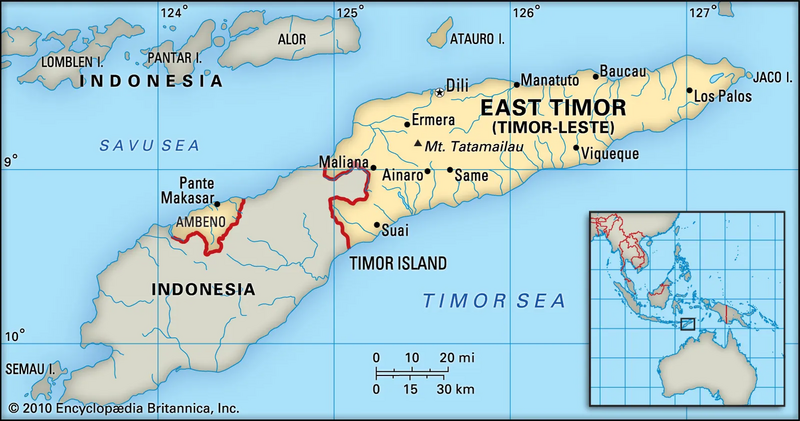
Oecusse, also written as Oecussi or Oe-Cusse, is an exclave region of Timor-Leste.
It is a piece of (East) Timorese land completely surrounded by the Indonesian region of West Timor on three sides, and the Timor Sea to the north.
Oecusse is also where the Portuguese traders landed in 1515, started the history of what Timor-Leste has become today.
Learn more about this very unique region of Timor-Leste!
What does Oecusse mean?
Geography & Climate
A brief history of Oecusse
Visiting Oecusse
Oecusse Top Attractions
Getting to Oecusse
Getting Around
Where to Stay
Best Time to Visit Oecusse
Frequently Asked Questions(FAQs)
The Origin of Oecusse
The 'Oecusse' comes from one of the two original kingdoms that formed the Oecusse enclave - the Oecusse and the Ambeno Kingdoms.
In the local language, Oecusse is sometimes translated as 'water pot'.
The capital of Oecusse, Pante Macassar (Makassar Beach), was named after the Makassar traders from Sulawesi. They once sheltered along this coast while waiting for the right winds to carry them home northward.
Geography & Climate
The enclave of Oecusse is located on the northwestern coast of Timor Island, separated from the rest of Timor-Leste by a strip of 60 kilometres (37 miles) of Indonesian territory of West Timor.
The Oecusse enclave is roughly 814 square kilometres (314 sq miles), with landscape shifts from flat coastal plain to rugged hills. The highest point of Oecusse is Pico do Nipane - 1,561 metres (5,121 feet).
The Tono River runs through the plains, and it dries up outside the wet season.
Oecusse's weather is the same as the rest of Timor-Leste (and the region):
- Dry Season (May – October) - warm and sunny, the best time to visit.
- Wet Season (November – April) - heavy rain, high humidity, causing some rough road conditions beyond Pante Macassar.
A Brief History of Oecusse
Oecusse is a very important part of Timorese (colonial) history. The Portuguese traders' arrival in Lifau in 1515, starting its colonial history chapter.
Pre-colonial European (10,000 BCE - 16th century)
The Australo-Melanesian population, with ancestry origin linked to New Guinea and Melanesia, inhabited the island for tens of thousands of years.
A later migration of Austronesians (some 3,000 BCE) arrived to the area with more advanced agricultural knowledge. The current Tetum people decended from this group.
The Portuguese Arrival (1515 - 1702)
In 1515, the Portuguese traders landed in Lifau (west of Pante Macassar), followed by the Dominican missionaries.
Lifau was the centre for Portuguese operations on the island throughout the 17th and 18th centuries.
The Topasses (the descendants of Portuguese soldiers and traders who had intermarried local women) controlled much of the sandalwood trade from Oecusse.
Oecusse as the Capital of Portuguese Timor (1702 – 1769)
In 1702, Lifau was established as the official capital of Portuguese Timor for about seventy years. Hoewever, in 1769, the capital city role was moved to Dili to escape repeated attacks from mostly the Dutch, who were expanding their own influences across the island.
But the Portuguese kept Oecusse as their territory throughout these years, onto the enclave of today's Timor-Leste.
Indonesian Occupation, Independence to today
In 1975, following the Carnation Revolution, Portugal hastily dismantled its overseas territories, including Timor-Leste. Many of its Portuguese settlers moved back to Europe, causing a vacuum of power in Timor-Leste.
The FRETILIN (Revolutionary Front for an Independent East Timor) party seized the opportunity to declare its Independence on 29 November 1975, but a day later, the Indonesian authority squashed the attempt and occupied Timor-Leste.
Oecusse was the first part of Timor-Leste that fell to the Indonesian authority, and the rest of East Timor was invided the week after.
Provinsi Timor Timur (East Timor Province) was Indonesia's 27th province all the way to 1999 where the UN sponsored Referendum decided that Timorese chose to become its independent country.
During the violence after the 1999 Independence Referendum, pro-Indonesian militias burned most of Pante Macassar to the ground, leaving only two surviving churches in the city.
Following the Timor-Leste Independence in 2002, Oecusse has been designated a Special Administrative Region then more recently, a Special Zone of Social Market Economy (ZEESM) that allows a development initiative for infrastructure development, such as roads, a seaport and an international airport (all are still in progress).
Visiting Oecusse
Pante Macassar is a small town; you can walk to most of Pante Macassar destinations on foot, or by tuk-tuk. Bicycle is also an option and there are places where you can rent one.
For anything beyond the town, roads outside Pante Macassar are rough and often require a 4WD, especially during the wet season.
Oecusse Top Attractions
Lifau Monument & Beach
The Portuguese Traders first landed here in 1515, a short distance west of Pante Macassar.
Today, there's a replica of a Portuguese caravel and six golden figures to commemorate the ocassion. The original landing pillar, which still carrying Portuguese emblems, stands nearby under a large tree.
This is one of the most modest sites of European colonial memorials! Also, the Portuguese built a fort here, which now stands as ruins (an old piece of artillery survived a demolition in 1769).
Via Sacra Trail
A trail of 14 Stations of the Cross was built into the steep hills above Pante Macassar, for those who want to endure it.
For others, this also happens to be the best walking trails around town, which offers the best panoramic views of the town, the coast and the enclave hinterland. The hike takes around 30 minutes to complete, and best taken in early morning or late afternoon to avoid the heat.
Fatu-Suba
A hilltop viewpoint above Pante Macassar with sweeping views over the coast and surrounding hills. It is recommended to do if you want to get the better perspective for the whole Oecussee enclave.
The road up is rough, so a motorbike or 4WD is recommended.
Numbei Market (Mercado Oecusse)
This is the main market in Pante Macassar, open daily but at its liveliest on Saturdays.
It also serves as the town's bus terminal for mikrolets for other parts of the enclave.
Tono River Bridge
Opened in 2017, this 380-metre bridge over the Tono River is the longest in Timor-Leste.
Before it was built, around 3,600 families on the far side of the river were cut off from Pante Macassar during the wet season.
Sakato Beach
Sakato is located around 16 kilometres east of Pante Macassar.
It has one of the better reefs in Oecusse, and snorkeling gear can be hired through the Oecusse Amasat guesthouse near the port (and sadly there is no dive centres operate in Oecusse).
Oecusse International Airport
The airport was completed in 2019 at a cost of $119 million as part of the ZEESM development plan for Oecusse.
It has become a tourist attraction by itself, since the airport has a longer runway and better facilities than Dili’s main airport, although it receives only a fraction of the passengers.
Getting to Oecusse
By Air
Aero Dili operates flights between Dili and Oecusse’s Rota do Sândalo Airport, which takes around 30 minutes to complete each way. Make sure to check schedules in advance as frequencies are limited and tend to change, and they also offer a charter flight with a flat fee.
By Ferry
The government-run Ramelau ferry departs Dili port twice a week on Mondays and Thursdays, and returns from Pante Macassar the following day. You can purchase the ferry tickets at the Dili Port Office, with an option for paying extra for a crew cabin bed for the night (highly recommended).
The ferry journey often takes 8 to 12 hours overnight, and the tides may dictate the time schedule of departure as the ferry may need to wait in place until the water is high enough to reach the coast safely.
By Land (via Indonesia)
Possible, but complicated. The overland route from Dili crosses Indonesian territory twice and passes through the Bobometo and Wini border crossings into Oecusse.
Standard tourist visa on arrival is not available at these crossings, so you will need prior arrangements through a Timorese consulate or embassy.
Indonesian visa fees apply each time you cross.
The journey from Dili takes around 12 hours.
Getting Around
Tum-Tums (electric tuk-tuks) are the main form of local transport in Pante Macassar and meet arriving flights and ferries.
Mikrolets (shared minibuses) connect the town to other parts of the enclave. Bicycle rental is available near the markets.
For trips to Lifau, Fatu-Suba, or Sakato Beach, a motorbike or 4WD hired through your accommodation is the most practical option.
Where to Stay
Accommodation in Oecusse is quite basic, with guesthouses and small local hotels with limited options. They are not listed on the usual international booking platform, so you need to just show up and ask for a room.
- Oecusse Amasat Guesthouse is located near the port, run by expats. They offer snorkelling and kayak hire.
- Dominican Café Guesthouse is part of the Dominican Sisters’ compound between a small park and vegetable gardens.
- A handful local guesthouses in and around Pante Macassar town centre that can be booked upon arrival.
Food & Drink
Pante Macassar has restaurants serving standard Timorese and Indonesian dishes, such as nasi goreng (fried rice), nasi campur (mixed rice with meat and vegetables) and grilled fish.
Dominican Café in town offers a shaded garden setting, with good coffee, fresh juices, cakes and ice cream. It is a perfect place to take a break from the opressing heat during the day.
In the evenings, look for some local moonshine called tua sabu.
Best Time to Visit Oecusse
May to October is the dry season, with many (remote, unpaved) roads are passable, the sea is calm enough for snorkelling at Sakato, and the ferry crossing is more predictable.
The wet season, which runs from November to April, brings heavy rain and makes roads beyond Pante Macassar quite difficult.
Practical Tips to visit Oecusse
Here are a few suggestions from our experts in Timor-Leste travel.
- Oecusse, just like the rest of Timor-Leste, uses US Dollars as its currency. Bring small US Dollar bills for most of your transactions, as change is hard to find. Most businesses do not take credit/debit cards as a payment method.
- ATMs are not always reliable or easy to find in Oecusse. If you need cash, bring some with you from Dili, or from home.
- Visa on arrival (VOA) for Timor-Leste is not available for overland entry via Indonesia (plan ahead if travelling by land)
- Infrastructure is stil in a developing status throughout Oecusse, and roads outside Pante Macassar are rough that a 4WD is strongly recommended for any trip into the more remote areas.
- Oecusse is deeply conservative Catholic, and dress modestly, especially when entering churches and local establishments.
- Plan on having limited connectivity outside Pante Macassar, as mobile coverage can be very limited or non-existent, and this includes the Wi-Fi.
Frequently Asked Questions
1. Is Oecusse worth visiting? Oecusse is the birthplace of Timorese colonial history (1515), but at this time of writing, still quite underdeveloped for tourism infrastructure. Travellers with an interest in particularly history and any off-beaten-path destinations would definitely feel like it's worth of a visit.
2. How do I get to Oecussee without flying? An overnight ferry, which takes around 8-12 hours from Dili is offered twice a week. Another way to reach Oecussee without flying is by overland travel, which involves a travel through Indonesia (West Timor) strip of land, which may require you to arrange multiple entry visa for both Indonesia and Timor-Leste (depending on your nationality).
3. Do I need a special visa for Oecusse? Although it is a special region of Timor-Leste, Oecusse follows the same visa regulation as the main Timor-Leste (Dili). If you arrive by air or ferry from Dili, you won't need any additional visa or permit, since you've already legally entered Timor-Leste. However, if you plan to enter overland visa Indonesia (West Timor), you will need prior arrangement as Oecusse doesn't issue Timor-Leste visas on arrival.
4. How many days do you need to explore Oecusse? Two full days to cover Pante Macassar, Lifau, the Via Sacra Trail, and Sakato Beach comfortably. Any additional days could be added to explore surrounding hills and villages outside the main tourist attractions.
Koryo Tours
Timor-Leste Travel Guide
Share
Halef Gunawan
Halef is Social Media and Marketing Specialist at Koryo Tours
Born and raised in Indonesia, he moved to the U.S. for college and later pursued full-time travel in 2019. Stranded in Sabah, Malaysia, during COVID, he and his partner, along with their German Shepherd, Kana, embraced van life and have been exploring North America since 2020.
📷 Instagram | 🇮🇩 Instagram (Bahasa Indonesia)
My First Koryo Tours Adventure in Syria During Ramadan (and the Iran War)