Jebeili Soap Factory, Aleppo, is where the world's oldest soap is still made by hand. Original Aleppo Soap. For over 700 years, the Al-Jubaili family has been making handmade Aleppo Laurel Soap - laurel-scented and aged for months underground in their factory.
Aleppo, Syria is one of the oldest inhabited cities in the world. The city has so many histories and legends that can be traced back for millennia.
One of the city's best-known claims to fame is its olive oil-based laurel soap, or simply Aleppo Soap (Aleppo sabun ghar in Arabic).
Aleppo Soap production is widely considered the oldest manufactured soap in the world, with a tradition that can be traced back over two-thousand years. The method of making it has remained essentially the same throughout.
Jebeili Soap Factory (also known as Al-Jubaili Soap Factory) is one of the historic family-run Aleppo soap workshops and has been in operation for over 700 years.
It is officially recognised as one of Syria's UNESCO Intangible Cultural Heritage.
Here's everything you need to know about the Jebeili Soap Factory in Aleppo.
What is Aleppo Soap?
Location and Setting of Jebeili Soap Factory
The History of Aleppo Soap
How the Aleppo Soap Is Made
Visiting the Jebeili Soap Factory
What to Buy at the Gift Shop
Frequently Asked Questions (FAQs)
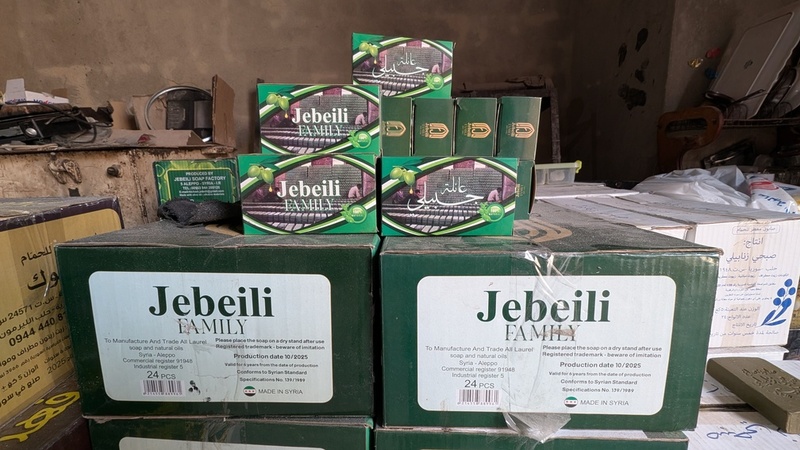
Aleppo Laurel Soap
What is Aleppo Laurel Soap?
Aleppo soap is a handmade hard bar soap, originally from the City of Aleppo.
It is classified as a Castile soap, made from olive oil and lye, and distinguished by the inclusion of laurel berry oil.
The ingredients come from different regions of Syria. The olive oil, its main ingredient, comes from the regions north and west of Aleppo. The laurel oil, which gives the soap its fragrance, comes from the coastal mountains, specifically from the area between Antioch and Kasab. The alkaline substance, essential for the soap's production, is obtained from the charring of the Anabasis plant from the Syrian steppe.
It is essentially made 100% in Syria, assembled from across the whole country, right here in Aleppo.
Location (and Setting) of Jebeili Soap Factory Aleppo
Aleppo's Old Market has been rebuilding itself since the Syrian conflict, particularly after the intense bombing campaigns of 2016.
The Jebeili Soap Factory is located in Aleppo's Old City, near the ancient gate of Bab Qinnasrin. The surrounding neighbourhood is a typical industrial Old City setting: thick stone-walled buildings, heavy doors, and cobbled streets.
Worth mentioning is the Bimaristan Arghun, right next door to the factory, a 14th-century hospital and one of the earliest mental health institutions in the world.
The History of Aleppo Soap
1st Century AD
Legend says that more than 2,000 years ago, women in Aleppo discovered that combining wild Anabasis plants with olive oil produces a foam effective for cleaning. This discovery marked the beginning of Aleppo's renowned soap-making tradition, a craft that has been passed down through generations ever since.
The Middle Ages
At the beginning of the Middle Ages, the first soap factories were established in Aleppo, particularly in the Bab Qinnasrin quarter, where the Jebeili Soap Factory still stands today. The factory has been in operation for over 700 years.
The Syrian Civil War
Before the conflict, around 120 soap factories operated across the city. The 2016 bombing campaigns devastated much of Aleppo's Old City, and opposition forces occupied the Jebeili Soap Factory during this period.
Today
Only 15 factories survived the war. Jebeili was among them, though it has had to rebuild its facilities twice to keep operating. The current owner, Hisham al-Jubaili, is the sixth generation of soap maker in his family. The factory is back in production.
How the Aleppo Laurel Soap Is Made
The olive oil is mixed with water and lye and heated to up to 200°C. The laurel oil is then added. Once the soap mixture reaches the right consistency, it cools overnight before being poured across the factory floor.
Workers walk over the spread soap wearing wooden platforms strapped to their feet, cutting it into pieces and distributing the mass evenly.
Each bar is stamped with a brass stamp bearing the name of the factory and the soap's classification. Then the stacking begins.
One of the most distinctive sights inside the factory is the drying room, where soap blocks are stacked into tall honeycomb-like towers that allow air to circulate freely.
Once sufficiently dried, the soap is moved to a subterranean chamber to age for six months to a year. During this time, the free alkaline content breaks down through slow reaction with air, the moisture reduces, and the soap hardens. The bars gradually change colour too, from bright green when freshly made, to a pale gold once fully cured.
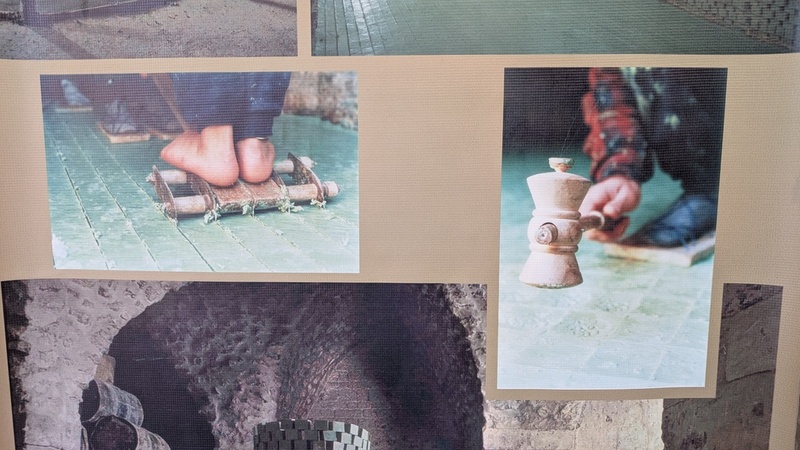
Informational board to show visitors how the Aleppo Laurel Soap is made
Aleppo Jebeili Soap Factory Visit
The factory is open daily except Fridays, and entry is free. The staff are friendly and happy to show you around.
Inside, you'll find large production halls where the soap-making process unfolds: the pits and machinery used to process the oils, the open stone floors where the soap is laid out and cut, and the stacks of bars drying slowly in towers that can reach several metres high.
Active production runs from mid to late November through to March. Visit during this window and you may catch the soap being poured, cut, and stacked in real time.
Outside of the production season, you can still tour the building, learn about the process, and see the soap at various stages of curing.
At the end of the visit, there is a small gift shop (the "Selling Section", according to the sign) stocking a range of soap products including bar and liquid soap.
Staff can answer questions in English, and purchases can be made in Syrian lira or US dollars. All products are priced in USD.
What to Buy at the Gift Shop
The gift shop sells products made in the factory: Aleppo soap, in all its unpacked, unfussy, fragrant reality.
Quality is determined by the percentage of laurel oil, typically between 2% and 20%, which also determines the price. Soap without laurel oil starts at around $1.50 per kilogram, rising to $3 for 5% laurel content, with prices roughly doubling for each additional 5%, up to 40%.
Neatly packaged versions of Aleppo soap, including those made by the al-Jubaili family, are available throughout Aleppo's souqs. But buying direct from the factory cuts out the middleman, costs less, and gets you the real thing. Raw, unlabelled, and smelling exactly as it should.
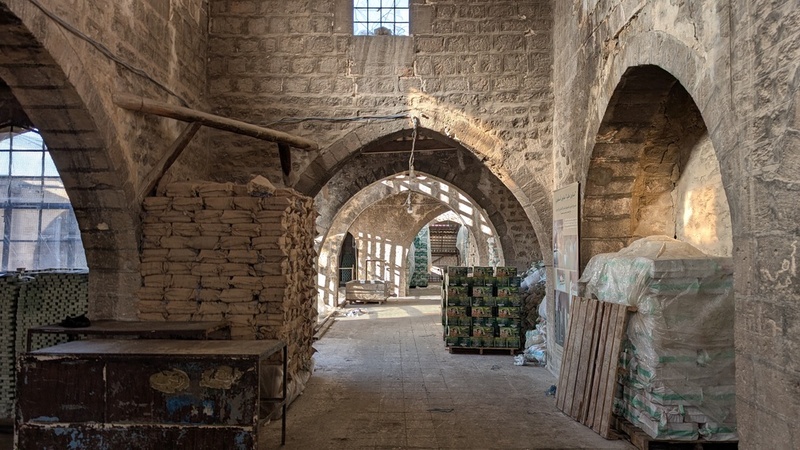
Jebeili Soap Factory Aleppo
Frequently Asked Questions (FAQs)
1. What is Aleppo Laurel soap? A handmade bar soap made from olive oil, laurel berry oil, water, and lye. It is considered the oldest manufactured soap in the world, still produced by hand in Aleppo's old city.
2. Where is the Jebeili factory? In the Bab Qinnasrin quarter of Aleppo's UNESCO-listed old city. Enter through the Bab Qinnasrin arch, follow the cobbled path, and the factory is on your left.
3. When can I visit? Daily except Fridays. Production runs from November through March; outside that window, the factory is quieter but still open to visitors.
4. Why does older soap cost more? Because it's better. The longer Aleppo soap ages, the milder and more skin-friendly it becomes. Some bars are aged for years before going on sale.
5. Is Aleppo safe to visit in 2026? Aleppo has reopened to visitors and the old city is increasingly accessible. Always check current travel advisories before your trip.
6. Can I buy soap at the factory? Yes, and you should. It's unpackaged and unfussy, which is rather the point.
Koryo Tours
Syria Tours
Share