On a wooded hillside just outside central Thimphu, the Royal Takin Preserve offers a quiet introduction to Bhutan’s national animal in a setting that feels closer to a forest clearing than a formal attraction.
While the Royal Takin Preserve (also known as the Motithang Takin Preserve) may not be an attraction on a typical visitor's Bhutan itinerary, we highly recommend a visit. It really adds valuable insight into Bhutan’s relationship with nature and symbolism.
But let’s start from the basic question.
What is the animal to see in the Royal Takin Preserve?
What Is a (Bhutan) Takin?
The Takin and Its Significance in Bhutan
The History of Royal Takin Preserve
Visiting the Royal Takin Preserve
Atmosphere and Experience
Why It’s Worth Visiting
Frequently Asked Questions (FAQs)
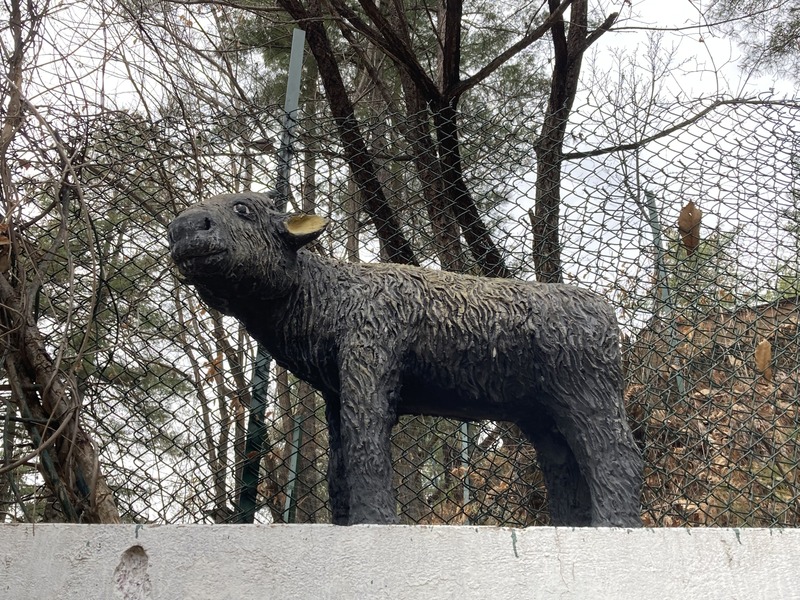
What Is a (Bhutan) Takin?
The Bhutan Takin (Budorcas taxicolor whitei) is a heavily built, hoofed mammal native to the eastern Himalayas.
A Bhutan Takin is an unusually odd-looking animal (if you're being blunt, describing it). It appears to be partial goat, partial cow, and part something else that you can’t quite put a finger on...
It is locally known as Drong Gimtse - འབྲོང་རྒྱ་མཚི in the Dzongkha language, the language of Bhutan.
The Bhutan Takin is officially the National Animal of Bhutan.
About the Bhutan Takin
Once thought to be closely related to the musk ox with solid with broad shoulders. But, it is actually genetically related to sheep.
Bhutan Takins are social animals and usually live in groups in sub-alpine meadows and forest terrain, sometimes in conditions with steep mountain slopes.
However, they can still easily scale these challenging landscapes around with somewhat graceful movements.
They are simply the gentle giants, in a form of a mythical cattle. Fit to the storytelling of local Bhutanese folklores and tales..!
The Bhutan Takin and Its Significance in Bhutan
The Takin holds a special place in Bhutanese culture and folklore.
According to the Bhutanese Mythology, the animal was created by the Buddhist saint Lama Drukpa Kuenlay (1455-1529), also known as the ‘Divine Madman’. He combined the head of a goat with the body of a cow to form a single creature.
The result was, well, you can guess it - the Bhutan Takin. A truly magical looking animal that combines the feature of both a goat and a musk ox or yak.
Whether taken literally or symbolically, the story reflects Bhutan’s tendency to blend humour, spirituality, and deep meaning.
Beyond myth, the Takin's status as Bhutan’s national animal reflects the country’s ongoing efforts on conservation and respect for native species.
You will often see the Bhutan Takins' image in Bhutanese paintings, illustrations, and photography, where it functions as both cultural symbol and living presence.
The History of Royal Takin Preserve
1970 -
The site was originally built as a small zoo near the Motithang district of Thimphu. A concept that didn’t sit well with many locals, including the King of Bhutan.
The idea of confining animals in a zoo setting for human entertainment is viewed as improper for a Buddhist country. This was for both religious and environmental reasons.
It was eventually converted into a place with a better alignment concept of preservation and conservation rather than entertainment.
According to the official signage at the site, the Preserve was built in 1974 to function as a genetic reserve for the Bhutan Takins.
2000-2020
In 2004, a collaborative effort of the Royal Government of Bhutan and World Wild Fund (WWF) of Bhutan converted the zoo into a national preserve.
The Royal Takin Preserve has since expanded its function to serve as a wildlife rescue and a rehabilitation sanctuary for other injured wild animals that have been brought for treatment and rehabilitation.
There are other wildlife such as the Blue Sheep and Satyr Tragopan (bird species), to name a few that are sharing home with the Bhutan Takins in the Preserve.
2020 - today
Today, the Royal Takin Preserve is a popular visitor attraction from Thimphu.
Many are visiting to learn about Bhutan's wildlife and its preservation efforts. Some locals might just be seeking a relief from city life in a more natural setting environment..!
For nature lovers, it is home to a well-maintained walking trail. This is the Ancient Takin Trail, which is maintained by the Guide Association of Bhutan.
Visiting the Royal Takin Preserve
The preserve is a short drive from Thimphu’s city centre. This makes it convenient as part of your itinerary with a tour group during a day of sightseeing.
Entry fees are collected that goes towards the feeding of these animals and also supporting the conservation activities.
The Royal Takin Preserve is designed as a natural forest environment with minimal barriers throughout the site.
You enter through a traditional Bhutanese gate and follow simple and easy-to-navigate trails supported by informational signage in both Dzongkha and English.
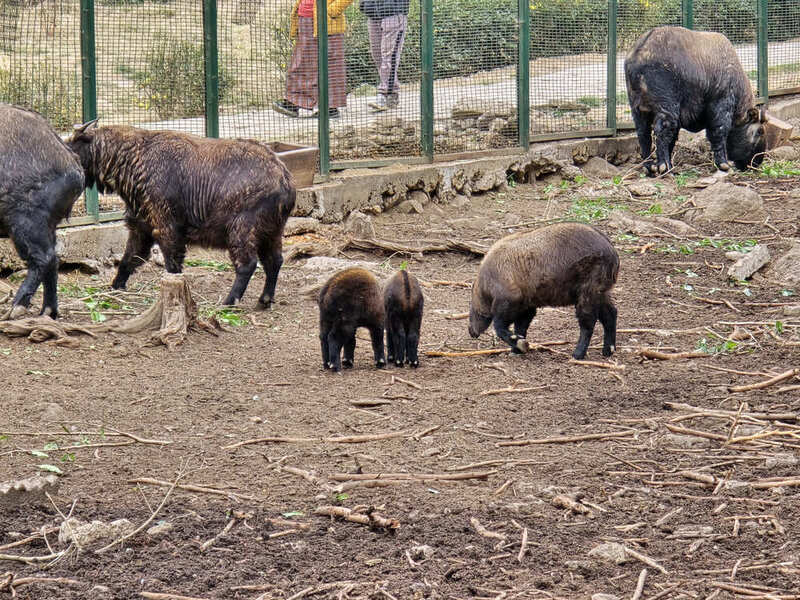
The animals are free to roam within the preserve in their natural habitat.
The Bhutan Takins are very easy to spot. They’re usually resting on slopes or moving slowly through the trees.
Other native wildlife, including the rare red panda and various bird species may also be visible.
You can spend around an hour here, depending on pace and interest.
Atmosphere and Experience
The Royal Takin Preserve is a laid-back place with natural tundra/forest environment.
Unlike what you’ve had in mind regarding Zoos or Animal Rehabilitation Centre, there are no feeding shows, loud crowds, interpreters/tour guides or structured explanations other than some minimal informational boards.
Just the takins and other wildlife in their natural habitat.
It just feels like you’re stepping into their space, which reinforces your feeling of respect towards the animals and the place.
Why It’s Worth Visiting the Takins
The most obvious reason why it’s worth visiting is to provide a brief escape from city life - (IF you think Thimphu has an overwhelming city feeling!). Trade streets, people and shops for trees, open air and wildlife sightings.
Also, seeing the takins in person helps you to dive deeper in understanding Bhutan’s folklore, national symbol and environmental values into a personal experience.
It may not be a highlight in the conventional sense, but it rounds out a visit to Thimphu in a meaningful way.
Frequently Asked Questions (FAQs)
1. What is a Bhutan Takin? The takin is a large Himalayan mammal native to Bhutan and nearby regions, known for its distinctive appearance (goat-like heads and oxen bodies).
2. Why is the takin important in Bhutan? It is Bhutan’s national animal and holds cultural significance rooted in folklore and conservation values.
3. How long should I spend at the preserve? It depends on what your style but on average, around 20 to 30 minutes is usually enough for a relaxed visit.
4. Is the Royal Takin Preserve a zoo? No. It functions as a wildlife preserve designed to provide a more natural environment for the animals.
5. Is it suitable for all ages? Yes. The paths are easy to walk, and the visit is calm and accessible. Signage are available in English language.
Koryo Tours
Bhutan Travel Guide
Share