Mar Musa Monastery is one of Syria’s significant religious destinations.
Mar Musa Monastery (officially known as Deir Mar Musa al-Habashi) has history that can be traced back to the 6th century (and even earlier if you include its pre-monastic history).
Today it is an active and open-to-all Syrian Orthodox monastery that draws pilgrims and visitors from all over the world, across all religious beliefs.
Let’s take a look at this unique monastery.
Mar Musa Monastery Location
Mar Musa Monastery History
Architecture and Interior of Mar Musa Monastery
What to Expect When Visiting Mar Musa Monastery
Staying with the Mar Musa Monastery Community
How to Get to Mar Musa Monastery
Frequently Asked Questions (FAQs)
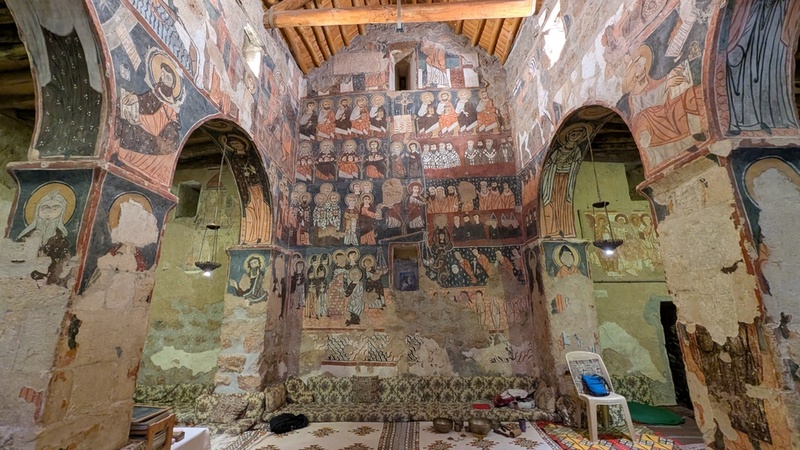
Mar Musa Monastery Interior Frescoes
Mar Musa Monastery Location
Mar Musa Monastery is located in a mountainous desert landscape north of Damascus, not far from the town of Nebek, Syria.
From the road below that connects the monastery to Syria’s main cities, the complex looks as though it has been intentionally carved into the mountainside.
To reach the monastery complex, you will need to climb around 400 steps to the top of the hill.
The setting is an arid and exposed landscape, and from the monastery’s upper terrace, you can see the desert stretching endlessly in all directions (including into Lebanon).
Mar Musa Monastery History
The Roman / Byzantine Era
The site was originally used as a Roman watchtower to monitor and control illicit trade along the ancient route connecting Damascus to Palmyra.
There are remnants of these ruins still visible at the site.
6th Century
The ruins of the Roman watchtower were transformed into Mar Musa Monastery in the 6th century.
It was founded by followers of Saint Moses the Abyssinian, a monk who lived a hermit lifestyle in the region.
Many of the surviving structures at the site can still be traced back to this era.
Medieval Period (11th–12th Century)
The monastery became an important Syriac Orthodox monastic centre, with pilgrims travelling long distances to visit.
The surviving frescoes, depicting scenes from the life of Christ and the Virgin Mary, were painted mostly during the 11th and 12th centuries.
18th Century
By the 18th century, the monastery was largely abandoned from its religious purpose.
Pilgrims still visited occasionally, and the ruins were often used as shelter by local shepherds and their flocks.
Late 20th Century
In 1984, Italian Jesuit priest Paolo Dall’Oglio led efforts to revive the monastic community.
The ruins and the monastery’s frescoes were restored with the help of the local community and support from the Italian state.
Today (2020s)
The Al-Khalil monastic community is the current caretaker of Mar Musa Monastery.
It is an open destination for all to visit, for tourism purpose as well as religious destination.
Architecture and Interior of Mar Musa Monastery
The monastic complex consists of several main structures, including the main church, communal living quarters, kitchen, and guest rooms.
Thick stone walls confine the exterior of the structures that blend into the surrounding rock face of the landscape.
The main focal point of Mar Musa Monastery is the interior of the church, with its restored medieval frescoes from the 11th and 12th centuries.
These frescoes are considered as one of the best Christian wall art in the Middle East.
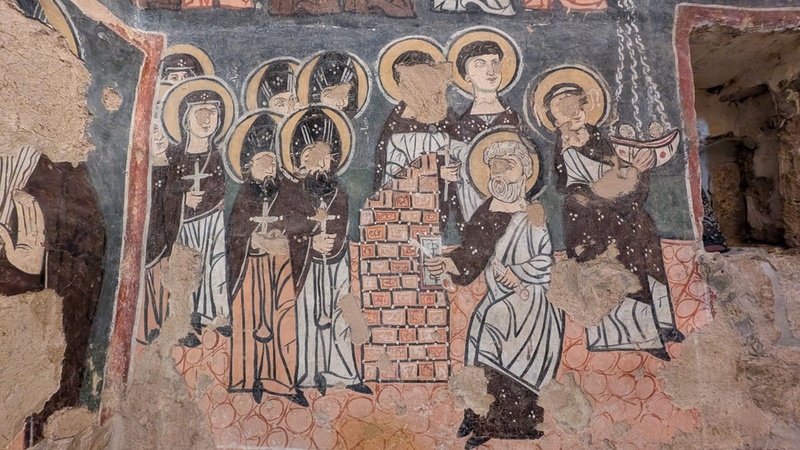
Detail of the Mar Musa Monastery Frescoes
What to Expect When Visiting Mar Musa Monastery
- Mar Musa Monastery is an active Syrian Orthodox monastery.
- It focuses on religious harmony and dialogue between Christianity and Islam, two of the main (religious) traditions in Syria.
- To visit the site, expect to climb more than 400 steps from the main road and parking lot to reach the monastery complex.
- Summer heat can be extreme with no shade, so visiting in the early morning or late afternoon is recommended.
- The community living at the monastery welcomes visitors to explore the site or even spend the night there.
- Meals are shared with visitors, and donations are welcome, although not required.
- As with any religious site, modest dress is expected (covered shoulders and legs), and voices should be kept low.
- You can expect simplicity from the community, and they will gladly answer questions or show you around.
- Upon request, they may also give tours and explain the history of the monastery.
- Many members of the monastery community speak English and come from different parts of the world.
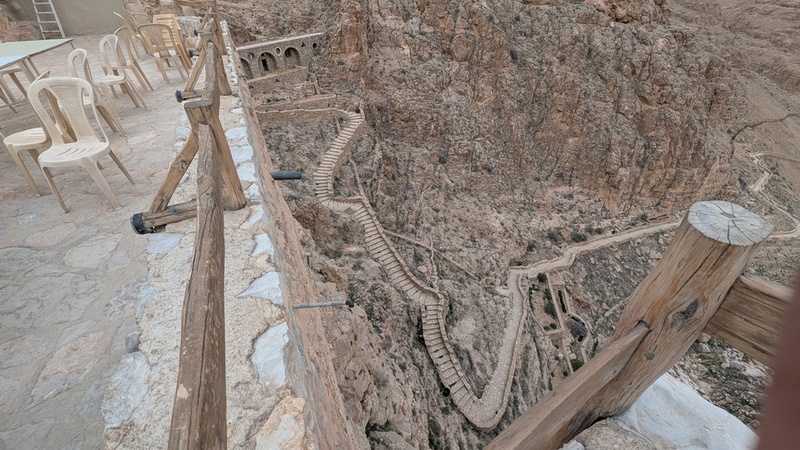
The 400+ steps to come up to the Monastery Complex
Staying with the Mar Musa Monastery Community
Here are a few things to know if you plan to stay at Mar Musa Monastery:
- You are welcome to stay overnight or live temporarily at the monastery (for as long as you need). Non-Syrian visitors should check their visa validity (overstaying in Syria is not recommended)
- The monastery does not charge fees for accommodation or meals, although donations are welcome to support the community.
- The monastery community operates on principles of sustainability and volunteerism.
- Visitors are encouraged to assist with preparing meals, washing dishes, general cleaning, and sometimes agricultural or environmental activities.
- A kitchen and dining area, including outdoor seating, are used for shared meals and conversation with the community.
- Meals are offered three times a day by volunteers, and while it is not required, visitors are encouraged to help with preparation or washing dishes.
- There are simple rooms available for sleeping, with communal toilets and showers.
- Daily mass is held in the morning, along with midday prayers and silent meditation.
- Religious services are generally conducted in English, except on Sundays when they are offered in Arabic (with catechesis).
- Other daily activities may include reading the Gospel, reciting the Quran, and reflecting on texts about non-violent activism, forgiveness, dialogue, and acceptance of difference.
- There is also a library available for visitors, where you may borrow books during your stay.
How to Get to Mar Musa Monastery
From Damascus - The drive to Mar Musa (parking lot) takes around 2 hours from Damascus city centre (approximately 100 km).
From the parking area, visitors must climb more than 400 steps to reach the monastery complex (the climb usually takes around 30 minutes)
Frequently Asked Questions (FAQs)
- Where is Mar Musa Monastery located? Mar Musa Monastery (Deir Mar Musa al-Habashi) is located about 80 km north of Damascus in the mountains near the town of Nebek, Syria. It is roughly a two-hour drive.
- How do you get to Mar Musa Monastery? Visitors drive to the base of the mountain and then climb a steep path of around 400 steps to reach the monastery. The walk takes about 20–30 minutes depending on pace. There is no accessibility access to the monastery.
- Can I visit Mar Musa Monastery? Yes. Everyone is welcome to visit, although it remains an active religious community. Guests are expected to dress modestly and behave respectfully.
- Can you stay overnight at Mar Musa? Yes. Overnight stays are possible for those who wish to experience monastery life, including communal meals and prayer.
- Why is Mar Musa Monastery famous? Mar Musa is known for its medieval frescoes, its remote desert location, and its role as a centre for interfaith dialogue between Christians and Muslims.
- What is the best time to visit Mar Musa? Spring and autumn offer the most comfortable temperatures. Summer visits can be very hot due to the exposed desert environment.
Koryo Tours
Syria Tours
Share